Showing posts with label Tim Raines 2008. Show all posts

Tuesday, January 04, 2011

Blog blast past: The annual Tim Raines rant ...

Robbie Alomar should take his rightful place in Cooperstown on Wednesday when the Baseball Hall of Fame vote is announced. What of another table-setting switch-hitter who played in Canada? From Jan. 5, 2010 ... apologies to the people mentioned by name. The meds are doing their job, thank you for asking!

Seeing as, "Numbers can be presented so many ways, folded into so many origami shapes," so it's understandable a baseball writer might twist it around after being bombarded with an "avalanche of numbers" during the lead-up to Wednesday's Baseball Hall of Fame election results. Jeremy Sandler should get the BBWAA honour for being a wee bit off-base.

"The obsession over numbers 'proving' Hall of Fame worthiness also leads to inauthentic comparisons. Tony Gwynn was a first-ballot selection with a .388 on-base percentage, 1,383 runs and 319 steals. Thus, one could argue Tim Raines should not be languishing with 22% support with his .385 OBP, 1,571 runs and 808 stolen bases."

(Two paragraphs later)

"Every player needs to be evaluated on his own merits against the best players of his era and of all time. To do this, numbers will tell part of the story, but will never tell the whole story."
Did anyone else see that? It seems as if (and please don't read this as a personal attack, it just happens to be one article that came to attention) the argument is for wanting to one day live in a world where we rate each ballplayer against the best players of his era, but without making "inauthentic comparisons" such as one between Tim Raines and Tony Gwynn. You should just be able to find "what lies beyond what the mere calculations can show."

From the department of, "yeah ... no," you cannot compare Raines to Gwynn just because one was a National League outfielder born in 1959 and the other was a National League outfielder born in 1960, a whole eight months apart! You may not compare a player who was a MLB regular from 1981-98 with someone who was a regular from 1984-99 just because they each:
  1. Played a corner outfield spot and some centrefield;
  2. Spent their peak years in the NL at about the same time (1983-87 for Raines, '84-89 for Gwynn);
  3. Usually batted in a similar place in the lineup (91% of Gwynn's career plate appearances and 90% of Raines' were hitting first, second or third);
  4. Hit similarly well in the leadoff spot (Gwynn OPSed .823, Raines OPSed .813)
  5. Hit similarly well in the 3-hole (Gwynn OPSed .860, Raines .856)
  6. Had similar short-and-squat builds (Raines was listed at 5-foot-8, 178 lbs.; Gwynn, 5-11, 199);
  7. Batted from the left side (Raines was a switch-hitter);
  8. Had a son of the same name make the major leagues;
  9. Had a son of the same name make the major leagues as an outfielder;
  10. Went into coaching after retiring as a player. Yep, totally inauthentic.
This is half about a fondly remembered former Expo getting his due (Jeff Blair: "... the lack of support for Raines is embarrassing") and half about media types who, present company included, get uber-defensive whenever something complex crops up. It is understandable. Some people don't like trying out new ways of seeing. Some cannot wait to see what's next.

Staying barely on-point, the argument is not that Tim Raines was better than Tony Gwynn.

The point is that they had contemporary careers where they each fulfilled the same role about equally well. Except Gwynn was not just a first-ballot inductee, as Sandler describes it, he was elected with 97.6% support three years ago. If you picture the Baseball Hall of Fame as the trendy new nightspot, Gwynn was let inside the velvet rope post-haste. Raines is standing out in the cold while the doorman pretends to scan a clipboard. Raines ... Raines ... Raines ... don't see it.

As Joe Posnanski, whom Sandler cites in his column without even a hint of irony, noted," ... there are only 26 players in baseball history who have received 90% of the vote, and that list does NOT include: Frank Robinson, Joe DiMaggio, Al Kaline, Mickey Mantle, Sandy Koufax, Yogi Berra, Bob Gibson, Walter Johnson and Warren Spahn."

Gwynn had the high batting average and the 200-hit seasons (a hitting feat you know is vital since Barry Bonds, Babe Ruth and Ted Williams accomplished it a combined never). Raines had the bases on balls, sick stolen-base success rate and scored more runs. Same aims, different means.

Raines' argument is not airtight; no one's is. However, the same out clauses that are applied to him have been overlooked for other players. For instance, one sympathetic sportswriter said of Raines, "Should get more votes than he does, but unfortunately his peak years were mostly spent on mediocre teams." Raines' teams finished above .500 in 12 of his 15 seasons as a regular, compared to 8-of-16 for Gwynn. For pity's sake, Ryne Sandberg played on only three winning teams in his whole career. No one ever mentioned that when he was on the ballot, since he played for the Chicago Cubs and was a clean-cut white guy.

Anyway, the song remains the same with Tim Raines. He received 24.3% support in 2008, 22.6 in 2009. Billy Williams, the 1960s and '70s Chicago Cubs outfielder, received similar support (23.4%) in his first go-around in 1982 and was elected five years later. For some reason, he kept gaining about 10% each year. It has not happened for Raines. It needs to this year or next.

The second part of this is feeling personally frustrated at working in the media and being surrounded by people who are rigid when fluidity is needed, especially when people can call BS so conveniently. It is disappointing to hear Jeff Blair, who is always a great read, say he "will not vote for a player on subsequent ballots if I didn't vote for him on the first."

There are issues with how some ballplayers have crept up to around 20% support to eventually getting the necessary 75% (Jim Rice was a classic example), but come on, Jeff. What, no one should ever re-evaluate their critical opinion, especially if new shit has come to light, man? In other fields, academe, film and literary criticism, people change their minds all the time. They decide they liked a book or movie, or that they hated it. about a book or movie they didn't like the first time around. It's called being human.

Getting back to baseball, you have to be careful not to beat people over the head with sabremetrics. It has found its rightful place. It is just a gas to see poor Jeremy Sandler projecting that he's threatened. Sorry to come off like a graduate of the Harry Neale School of Knowing What Everyone Is Thinking, but here is a grown man who says, "People do not live and die with their favourite players because of mathematical formulae. Adjusted ERA or VORP never made a kid put a poster on his wall." One, as if that proves anything and two, did anyone argue that we should hang our arses on trying to see the world through a child's eyes?

Yeah, when you were a kid, you were drawn to specific ballplayers for all sorts of reasons, but no one voted to put George Bell into the Hall of Fame because he had an awesome Jheri-curl and once tried to do a flying karate kick on a Boston Red Sox pitcher named Bruce Kison.

You grew up, kind of, and you learned to use your mind, instead of losing it when faced with complexity.

Enjoy election day. Please keep an eye on how big a leap Mark McGwire takes. By 2 p.m., Roberto Alomar should be a Hall of Famer. Sweet.

Friday, March 05, 2010

Jusssst a bit outside: the San Diego Padres preview

Duty calls to preview the MLB season. In the spirit of that, we'll have 30 bits of notes and errata very tangentially related to each team, in reverse order of PECOTA projection. At bat: the San Diego Padres.
  1. Call when you trade Adrian Gonzalez: The Padres better not drag this out longer than The Office did with Pam's pregnancy.

    Just send Gonzo and his redonk park-adjusted OPS from the hitters' graveyard that is Petco Park to some bandbox in the AL. The only reason to keep him in San Diego an entire season is to see if he can draw 162 bases on balls.

  2. What bandbox would that be? Padres GM Jed Hoyer is used to work under with Boston's Theo Epstein. Just sayin'.

  3. He is San Diego's answer to Dany Heatley, or Vince Carter: At least former Cy Young-winning ace, Jake Peavy, is playing in another league. Padres diehards are less than impressed Peavy is apparently pushing his new team, the Chicago White Sox, to trade for his former club's best player.

  4. They'll be bad for a while: A thin farm system, an ownership change and a dried-up free-agent market will do that to a franchise. They're basically the Blue Jays with a real ballpark and year-round beach weather.

  5. Ridiculous spring training optimism, thy name is: Tony Gwynn Jr., the Ben Mulroney of leadoff men (he's gone a long way on a surname and taken that as evidence of actual talent), says, "A .400 on-base percentage is my target."

    His famous father might have a better shot at doing that this season. Gwynn Jr.'s lifetime on-base is .331.

  6. Simile time: Kevin Correia being a team's best starter is like having Kevin Corrigan be the lead in a movie. Both are good in a secondary role, but can't carry the whole show.

    Correia was a nice redemption story last season after being cut adrift by San Fran.

  7. Come on, Stairsy: Canada's own Matt Stairs, still swinging at 42 years old, would be the first position player in modern baseball history to play for 12 teams if he can make San Diego's Opening Day roster.

  8. Not exactly the Miracle speech: The Wall Street Journal had an article on author David Shenk and the idea, "the new science tells us that it's equally foolish to think that mediocrity is built into most of us, or that any of us can know our true limits before we've applied enormous resources and invested vast amounts of time. Our abilities are not set in genetic stone."

    That's too complicated to work as a motivational slogan for the talent-deprived Padres. However, the article references Red Sox Hall of Famers Bobby Doerr and Ted Williams, who played for the original minor-league incarnation of the Padres.

  9. They're kind of under the radar: L.A. Lakers forward Ron Artest did a radio interview last year wearing a Padres hat. When it was pointed out, he said he didn't know there was a baseball team in San Diego.

  10. Some dead spots in the lineup, like six of them: They hit only 141 home runs last season, and 40 came from one guy. Their second-leading four-ply swatter, Kevin Kouzmanoff, was traded to Oakland.

  11. The house the Mantle rookie card built: A former Padres equipment manager named Clyde Bone is offering to trade his baseball card collection (valued at 500 grand) for a house.

  12. If you believe in luck: Rookie outfielder Aaron Cunningham (.382 on-base, .493 slugging in the minors) turns 24 on April 24, so it's his lucky year.

  13. Good thing Petco is a pitchers' park: Their starting rotation had a 4.78 ERA last season. That's like 6.00 in another park.

  14. Not up for discussion! Tony Gwynn was marginally better than Tim Raines, but got elected to the Hall of Fame with almost 98% support and the latter has needed three years just to crack the mythical 30% barrier in BBWAA balloting.

    Gwynn, the quote-unquote best hitter since Ted Williams, usually batted third, where his career OPS was. 860. Tim Raines' career OPS hitting third? .856. Almost exactly the same.

  15. Root for this guy! SD has a 20-year-old outfield prospect named Jaff Decker who on-based .442 last season in Single-A ball. His body type is described as resembling John Kruk and Matt Stairs, so there's a visual.

  16. Perish the thought: Remember the sad story of Matt Bush, the former No. 1 overall pick who bombed out spectacularly? Yeah, the Padres took him ahead of Justin Verlander, last season's AL Cy Young Award winner.

    The No. 1 pick rotated between leagues then. Verlander's Detroit Tigers should not have been picking second in 2004 after losing a league-record 119 games the previous summer. What happened might have been just, plus the Padres went for the signable guy who didn't have Darth Vader for an agent.

  17. Now it's just sad: Infielder David Eckstein was the 2006 World Series MVP just days before the Republicans got hammered in the U.S. midterm elections. Both have had similar fortunes since.

  18. Third base to outfield conversions? When will people learn? Chase Headley, one of the team's few league-average hitters, is back at his regular fielding position.

  19. Discuss: Shortstop Everth Cabrera is entertaining, if you like shortstops who call to mind the days when teams lived with erratic fielding, low stolen-base success rates and utter lack of plate discipline.

  20. One simple request: Will Ferrell's Anchorman sequel should include some reference to the Padres' 1984 pennant.

  21. Record watch: Stairs is one pinch-hit home run from tying former Jay Cliff Johnson's record of 20.

  22. Drawing a Blanc to come up with 30 things about a struggling small-market team: Left-hander Wade LeBlanc shares a birthday with Sidney Crosby, Aug. 7.

  23. Smart guy: You might have heard Dick Enberg is calling Padres games on TV. He even hired an aide to help him communicate with the Latino players. How many broadcasters do that?

  24. Only saying this once: It is officially passe for sportswriters to refer to a coach or GM who is under 40 as "Doogie Howser." That show was cancelled 15 years ago and some would say it's in use among sportswriters who have hangups about answering to someone who's younger than them.

    Hoyer, the Padres' 36-year-old GM, has the Doogie tag. It gets dragged out with the 40-year-old Ottawa Senators coach Cory Clouston.

    Granted, the latter is allowable. Cory Clouston bears more than a passing resemblance to Neil Patrick Harris, and as a hockey coach, probably has a special room just for his suits.

  25. Fun fact: Leftfielder Kyle Blanks, who is 6-foot-6, 285 pounds, is the heaviest player to ever hit an inside-the-park home run. There's no truth to the rumour the Chargers are signing him as a blocking tight end.

  26. Fun coincidence: The Jays have Buck Martinez, who once went from the broadcast booth to managing the team, back as their TV guy. Coleman did the same thing in 1980. He lasted one season.

  27. Now you know the rest of the story: Why does San Diego's NFL team consistently underwhelm in the playoffs, while its baseball team disappoints. Blame the desperation that inspired the San Diego Sockers of indoor soccer fame to make a very 1980s music video:


    Do you need a winning team for a winning town? Did they rent Edmonton's inferiority complex?

  28. Plus we all know he'll end up in Boston: It's a violation of the "renovating the restaurant you don't own, or spending the 200 million dollars you don't have" rule to suggest a trade destination for Gonzalez.

  29. PECOTA says: 73-89, fifth NL West, 654 runs scored, 738 runs allowed.

  30. In English, please: San Diego's lucky it has hot women.

Tuesday, January 05, 2010

Confidence bordering on obnoxiousness with Alomar, Dawson

Roberto Alomar and Andre Dawson, a Blue Jay and an Expo, forming the Baseball Hall of Fame's 2010 induction class — it could happen.
— some fat, dumb and bald guy this time last year
Thank goodness Cooperstown is only a four-hour drive from a border crossing, eh!

Roberto Alomar is overqualified for the Baseball Hall of Fame, if anything. It is almost like you can't feel an euphoria because it's his just desserts.

A gut feeling is he and Dawson receive somewhere around 80% support, which is all it takes. (Terence Moore, one U.S. columnist, says it will be only those two, apologies to Bert Blyleven if that is the case.)

Anyway, Stephen Brunt found the words to evoke the Blue Jays' early-1990s salad days and it is a must-read. Meantime, some Canadian OMDs have finally clued in about two years too late about Expos great Tim Raines' bona fides, and then there are those how try to be authoritative while misrepresenting the facts (Ryne Sandberg was elected in his third year on the ballot).

Throw in the late, great Tom Cheek finishing first in the fan balloting for the Ford C. Frick Award and well, Cooperstown could have that Canada-rama in August, which probably has the people at the Hall of Fame quaking a bit over their bottom line.

Alomar received 11-of-12 votes from staffers at the Chicago Tribune and USA Today, if that is any kind of straw poll.

Just for fun, here is a Keltner test for Alomar which should remove all doubt.

Was he ever regarded as the best player in baseball? Did anybody, while he was active, ever suggest that he was the best player in baseball?

Some time around 1993, Sport magazine ran one of those Barry Bonds vs. Ken Griffey Jr. comparison articles that monthly sports magazines ran to compensate for the time lag (and you wonder why they folded). Tony La Russa said neither, Alomar was the best player in the game. And he's a genius.

Retrospectively speaking, Alomar topped the AL in win shares in 1992 (34) and 1999 (35). That's cribbed from a 2004 Matthew Namee article that notes that around '93, "with the possible exception of Barry Bonds, Roberto Alomar was the most complete package in baseball. He was a switch-hitter who hit for a great average, drew a bunch of walks, had good power. He stole a ton of bases and was rarely caught, and he was a Gold Glove middle infielder.

Was he the best player on his team?

He was the best player on the 1991, '92, and '95 Jays (the latter because someone had to be), the 1996 Baltimore Orioles and 1999 and 2001 Clevelands.

Was he the best player in baseball at his position? Was he the best player in the league at his position?

Yes. He won 10 consecutive Gold Gloves at second base (1991-2000) and added four Silver Slugger awards.

Did he have an impact on a number of pennant races?

He was on seven post-season teams during an 11-year stretch, plus a 90-win Cleveland team which fell one win short of the post-season in 2000.

The '00 Indians were a .500 team at the end of July. They went 40-22 (.645) across the last two months to almost catch the Oakland Athletics, with Alomar hitting a practically Pujolsian .370/.437/.557 to spur the charge.

In 1997, he hit .500/.532/.800 in September to help the Orioles finish two games ahead of the Yankees for the AL East flag.

Was he a good enough player that he could continue to play regularly after passing his prime?

No. The New York media has never let it drop that Alomar hit a wall at age 34 and endured "a discouraging turn with the Mets in 2002 and 2003, when he hit just .265 over 222 games." Ryne Sandberg was 34 when he quit the Chicago Cubs mid-season in 1994; he returned to play two middling seasons.

Is he the very best player in baseball history who is not in the Hall of Fame?

Toss-up between him and Raines.

Are most players who have comparable career statistics in the Hall of Fame?

Five of his 10 most comparable players
are in the Hall of Fame and the very much active Derek Jeter is one of the other five, so yes. Alomar and, wait for it, Tim Raines are the only post-1950 players with 1,500 runs scored who have not been inducted.

Do the player's numbers meet Hall of Fame standards?

Alomar's 193 on Bill James' HOF monitor is 47th-best all-time, the highest of anyone who played entirely in the expansion era and entirely at second base. (Joe Morgan is 60th.) Alomar is 50th in HOF standards, putting him in a class with Morgan and Craig Biggio.

Only Bonds scored more runs during Alomar's first 14 seasons in the majors (ESPN.com).

Is there any evidence to suggest that the player was significantly better or worse than is suggested by his statistics?

The fielding stats which are now taken for granted were not readily available in the 1990s. Alomar's fielding reputation might have been inflated, especially since he had benefit of playing more than half his games on artificial turf from 1991-95.

People over the last 10 years have accepted that stolen-base success rates are more important than just raw steal totals, so Alomar's 81% success rate counts for more than his total, 474.

Is he the best player at his position who is eligible for the Hall of Fame but not in?

Biggio is not yet eligible.

How many MVP-type seasons did he have? Did he ever win an MVP award? If not, how many times was he close?

Put it this way: Dustin Pedroia was the American League MVP in 2008 as a second baseman who OPS-plused 122. Alomar had six seasons where he OPS-plused 129 or better, scored 100 runs and received a Gold Glove.

God only knows why he had little traction with MVP voters during his Toronto years, when he finished sixth three years in a row.

He never won the MVP Award. His best finish was third in 1999 (tied with Manny Ramirez and ahead of sixth-place Derek Jeter, who should have won), followed by a fourth in 2001. He also finished sixth from 1991-93 with the Jays, largely since the voters of the day tended to go for RBI guys.

How many All-Star-type seasons did he have? How many All-Star games did he play in? Did most of the other players who played in this many go to the Hall of Fame?

He had 13 all-star type seasons, 1988 and 1990-2001. He was selected 12 times; in 1988 he had the best season ever by a 20-year-old second baseman (The Hardball Times), but was overlooked for the All-Star Game since he started the season in the minors and was playing for a going-nowhere San Diego Padres team.

Off-hand, the 12 appearances ranks well with several first-ballot inductees who played in the AL in the 1980s and '90s: George Brett made 13 all-star teams, then there are Wade Boggs (12), Dave Winfield (12), Rickey Henderson (10), Eddie Murray (8) and Paul Molitor (7). The other same-era second baseman who's in the Hall, Ryne Sandberg, had 10 selections. Barry Larkin played in 12, but one was a courtesy invite in his final season.

Most people who went to the All-Star Game as often as Alomar have gone to Hall of Fame, usually with not much debate.

If this man were the best player on his team, would it be likely that the team could win the pennant?

The '91-92 Blue Jays each won 90-plus games and the AL East. The '96 Baltimore team, the first wild-card entry to win a playoff series, reached the American League championship series. In 1999, Alomar tied for third in MVP balloting while helping Cleveland to a 97-65 record one win off the AL's best.

What impact did the player have on baseball history? Was he responsible for any rule changes? Did he introduce any new equipment? Did he change the game in any way?

None especially, although he was among the many great Puerto Rican players who have reshaped the sport. He would be the first elected (the late Roberto Clemente was a special case).

Did the player uphold the standards of sportsmanship and character that the Hall of Fame, in its written guidelines, instructs us to consider?

Yeah, the spitting incident. Only two lives were really affected by it and John Hirschbeck moved on long ago, telling the New York Daily News recently, "It's long over with and a lot more good has come out of it than you can ever believe. If that was to cost Robbie the Hall of Fame, I would feel awful."

Monday, January 12, 2009

Raines '09 — That's the kind of day it's been

Rob Neyer has a post up saying "all hope should not be lost" with respect to Tim Raines' Baseball Hall of Fame chances.

Block-quoting from it almost doesn't do it justice and neither does excerpting anything from Joe Posnanski's post, other than what he said about Tim Raines getting only 22.6%. It would be nice to be as sanguine as FanGraphs ("I can no longer get emotionally invested in it. The process is too broken, the voters too uninformed"). There is so much so much Neyer hits on, especially the cold, hard truth of how Raines and Andre Dawson's careers were marked and marred by the labour wars of their era. His contention is without collusion, Raines might have been National League MVP in 1987, and people would have regarded his career differently. What the hell. One blockquote:
".... Raines reached base more times in his career than Tony Gwynn, and that's true: 3,977 times for Raines, 3,955 for Gwynn. Did you know Raines reached base 503 more times than Dawson? That Raines is 41st on the all-time list and Dawson is 96th?

"You might have read somewhere that Dawson finished his career with a .323 on-base percentage — exceptionally low for a 1980s outfielder/Hall of Fame candidate — and that's true, too. Did you know Dawson's .482 career slugging percentage isn't anything special, either? Did you know Dawson's 119 career OPS-plus (OPS adjusted for league and home field) is worse than Raines' 123? Did you know on-base percentage should be weighted more heavily than slugging percentage? Did you know that for all the talk about Dawson's impressive combination of power and speed, Raines stole nearly 500 more bases?"
OK, a little more. You can read between lines and understand how frustrating this day has been. Take it away, Mike Wilner:
"My formative years as a baseball fan were from about 1979-1985, and I don’t remember thinking that (Jim) Rice was an incredibly scary guy. That’s one smell test that fails, but the truth is in the performance.

"You know how you think Scott Rolen was a major disappointment offensively this season and is pretty much done as a good hitter (see how well I know my readers)? Scott Rolen's 2008 was Jim Rice's CAREER away from Fenway Park. Rolen hit .262/.349/.431 this year, for a .780 OPS. Rice hit .277/.330/.459 on the road for his career, for a .789 OPS."
Poz was a little more circumspect about the future prospects for Raines:
"My biggest disappointment in the voting this year is that Tim Raines actually went BACKWARD. I can't for the life of me figure this out. Maybe it's because Rickey Henderson was on the ballot and a few people felt like they could only vote for one great leadoff hitter at a time. I don’t know. Raines was a great player on so many different levels. I hope that he starts to gain some Hall of Fame traction next year."
People want to remember Jim Rice as the mostfearedhitterofhisgeneration. (More than Mike Schmidt and his 548 home runs? More than George Brett, who once hit .390 -- .390 with power -- over an entire season!) As for dominance over a 10-year period, Raines scored the most runs in the National League from 1981-90.

It just goes on. The voters want to remember Tony Gwynn as this incredible hitter, they want to remember Dawson as an exemplar of class and dignity. They want to trim the facts to fit their opinions, like most people.

Fair enough. It's fine if you want to have your memories. It's far better to do some homework and make sure.

Related:
Shifting the Hall argument (Rob Neyer, ESPN.com)

Raines '09 — right back where we started from...

Tim Raines: 22.6% support in the Baseball Hall of Fame voting.

All the screaming and yelling in the world and sitting at home eating can after can of dog food until your tears smell like dog food won't make it better. One of our contributors, who doesn't have the seamhead sickness, probably nailed it just now over MSN: "I think Raines is a lost cause."

Nothing is over until we decide it is, to quote a great man who never actually existed. In our heart of hearts, the belief is people will come around.

Neither Raines, Andre Dawson nor Bert Blyleven budged the needle. Raines' support dipped by 1.7%, while the Hawk and Rik Aalbert each jumped by 1%. It looks terrible, especially as a harbinger of what might be in store for Roberto Alomar in 2010, but everything looks clearer in time.

Congratulations are due to Rickey Henderson and Jim Ed Rice. The latter, thanks to the politicking of Masshole nation -- there's a mental image of Donny from Southie writing mostfearedhitterinthegame mostfearedhitterinthegame mostfearedhitterinthegame all over the walls of his duplex -- squeaked in by seven votes on his final try. Good for him. It's a baffling choice and it's just loser talk to point out, as Poz did, that a team of Rices, over a 162-game season, would score only 30 more runs than a team of Raineses, even though one played in Fenway Park and the other played at the Big O and was a much better defensive outfielder.

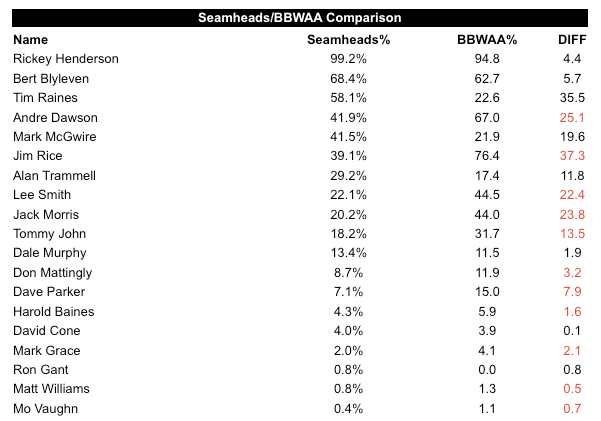
Mike Lynch at Seamheads did the calculating, based on a straw poll done through Facebook (full disclosure: I participated). No player had a bigger difference between his support in the Seamheads poll and the BBWAA vote than Rice, only his worked out in his favour in the official vote (76.4%, compared to 39.1% support among us geeks). Raines had the second-biggest (35.5%), only it worked against him.


Who knows where it goes from here. It's always better to veer away from being a drama queen. One comparable in Cooperstown voting for Raines is Billy Williams, the Chicago Cubs outfielder of the '60s and '70s. Williams polled in the low 20s in his first time on the ballot, 1982. On his second try, he jumped to 40.9% in '83, and was eventually elected in 1987. Raines didn't jump at all.

What can you say? Politics trumps ability.

Saturday, January 10, 2009

Cooperstown: Vote two days away

  • John Brattain over at Baseball Digest Daily about how an Andre Dawson supporter can rationalize away his dreadful .323 on-base percentage. John's point that Richie Ashburn, with a career slugging percentage of .382, was eventually inducted, is valid:
    "Ashburn would likely have been a lesser player if he sacrificed contact for power and in the same way, Dawson probably would have lost value had he sacrificed power for better contact since they were focusing on their weaknesses rather than building on their strengths. Ashburn was 5′10” 170 lb. Dawson, 6′3” 200 lb–one had a smaller strike zone, the other a more powerful physique–generally one plays the cards they are dealt."
  • It is disappointing to see Tim Raines included on only 33% of the 51 ballots counted by Home Run Derby. Dawson received 70.6%.

    As noted, it would be great if he could get in the 40% range, but at least it's a nice jump from last season. It's not all bad, considering the inevitable Rickey Henderson comparisons.
  • Seamheads has posted a Q&A with HOF voter Dave Kindred. It's worth reading if you want a window into a closed mind.
    Q: How about the statistical revolution? Do you still rely on traditional stats to make your selections or have you branched out to include newer measures like Win Shares, VORP, WARP, DIPS or any other sabermetric measure?

    A: All those are fun, and someday, when I grow up, I hope to have my elders explain them to me.
  • Chad Finn at Touching All The Bases says if he had the chance, he would vote for a certain former Expo: "The second-best leadoff hitter of his era, I'd love to see him inducted the same year as friend and fellow ex-Expo Andre Dawson, who would be No. 6 on this list."
  • One of the same writers in Tampa Bay who was responsible for selecting light-hitting shortstop Jason Bartlett as the Rays' MVP -- when he was their fourth-best infielder -- also says Raines is "just not good enough" to merit induction. Arrrrrgh.

Thursday, January 08, 2009

Hail to the Cork...

In a sense, Corky Simpson, who admitted he did not vote for Rickey Henderson for the Baseball Hall of Fame, may have delivered the ultimate burn on the poll-struck media.

Everyone is taking a run at a retired sportswriter in Arizona, especially since Henderson is the only sure thing for the Hall of Fame, based on a poll of writers who have published their ballots. Rob Neyer riffed on it and it's bean Deadspinned (although last anyone checked, Mr. Simpson was 70 -- septuagenarian, not octogenarian), which means this should be kept brief. The Yankees blog River Avenue Blues seems to be one of the only few to have referenced Simpson's previous 15 minutes of fame.

Sixteen years ago, he was the only voter in the Associated Press college football poll who ranked Alabama No. 1 at the start of the season, when the Miami Hurricanes and Washington Huskies were considered head and shoulders every other college football team in America. We all remember how that turned out.

You could also say what goes around comes around, since Simpson's choice in 1992 had the air of blind pig, acorn. As he related, a writer from Alabama told him to watch out for Alabama and he took it to heart. He was on to something and maybe he has been all along:
"If that year proved anything to me, it was the fallacy of the polls. They're a lot of fun, but they mean nothing. It's fun to follow the teams, but they're not that important."
There's a little irony in the fact the big 'Bama backer from those pre-BCS days is getting roasted today. Here's a guy who, possibly by dumb luck, got it right once in a sport which gets it wrong almost every fall. Florida and Oklahoma are playing for the Bowl Counterfeit Series national title tonight large on the say-so of some sportswriters, some coaches and computer rankings that have been fiddled with more than the books for Tony Soprano's waste management business. Are they the two best teams? It's very debatable. If you want to take a pass and say that for your money, this was all decided six days ago when the Utah Utes beat Alabama to finish undefeated, that's fine.

And what is the Baseball Hall of Fame vote but a big poll which is a lot of fun. It would be were it not for the fact that retired ballplayers count on it as affirmation of their place in the world and seamheads -- present company included -- get so pent-up over it every December and January. It is, ultimately, one big poll, and you knew someone would goof it up and not vote for Rickey Henderson.

Well done, Mr. Simpson. Every 16 years, you put one over on everyone, and this time you did while voting for Tim Raines.

Related:
No Hall of Fame vote for Rickey … why? (Rob Neyer, ESPN.com)

Wednesday, January 07, 2009

Cooperstown: More support for the Rock

"No player in major league history has a better stolen base percentage than Raines’ 84.7. He stole 70 or more for six straight seasons. His career on-base percentage of .385 is so bar beyond his peers it’s ridiculous.

How did 75 percent of the voters ignore Raines a year ago? It makes no sense. Hopefully, the big jump in votes he receives this year puts him in position to make the trip to Cooperstown he so obviously deserves in 2010." -- Tim Cowlishaw, Dallas Morning News
Forty-two per cent or bust, people. It would be a big step.

Monday, January 05, 2009

Seven days till Cooperstown...

All of the baseball posts you're going to see in the next seven days are enveloped in an air of apology.

The Baseball Hall of Fame vote is in seven days. For some of you, it's about as pertinent to your day-to-day life as Yosemite Sam mudflaps on a Learjet. Sorry, but for some of us, it's like a U.S. presidential election which happens every year -- like a Canadian election.

Joe Posnanski appeared on Mount Olympus late last night holding a couple stone tablets bearing the names of the players he voted for, in no particular order. Mike Lynch at Seamheads has been taking mock ballots from the hardest of the hardcore baseball geeks, who suffice to say, are proving to be a tougher crowd than the Baseball Writers' Association of America. That site also ranks this year's candidates by Win Shares, which might be eye-opening for anyone who is on the fence about a certain former Montreal Expos leadoff hitter.

Poz says he will vote for Bert Blyleven, Rickey Henderson, Tommy John (who's on the ballot for the final time), Mark McGwire, Dale Murphy, Alan Trammell, and of course, Tim Raines. He voted for Raines last time.Andre Dawson not on that list:
"I have the utmost respect for the guy, but I just can’t do it. That .323 on-base percentage … it would be lower than all but five Hall of Famers — Bill Mazeroski, Joe Tinker, Luis Aparicio, Rabbit Maranville and Brooks Robinson. And none of them went in for their bats. I guess the way I look at it, this is a bit like voting in a .255 hitter. I will say I wish I could get past it."
Anyway, the Seamheads polling has been a minor revelation. Out of almost 150 respondents so far -- and we're talking hardcore baseball geeks, completely unredeemable people -- Rickey Henderson was the only who got the magic 75% support. Henderson drew 99.3% -- yeah, one person had to be the one who didn't vote for him.

Blyleven, the best pitcher not in Cooperstown, was polling around 70% and Raines was around 65%. As for Jim Rice, don't ask.

Elsewhere around the web, Chicago sportswriter Rick Telander said he voted for Dawson but not for Raines. Paul Sullivan at the Chicago Tribune voted for both former Expos, without mentioning that they played for the Expos, but a win's a win. The Tribune had all of its writers who votes talk about their ballots, but alas, Sullivan seems to be the only one who voted for Raines.

Sean McAdam at the Boston Herald has the ballot that might exactly reflect the BBWAA vote -- Henderson, Dawson and Jim Rice.

Seriously, what else is there to get excited about in the first full of January

Sunday, January 04, 2009

Canada and Cooperstown: It's all about 2010

Roberto Alomar and Andre Dawson, a Blue Jay and an Expo, forming the Baseball Hall of Fame's 2010 induction class — it could happen.

One is hopeful for Dawson that his wait ends a week from tomorrow when the Baseball Writers Association of America vote is announced. The former Expos slugger told MLB Home Plate recently that the Hall of Fame has "lost its luster. I feel it (induction) is inevitable ... how I will react to it, I just don't know." Jeez, does that sound like the way someone should look at his sport's highest individual honour? Meantime, looking ahead, Alomar is the best of the lot among the first-timers for the 2010 ballot. He would be the first player from a Canadian-based team to go into Cooperstown on the first ballot (OK, so it's not as exciting as the Jays winning the AL East, whatever).

Dawson should make it this season or next, although Jim Rice got 64% in 2006 and is still waiting, three years later. Alomar, meantime, is probably the lone first-ballot Hall of Famer who comes up in 2010. Among the others, Barry Larkin seems doomed to the same area of purgatory as Alan Trammell, another shortstop who did almost everything well, but didn't have one or two areas where he stood out. The ballplayers got Larkin; statheads got him; the media might not.

Fred McGriff, who of course the Jays traded for Alomar on Dec. 6, 1990, is probably better than some of the first baseman/corner outfielder types enshrined in Cooperstown. His career numbers in the traditional categories probably aren't what voters would like to see from someone who played through the heavy-hitting '90s (although McGriff's total of 491 homers jumps to 511 when put in a stat-neutral context). The long-time Seattle Mariners designated hitter Edgar Martinez is also going to provide a good test case for whether someone who was a full-time DH can be elected.

It could happen. Alomar's credentials are beyond reproach. Only five players accumulated more Win Shares between 1984 and 2003. He

As for Tim Raines, it comes down to setting a target. It would be satisfactory if he can get into the 40-45% range this. It is absurd that players get more worthy in sportswriters' eyes even though they have not swung a bat or thrown a ball for years, but the media tends to be lemming-like with their thought process. Jim Rice hovered around 50% support for several years, before the New England hype machine went to work.

So it goes. Nevertheless, Alomar and Dawson in 2010. It could happen.

(It's acknowledged that I spend way too much time obsessing over the Baseball Hall of Fame.)

Related:
Raines hoping for big jump in HOF vote; Game-changing leadoff man believes he earned enshrinement (Bill Ladson, MLB.com)

Wednesday, December 31, 2008

Zen Dayley: You know what? The Hawk's a lock

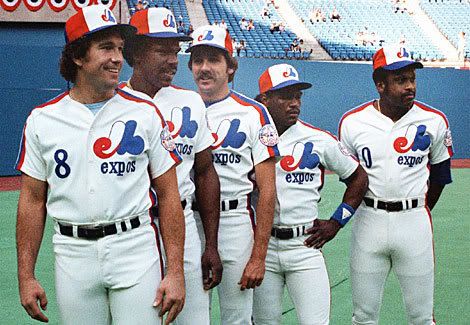
Out of Left Field is looking over the legitimate candidates for the Baseball Hall of Fame during the lead-up to the big vote on Jan. 12. Former Expos great Andre Dawson (second left in picture, beside the next manager of the Blue Jays) is getting closer to induction after receiving 65.9% support in 2008, his seventh try.
The biggest piece of context with Andre Dawson is that he was touched by the Mickey Mantle myth, which is a good thing.

Who knows, maybe sports talk radio has sucked the sympathy out of fans. The biggest piece of context with the great Expos outfielder is that he performed for a generation who had grown up on stories of athletes whose careers were cut short They knew the litany of legends whose careers had been cut short by bad knees -- Mantle, Bobby Orr in hockey, Gale Sayers and Joe Namath in football. It went double for him, since he was playing on the "concretelike turf of Montreal." (Sports Illustrated, June 15, 1987.) That should preface anything said below.

That was a very real phenomena that maybe isn't fully appreciated when you look through a stathead lens and see only the just-okay numbers -- 438 homers, 1,373 runs, 1,591 RBI, .323 on-base percentage. A gut feeling is that Dawson might make in this time. Getting past the 65% mark usually means it's inevitable a player will get the 75% needed for election.

Summing him up in three sentences: Eight-time Gold Glove winner. Won the MVP in 1987; was runner-up in 1981 and '83. One of only six players with 400 career home runs and 300 stolen bases.

Was he ever regarded as the best player in baseball? Did anybody, while he was active, ever suggest that he was the best player in baseball?

No, although he might have been one of the most respected men in the game.

Was he the best player on his team?

Dawson was a full-time player for 16 seasons and led his team in on-base plus slugging (OPS) only five times (1980, '81 and '83 with the Expos and '87-88 with the Cubs), which is low for someone who batted third or cleanup. Gary Carter was the runner-up for MVP in 1980 and Tim Raines had a monster season in 1983 -- 133 runs scored, 90 stolen bases, .393 on-base percentage.

That leaves Dawson with three seasons where he was his team's best player. One was strike-shortened.

Was he the best player in baseball at his position? Was he the best player in the league at his position?

He might been the best centrefielder in the majors in 1981. That was really the only season where he was the dominant player at his position. He was MVP runner-up to another centrefielder, Dale Murphy, in '83. In 1987, when Dawson was MVP (by that time, he had moved to rightfield), Darryl Strawberry was far more productive (.284/.398/.583) in Shea Stadium than Dawson (.287/.328/.568) did playing at Wrigley Field.

Did he have an impact on a number of pennant races?

He had an impact on four -- 1979, '80, '81 and '89. He had strong Septembers in '79-80 when the Expos were nosed out for the NL East pennant in the final days of the season (no one remembers it this way, but the team had strong finishes). He had a so-so final month in 1981, but on Sept. 21, homered in the 17th inning to give the Expos a 1-0 win over the Pirates; by the margin of that victory, they beat the Cardinals out by a half-game to win the second-half title.

Was he a good enough player that he could continue to play regularly after passing his prime?

Yes, he played until he was 41 years old and had his last season as a regular at age 39. The last six seasons of his career basically broke down to two average seasons with the Cubs, two seasons DHing about 80% of the time for the Red Sox and two seasons as a part-timer with the expansion Florida Marlins.

Is he the very best player in baseball history who is not in the Hall of Fame?

No. Raines, Ron Santo and Alan Trammell among others would rank ahead of him.

Are most players who have comparable career statistics in the Hall of Fame?

Five of Dawson's 10 comparables are in Cooperstown: Ernie Banks, Al Kaline, Dave Winfield, Billy Williams and Tony Pérez. Banks hit more than 500 homers, while Kaline and Winfield each made it to 3,000 hits, so they had no problems being inducted, plus they each played in big makrets. Williams needed six years to be elected and Pérez, who was a controversial, borderline case, got in on his ninth try in 2000.

Do the player's numbers meet Hall of Fame standards?

The magic 8-ball would say, "Outlook kind of hazy." His Triple Crown stats -- .279 average, 438 homers (only three seasons with more than 30), 1,591 RBI -- are such that you'd be looking for other stuff to put him over the top.

He's in a no-man's land when it comes to the HOF Standards test, scoring 44.1 -- not a lock, but more than a non-starter, and better than Jim Rice. He fares better on the HOF Monitor.

Is there any evidence to suggest that the player was significantly better or worse than is suggested by his statistics?

The testimonials to how he played through pain and had a throwing arm that was "legendary" (to quote Scott Miller, who's apparently a big Barney Stinson fan) suggest he was better than the numbers indicate. Contemporary evidence, namely that garden-variety .323 OBP, help make the case for "worse."

Joe Posnanski has debunked the myth that players of Dawson's vintage would have walked more if they had just appreciated the value of base on balls and a good on-base percentage. Poz found that walk rates have not budged in the past 30 years. The argument also falls apart when you compare Dawson's career OBP to other home run and RBI champions from the 1980s and early '90s. You could look it up.

Is he the best player at his position who is eligible for the Hall of Fame but not in?

No. Among centrefielders who played at the same time, there's Murphy, and there's Dwight Evans among rightfielders, to name just a couple. In the New Historical Baseball Abstract, James lists him as the 19th-best rightfielder, behind non-Hall of Famers Dave Parker, Bobby Bonds, Bobby Murcer and Ken Singleton.

How many MVP-type seasons did he have? Did he ever win an MVP award? If not, how many times was he close?

He had a MVP-like season in '81 (.302, 24 homers, 64 RBI, .553 slugging in the strike year) and again in '83 (.299-32-113, plus 104 runs scored and a Gold Glove). He won the award in the 1987, but in this day and age, he might not have won.

Nineteen eighty-seven was actually a watershed moment when it came to MVP voting: It was the last time that RBI champs were both MVPs. Neither Dawson of the Blue Jays' George Bell was the best player in their league.

Dawson had a ridiculous home/road split (1.041/.768). That was also the last full season of day baseball in Chicago, and he OPSed 1.016 by day and a .687 -- paltry -- by night. Sportswriters now would have made a much more informed choice.

How many All-Star-type seasons did he have? How many All-Star games did he play in?

He probably had about nine All-Star-type seasons. He was not picked in 1980 when he hit .308, scored 96 runs and had 41 doubles for a 90-win Expos team, but he was a near-automatic pick until he reached the other side of the hill.

Did most of the other players who played in this many go to the Hall of Fame?

Probably.

If this man were the best player on his team, would it be likely that the team could win the pennant?

A lot would have to go right for that to be the case -- like having Gary Carter and Tim Raines on your team.

What impact did the player have on baseball history? Was he responsible for any rule changes? Did he introduce any new equipment? Did he change the game in any way?

There was the matter of that blank contract he showed up at spring training with in 1987. It did prove to be a smoking gun in the players' collusion case against the owners.

Did the player uphold the standards of sportsmanship and character that the Hall of Fame, in its written guidelines, instructs us to consider?

He would not have got this close without it and there is not a thing wrong with that statement, other than the poor quality of the narration. Keep your fingers crossed he goes in at the same time as Jim Rice, to mitigate the Masshole love-in.

Post-script: Rob Neyer tackled Raines vs. Rice in an interview yesterday with Fire Brand of the American League.
"I can't support Jim Rice's Hall of Fame candidacy because I don't believe he's among the 20 best left fielders in major league history, or even among the five best corner outfielders who are today not in the Hall of Fame. Just to make the most obvious argument, Rice wasn't nearly the ballplayer that Tim Raines was. That's objectively true, and it's frustrating to me that so many Hall of Fame voters believe that Jim Rice was a great player, but Tim Raines was not."
Related:
Upon further review, Hawk belongs in Cooperstown (Scott Miller, CBS Sportsline)
My Hall of Fame Ballot -- Henderson, Blyleven, Raines, Morris (Dan Graziano, Newark Star-Ledger)
Hall of Fame ballot tests first-time voter (Joe Capozzi, Palm Beach Post)

Saturday, December 27, 2008

What would happen if....

Over the course of holiday season, some sports issues have clearly come to light that demand either a question or a response.


First off, did the Czechs feel like the folks Romans used to torture at the colosseum once the score reached 5-0?

How can the NHL justify watching the Phoenix Coyotes lose $35 million IN OPERATIONS ALONE, and not justify another Canadian Franchise? Unless they want to screw the player's union and keep the escrow money?

Why can't that franchise be in Toronto (perhaps somewhere in northern Toronto?), Kitchener-Waterloo or, perhaps Winnipeg?

How can the Baseball Hall of Fame voters justify excluding Tim Raines from the Hall of Fame, yet consider the 'roid ragers that will come up on the ballot in upcoming years?

Why does the Hockey Hall of Fame seemingly let anyone with 1,000 points and a handshake into its hallowed shrine, when Baseball has standards?

How can those standards exclude Tom Cheek from the media wing of the Baseball Hall of Fame?

Why doesn't Bob Cole call curling games, a sport he once played at a high level, instead of hockey, a sport he can clearly not can't keep up with anymore?

How will Bob Cole cover Vancouver Canucks games once Sundin teams up with the Sedin twins?

(editor's note: Probably like this: "There he goes! Whoa Baby, look at him go. What a pass to the Sunnnnnnedin."

Why hasn't Martin Sheen ever played a baseball manager in a movie?

Why didn't Oren Koules stick to making bad horror flicks and mediocre TV shows? Was he expecting to catch lightning in a bottle and settled for aging free agents instead?

Could the B.C. Lions beat the Detroit Lions straight up?

How did the Boston Bruins grab a 10 point lead on the Montreal Canadiens when the Canadiens were the favourites?

Did Rickards deliberately try to find bartenders that look like Bob Gainey for their new ads?

Was Bob Gainey auditioning for a new job in said ads?

If that doesn't work, are Alexander Keith's commercials next? (Willllllllllllsssssssssooooooooooonnnnnn!)

Nashville isn't the NHL's canary in the economic coal mine. Detroit is.

When Stephen Harper caused a constitutional crisis to stay in power, citing the coaliton was undemocratic, did he realize that shutting down Parliament isn't exactly setting the best example?

It may seem to a purist that a dome stadium in Regina for the Saskatchewan Roughriders is a bad idea. But it's not like the fans there had much of a tradition with home playoff games....

Why the Saskadome is a good idea: no CFL stadium currently requires ear protection for games against Hamilton. Health Canada would have to mandate such a law if a dome is built in Regina. Either that, or fans would train in the off season by standing next to jet engines. And unlike the new stadium plans in Winnipeg (which are spiffy, but...) Regina could use the whole stadium year round for public recreation, which isn't such a bad idea in January.

To Paul Beeston: For the love of god, please stay as Jays' head honcho.

To J.P Riccardi: Pulling the pin on the development plan in Year 6 isn't a ringing endorsement. Probably best to redo the resume and hand them out at Wal-Mart. Who knows. That greeting doesn't look too hard, and you might find a decent reliever for your softball team.

The Canadian Football League will survive the NFL's arrival in Toronto ( in Western Canada), but the idea of the NFL coming to the Big Smoke is just as laughable as the Bills playing games at Epcot. Don't believe me? How many tickets did they REALLY sell at Rogers Centre? Not 54,000.

The Continental Cup is an idea that deserves to die, but should be replaced with another, more plausible idea. Games between teams from across the globe can be good for the sport. Skills competitions can work too. Ryder Cup format? Not so much.

Kevin Martin and Glenn Howard may be the present in curling. Winnipeg's Mike McEwen will be the future, not Brad Gushue.

Who in their right mind would pay $2,500, regular price, to watch a regular season baseball game?

Who wouldn't pay $2,500 to see North Carolina light up Duke at the Dean Dome?

How is it possible there's a professional mini-golf circuit? Is there some kind of skill getting past the windmill?

Happy New Year,

Keith the Curling Guy.


Friday, December 05, 2008

Zen Dayley: Will McGwire have to buy a ticket to Cooperstown?

Thank you, Mark McGwire, for giving me a reason to watch TV with my kids again. The endless image of the president hugging Lewinsky has been replaced by McGwire hugging his son, hugging the tear-filled family of Roger Maris, and hugging his rival, Sammy Sosa. Thank you, Mark McGwire, for giving us back the hug.
-- Letter to the editor of the Boston Globe, published Sep. 10, 1998


This should be fun.


Warm up the Keltner List Machine!

Was he ever regarded as the best player in baseball? Did anybody, while he was active, ever suggest that he was the best player in baseball?

Regarded as such? Maybe. He won the Associated Press Athlete of the Year in 1998 and was named along with Sammy Sosa as Sports Illustrated's Sportsman of the Year. He led the league in on-base average twice and slugging average four times, and should have won more MVPs than he did (zero). The entire SI staff loved him dearly and he was often portrayed as a proud California boy doin' good by God.

He wasn't the best all-around player, but it's possible that he went first overall in many fantasy drafts.

Was he the best player on his team?

It's tough to be the best when your teammate has 42 homers and 40 steals. Or is also eligible to go into the Hall. (Or is already there.) But once the A's got awful in the mid-90's, McGwire was definitely the best player on his team, and remained so until his final days in St. Louis.

Was he the best player in baseball at his position? Was he the best player in the league at his position?

Probably. Either him or Jeff Bagwell. Maybe Frank Thomas. But they're also Hall-worthy, so I'm not sure it matters.

Did he have an impact on a number of pennant races?

If that number is "four" then yes. Oakland went to three World Series in three years and McGwire, as one of the Bash Brothers, played a big part in getting them there. There's also 1992, when Oakland won 96 games and lost in the first round to some team from up north, but as he kept hitting, the A's stopped winning and that was about it for his pennant-race experience.

Was he a good enough player that he could continue to play regularly after passing his prime?

We're hinting at the answer to a future question, but either he wasn't or he just chose to stop. McGwire only played two years after age 35 and didn't appear in 100 games in either. 35 is typically past the end of a player's prime years anyway, but McGwire's career path is...atypical.

Is he the very best player in baseball history who is not in the Hall of Fame?

No. Among eligible players, Rickey Henderson is ahead of him and maybe Tim Raines is too. (Tim Raines should be in the Hall. Write your MP.)

Are most players who have comparable career statistics in the Hall of Fame?

This is where it starts to get nutty.

Whatever list you want to use, you'll find Harmon Killebrew as a moderate match and a bunch of other guys who don't really compare. His career was pretty much only possible in the era he played in, and he was far above most of his contemporaries.

I know what you are all thinking and we will handle that in a moment.

Do the player's numbers meet Hall of Fame standards?

McGwire could really, really hit. Home runs especially. Fifth-best all-time, by some measure, and second only to Barry Bonds in modern times. 583 isn't a small number. Top-ten in slugging average, too.

But, really, he's just a home-run hitter. A guy with his batting average can't possibly be a Hall of Famer.

...oh, please. Let's not be lazy. Because of his incredible home-run skill, he was able to achieve excellence in other areas. Like on-base average. His is higher than Rod Carew and Joe Morgan, two Hall-of-Famers primarily known for getting on base, and also better than recent Hall-of-Famer and noted singles hitter Tony Gwynn. But McGwire did more than hit singles. He outslugged and outhit many current (legitimate) Hall-of-Famers. His numbers meet the standards, full stop.

Is there any evidence to suggest that the player was significantly better or worse than is suggested by his statistics?

Just give me a second--the doorbell's ringing and I have to go let the elephant into the room...

Okay, let's consider the home-run-by-age graphs at Batter's Box here, and in particular how bizarre McGwire's career is. And how bizarre some of the other sluggers from this era look, relatively speaking.

Clearly McGwire played in an exceptional time and took advantage of it. There's no way his numbers would have been that good otherwise, right?

(pause)

I hope you didn't believe that, or else I'd have to use the same rhetorical device twice in a row. But just to clear things up, McGwire is not Bret Boone. If you neutralize his stats at Baseball-Reference, he gets better. About 10 points are added to each of his averages, and he ends up with 610 homers instead of 583. Meaning, he was not an androstenic mirage. Or at least not any more than the average player was at the time. And I don't consider that to be an issue with his candidacy.

Is he the best player at his position who is eligible for the Hall of Fame but not in?

Yes, indeed. His ranking in Bill James' New Historical Baseball Abstract is third among first basemen, behind Lou Gehrig and Jimmie Foxx, both inner-circle, absolute slam-dunk Hall of Famers.

How many MVP-type seasons did he have? Did he ever win an MVP award? If not, how many times was he close?

Oddly enough, he never won the MVP award, even in 1998. He finished second that year, because Sosa's Cubs made the playoffs. In 1992 he finished fourth when Dennis Eckersley won the award for some reason. 1987, his rookie year, was MVP-like, and he finished fifth in 1999.

He probably should have won two or three of those awards and if he played on a winning team in '87 or '98 or '99, he would have.

How many All-Star-type seasons did he have? How many All-Star games did he play in? Did most of the other players who played in this many go to the Hall of Fame?

He was selected to start the All-Star Game six times and made the team six other times. Maybe two of those were undeserved, but six plus six is twelve and most of the players with 12 or 13 appearances are in the Hall. Everyone with at least 14 appearances is either Barry Bonds, Pete Rose, or some Hall of Famer.

If this man were the best player on his team, would it be likely that the team could win the pennant?

Past evidence says maybe, because he wasn't the best player when Oakland won (although he was close) and he was the best player when his teams didn't (but that was hardly his fault). There's no reason to believe that, if the A's had any kind of a supporting cast in the mid-90's, they would have been held back somehow by their power-hitting first baseman.

What impact did the player have on baseball history? Was he responsible for any rule changes? Did he introduce any new equipment? Did he change the game in any way?

Well, his impact on baseball history was enough for Stephen Brunt to stop sending in his Hall of Fame vote.

But McGwire didn't change the game; he just played it, in every sense of the word. If the discovery of androstenedione in his locker forever changed how baseball treats drug users, then it's pretty weird that Bonds not only managed to break McGwire's record but also packed stadium after stadium with fans wanting to see him sock a few dingers, don't you think? (The Giants' attendance dropped off dramatically last year, when Bonds didn't play at all.)

In other words, drug testing, which was long overdue, was not brought in because of Mark McGwire.

Did the player uphold the standards of sportsmanship and character that the Hall of Fame, in its written guidelines, instructs us to consider?

Depends on when you ask the question. If you ask it now, he's a lying bastard who embarrassed himself and the wonderful game of baseball in front of Congress.

But if you ask it in 1998, he's a classy athlete who actually cares deeply about eradicating child abuse. Who cares about over-the-counter drugs in his locker? He's allowed America to move on from Clinton and Lewinsky by being the front man for an historic quest "that reaches deep into our childhood souls." (There's lots, lots more, but ProQuest can only handle so much saccharine.)

Neither answer is entirely true.

Bottom line

Mark McGwire's Hall-worthy accomplishments were not derided and belittled at the time the way they are now. Choosing to punish him for drug use at a time when it was encouraged might be retroactively ethical, but not really what people are supposed to be voting for here. (And giving lame answers in front of a camera would disqualify every athlete, ever, so don't even bother with that one.) His induction cannot tarnish the reputation of the game if, a mere ten years ago, he was the one saving it.

Writers, hold your noses and put McGwire in the Hall. Give us back the hug.

Thursday, December 04, 2008

Zen Dayley: Mr. Henderson presents

Out of Left Field is looking over the legitimate candidates for the Baseball Hall of Fame -- no disrespect to Dan Plesac -- over the next few weeks. Now batting, Rickey Henderson.
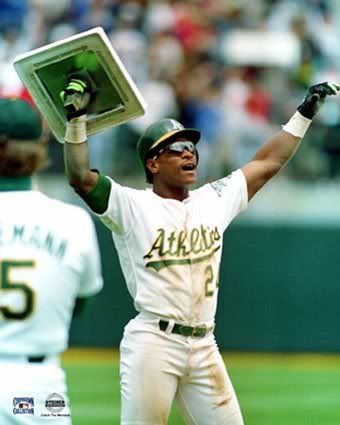
The Golden Baseball League is campaigning to have Rickey Henderson go into Cooperstown as a San Diego Surf Dawg.

Of course, they're kidding, especially seeing as the Hall of Fame no longer lets players pick which cap they're depicted wearing on their plaque. It just figures you would get something like that, since Rickey Henderson seemed to attract zaniness. He has become this larger-than-life character whose baseball legend probably exceeds the full gamut of his personality, only because the stories about him not knowing teammates' names and refusing to cash million-dollar cheques have been repeated ad nauseam, to the point where fact and fiction blur.

The real question is whether Henderson is going to get 98% of the vote. A gut feeling is it might not be that high, but it should top 90%, easily.

Was he ever regarded as the best player in baseball? Did anybody, while he was active, ever suggest that he was the best player in baseball?

That was the case in 1990, when Henderson won his MVP award after putting up a sick 1.016 on-base-plus-slugging and leading the Oakland A's to a 100-win season. He was also second in MVP balloting in 1981, a strike-shortened season.

Was he the best player on his team?

He was the A's best player, certainly from 1980-84, and again in 1990. He was the Yankees' best probably in 1985 --when he became the first player since Lou Gehrig almost a half-century earlier to average more than a run scored per game -- and likely again in 1986, when he scored 130 runs.

Was he the best player in baseball at his position? Was he the best player in the league at his position?

By mid-1986, Sports Illustrated had proclaimed Henderson and Tim Raines as "simply the best leadoff men ever." (John Brattain, who knows his stuff cold, notes that from 1983-89, Raines was the more productive of the two.)

Henderson and Raines as the game's best left fielder was a toss-up throughout much of the decade, save for 1987, when Rickey was limited to 95 games by a hamstring injury. Henderson was also the game's best in '90, and remember, that was the season Barry Bonds won his first MVP award.

Did he have an impact on a number of pennant races?

No Jays fan needs any reminder of 1989, when he dismantled the Jays in the ALCS by OPSing 1.609 and going 8-for-8 stealing bases in Oakland's five-game win. This question can probably be spun around to post-season performance. He was on eight playoff teams and hit .284/.389/.441 in the post-season, with 47 runs and 33 steals in 60 games -- and remember, that's when you're only seeing the best of the best pitching staffs.

Jays fans might not remember this. During the Jays' Drive of '85, Henderson scored 39 runs from Sept. 1 through the end of the season.

Was he a good enough player that he could continue to play regularly after passing his prime?

Rickey hasn't passed his prime, just ask him. Rickey is still going strong. Rickey -- who turns 51 on Christmas Day -- is working on his comeback.

Henderson hung on for way too long -- he actually played his final pro season in a stadium named after Tony Gwynn, one of his contemporaries. However, from age 37 to 39, he could still get on base at close to a .400 clip and steal a lot of bases. In 1996, when he helped the Padres win the NL West, he very nearly had more runs scored (110) than hits (112), which is nearly unheard of. (He walked 125 times.)

Is he the very best player in baseball history who is not in the Hall of Fame?

Pretty much, outside of Barry Bonds, who isn't yet eligible.

Are most players who have comparable career statistics in the Hall of Fame?

No one really compares to Rickey Henderson. The way the similarity scores on baseball-reference.com work is that a score in the 900s says two players were very similar. Once you get below 900, they really weren't that similar.

The most similar player to Rickey Henderson is Craig Biggio with a score of 721, which means he wasn't anything like Rickey.

Do the player's numbers meet Hall of Fame standards?

This will be a slam dunk. He scored a record 2,295 runs, stole 1,406 bases, is in the 3,000-hit club.

Is there any evidence to suggest that the player was significantly better or worse than is suggested by his statistics?

If anything, he was better. Henderson's lifetime batting average was .279, but his secondary average was .416 when you factor in all the walks, stolen bases and extra-base hits. According to baseball-reference.com's stats neutralizer, his career OPS of .820 would have been in the .900 range if he had played in a "historically neutral environment."

He only won one Gold Glove, since it's tough to win it playing left field, but many have written that his fielding was excellent. He was good enough to play almost 450 games in centrefield.

Is he the best player at his position who is eligible for the Hall of Fame but not in?

Yes, he is. Bill James rated him as the No. 4 leftfielder of all time in his New Historical Baseball Abstract, with Tim Raines eighth.

How many MVP-type seasons did he have? Did he ever win an MVP award? If not, how many times was he close?

He had at least three -- 1981, the strike year, when he hit .319/.408/.437, won a Gold Glove and scored 89 runs for an A's team that played just 109 games. He finished second behind the Milwaukee Brewers reliever, Rollie Fingers.

Four years later, after being traded to the Yankees due to some fiduciary troubles the A's were having, he had a MVP-like season in the Bronx -- only the award ended up going to Don Mattingly, who was the only driving him in more often than not. (Actually, it could have gone to George Brett.)

It's curious, all these years later, to note that Mattingly's OPS, .939, was just a smidge better than Henderson's .934. The big difference is that Yankee Stadium was tailored to lefty hitters, and Mattingly hit 22 of his 35 homers at home. Henderson hit 16 of his 24 on the road, where they probably had more impact, since the Yankees were sub.-500 away from the Bronx, which cost them the AL East pennant. Mattingly was not a bad pick, but Henderson or Brett might have been better.

Finally, in 1990, Henderson won the MVP going away, but it took a massive season.

How many All-Star-type seasons did he have? How many All-Star games did he play in?

He was a 10-time all-star, starting eight games. He wasn't selected in 1981, the strike year, when he was MVP runner-up. He was also left off the AL team in 1993, when he had a .462 on-base percentage at the break. Cito Gaston, and you probably had to be there, took catcher Terry Steinbach to fill out his Oakland quotient.

Did most of the other players who played in this many go to the Hall of Fame?

It's not really relevant, so the answer is yes.

If this man were the best player on his team, would it be likely that the team could win the pennant?

He was the A's best player in 1989 and '90, and they won the pennant. He was the best player on the 1985 Yankees, whose 97-64 record was second-best in the AL in that pre-wild card era.

What impact did the player have on baseball history? Was he responsible for any rule changes? Did he introduce any new equipment? Did he change the game in any way?

People have said that in the NFL, the rise of the shotgun formation, the two tight end offence and the emphasis on left tackles was a reaction to pass rushers such as Lawrence Taylor in the 1980s. Henderson was so quick and so smart; as the scout Charlie Metro said it was basically impossible to throw him out. Over the course of his career, pitchers began shortening their motions and putting more emphasis on their pickoff move; that was certainly a counter-move to Henderson, Raines and other basestealers of the 1970s and '80s. The speed revolution was not enduring, but it did make for a fundamentally different type of ball, for a time.

Did the player uphold the standards of sportsmanship and character that the Hall of Fame, in its written guidelines, instructs us to consider?

For all the colourful history, and the contract holdouts, there really is no major baggage. That, "today, I am the greatest of all time" speech should be forgotten.

Tuesday, July 29, 2008

Zen Dayley: Teix in California headlines in...

A detour through the land of linkin' before settling in to watch Roy Halladay work...
  • The Angels aren't the best team in baseball, but they did get Mark Teixeira. No one talks about it, but Vlady Guerrero, former Expos star, former AL MVP, hasn't got it done in the post-season, so the Angels desperately needed a power bat.
  • Did anyone actually go to the Hall of Fame induction weekend? The combo of high gas prices and a lack of readily identifiable inductees made Cooperstown a ghost town. It serves them right for not voting in Tim Raines. (The Hardball Times has a hunch he'll make it by his 15th year on the ballot, 2022.)
  • Veteran baseball writer Hal McCoy is a bit crusty.
  • How does the Rays pulling a Joba and bringing up phenom David Price to be a middle reliver sound to you?
  • It's a couple days old, but the local paper in Wisconsin had a good profile on Seattle Mariners bonus baby Phillippe Aumont working to overcome his rough start in life. 

Monday, March 31, 2008

DUSTIN OFF SOME STORYLINES; TSN IS MOST LOW DEF

ESPN.com will be OK with or without a link from here. Regardless, Jonah Keri and his high-minded contemporaries were nice enough to take a contribution for raines30.com back in the fall and attention should be paid to his 100 Storylines for the 2008 baseball season.

In particular, Keri is touting Dustin McGowan to supplant Roy Halladay as the Jays ace by the end of the season. That's a relatively new one.

It's too bad about the Jays getting rained out this afternoon. Mike Wilner's best line about the "ludicrisosity" of scheduling a baseball game in New York City on March 31:
"I get to come to Yankee Stadium for the first time in my life and I get to see a big white tarp rolled out on to the field."
Meantime, the Drunks call attention to the real kick in the pants, which is that fans miss out on getting to watch the opener in HD. TSN will be airing the season opener of the Rogers-owned baseball team on Tuesday rather than the Rogers-owned network, which is showing Mathematically Eliminated vs. Effectively Eliminated, the Leafs and the Sabres.

Granted, the ballgame could be a nothing game too, but no one will know that for at least a month. What's better? TSN tomorrow or more rain and Sportsnet picking it up on Wednesday? Let's hear it.

Please don't make this into a Jamie Campbell vs. Rod Black kvetchfest. It's tiresome, for one. It's not about them. It's on the highers-up in Canadian broadcasting who don't invest in bringing along bona fide baseball play-by-play people and just expect to get lucky, which can happen. The rest of us are just supposed to believe that there isn't a man or woman in a country of 33 million people who can commentate baseball. That's hard to believe.

Thursday, February 21, 2008

GIBSON'S FINEST

Missed it when first ran, but Jonah Keri (one of the much more brilliant baseball minds behind raines30.com) has a nice retrospective at ESPN.com on the 40th anniversary of Bob Gibson's 1.12 ERA season in 1968.

One has to love the quote Keri got from Billy Williams, the Hall of Fame outfielder about what it was like when Gibson and Ferguson Jenkins, who were both fast workers, would go head-to-head at Wrigley Field:

"When he and Fergie were pitching, you could always schedule something after the game ... The game would be done at 3:30, so you still had a lot of daylight left to go fishing."
Gibson was never pulled from a game during that season (28 complete games in 34 starts; he was pinch-hit for the other six times) when he recorded the lowest ERA since the end of the Dead Ball era that concluded shortly after World War One. Guess what, though? The Cubbies, who finished 13 games behind Gibson's pennant-winning Cardinals, won two of the three Jenkins-Gibson matchups.

Related:
Forty years later, Gibson's 1.12 ERA remains magic number (Jonah Keri, ESPN.com)