Showing posts with label Jonah Keri. Show all posts

Wednesday, March 16, 2011

Ultimate baseball league: Montréal Expos

The Expos could be the favourite in the NL Newbie division, which consists of expansion cousin San Diego, the Milwaukee Braves-Brewers and the trio that began play in the 1990s, the Arizona Diamondbacks, Colorado Rockies and Florida Marlins.

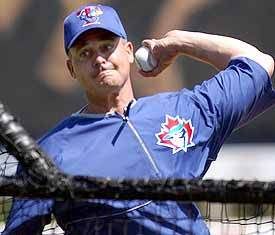
For starters, since a guideline was, when in doubt, put a player with the team which needs him more, Pedro Martínez (pictured), is on the Expos instead of the Boston Red Sox. The starting staff should be strong, although it leans right more than Steven Harper.

Offensively, how does Tim Raines-Andre Dawson-Vladimir Guerrero outfield (with Rusty Staub at DH and Gary Carter batting cleanup) grab you? Granted, manager Jonah Keri might have to get creative to optimize this lineup.

The infield is a weak spot. It still sucks that Hubie Brooks went down with a season-ending knee injury in 1986 when he was batting .340 and OPS-ing .956; otherwise he would have had the best season by a Montreal infielder. (The arbitary cutoff being observed here is 500 plate appearances for an everyday player, 400 for a utiltyman, 350 for a catcher. Brooks batted 338 times that season.)

STARTING LINEUP
  1. LF Tim Raines,# 1985 (7.5). For the Rock, we'll pick a quintenessential Rainesian season where he on-based .405 with some power, had 52 net stolen bases (70-for-79), scored 115 runs and played a lights-out left field. All that and he didn't crack the top 10 in MVP balloting. C'est la vie.

    In the present, of course, as a Raines supporter, it was gratifying that he is halfway to the Hall of Fame after garnering 37.5 per cent support in the 2011 Cooperstown voting. We all knew it would be a long process.

  2. RF Vladimir Guerrero, 1998 (7.1). The age-23 version of Vlady would provide plate coverage nonpareil out of the 2-hole, along with power and speed. He might have to come out for late-inning defence.

  3. DH Rusty Staub,* 1969 (5.9, 6.7 oWAR). Le Grand Orange was traded a lot during his career, but had his best three seasons with the early Expos.

  4. C Gary Carter, 1982 (7.8). Remember when he trying to get a a major league managing job? This space did have some fun with that. Here is hoping it will not have to be reenacted during the 2012 U.S. election.

  5. CF Andre Dawson, 1983 (6.6). One of his two seasons as runner-up for MVP; he was better in both than he was when he actually won with the last-place Cubbies in '87.

  6. 1B Andrés Galarraga, 1988 (5.1). It was a tough call to go with The Big Cat over Scoop, Al Oliver, but the .302/.340/.502 line Galarraga put up in '88 tops Oliver, who couldn't take a base on balls or field by the time he came to Canada.

  7. 2B Jose Vidro,# 2002 (4.6) / 2B Ron Hunt 1971 (4.9). Contrary to how some older writers remember it, the Expos did employ some decent second basemen after Rodney Scott was released in 1982. Vidro , who hit almost the same for his career from each side of the plate, was the best of the lot.

    Hunt was once described by Bill James as "being as bad a player as you can be with a .400 on-base percentage." He holds still holds the record with 50 hit-by-pitches in a single season.

  8. 3B Tim Wallach, 1985 (5.5). Was the National League's Gold Glove and Silver Slugger third baseman in 1985. Now you know when Michael Jack Schmidt moved across the diamond.

  9. SS Orlando Cabrera, 2001 (3.3). Every organization has that one black hole; the pool at shortstop was a little thin. Cabrera was good, as evidenced by the fact he's always with a team that makes the playoffs.
STARTING PITCHERS
  • RHS Pedro Martínez, 1997 (8.2). One would imagine it was a tough call whether to place Pedro with the Expos or with the Boston Red Sox, where he had his two best seasons according to WAR (10.1 in 2000, 8.4 in 1999). Then again, if you've ever met a Red Sox fan, you would know it was not a hard decision at all.


  • RHS Steve Rogers, 1982 (8.4). One of the better pitchers to never receive a single Hall of Fame vote. This is also a good time to remind people of Blue Monday. Yours truly once had the misfortune to work with an ex-Montrealer (know how you know someone is from Monreal? They tell you) who whenever the Expos came up in conversation, would say they had the tying run on third base with one out in the bottom of the ninth inning in that game. Nope; not true. The Expos never even got a runner past second base after the first inning that day.

  • RHS Dennis Martínez, 1991 (5.5). El Presidente, El Perfecto. That is all.

  • RHS Bill Stoneman, 1971 (5.4). No need to remind people Stoneman pitched the Expos first two no-hitters or that he was general manager of the Angels when they won the World Series in 2002. He almost he three no-nos; in his career-best season, 1971, he had a one-hit, one-walk, 14-strikeout game. Considering he led the NL with 146 bases on balls that season, a one-walk game was pretty extraordinary.

  • RHS Javier Vazquez, 2003 (5.4). How often does a NL pitcher throw a nine-inning complete game and lose? Vazquez did so in yours truly's last visit to the Big Owe. Mark McGwire couldn't even get a ball in play (three strikeouts and a pop foul) against him that night. And the Expos still lost.

  • RHS Liván Hernández, 2003 (5.3). Of indeterminate age and weight, but keeps on keeping on. Gave the Expos their last hurrah with a push for the wild card in '03.

BENCH
  • CF Marquis Grissom, 1992 (5.6). Former stolen base champ is the answer to a great trivia question: who was in centrefield when the 1995 and 1997 World Series ended? Grissom was on the winning Atlanta Braves in '95 and on the losing Clevelanders in '97, who lost on Edgar Renteria's 11th-inning walk-off single in Game 7.

    Grissom would provide some late-inning fielding insurance in place of Guerrero.

  • 4C Larry Parrish, 1979 (4.7). There will be some PAs at either infield corner or as the designated lefty-masher.

  • 2B Delino DeShields, 1992 (4.0). Apparently Delino was a demigod to first-gen gamers. He had an awesome name, so of course he passed it to his son, now a Houston Astros outfield prospect.

  • C Barry Foote, 1974 (2.2). Gary Carter would catch 95 per cent of the games, so it's not a worry there's no good alternative.
BULLPEN
  • CL John Wetteland, 1993 (4.6). He was out there. He is still out-out there.

  • RHR Tim Burke, 1987 (4.2). Made the Expos in '85 as a non-rostered player and wound up becoming their relief ace within two years; during that Year of the Homer in 1987, he gave up only three in 91 innings. Actual quote: "If Jesus were on the field, He'd be pitching inside and breaking up double plays."

  • RHR Jeff Reardon, 1982 (3.5). Gary Carter beat him to the trend of former Expos earning World Series rings by a season; Reardon got his with the 1987 Twins. Having him here is just an excuse to bask in some Steve Rushin brilliance the SI Vault, writing on the development of the closer:
    Baseball's closers have, historically, come from a can of mixed mustachioed nuts. And Reardon has closed more often than the most prolific of Century 21 agents: Through Sunday, Reardon's 339 career saves left him three short of breaking the alltime mark held by Hall of Famer-elect Rollie Fingers. Fingers, you'll recall, carried his teammates on the waxed handlebars of his curlicue mustache. Remember, too, the road-kill beards of Bruce Sutter (300 saves) and Gene Garber (218), the hood-ornament-steer-horns 'stache of Sparky Lyle (222) and the fearsome Fus of Goose Gossage (308) and Mike Marshall (178).

    Long before the invention of the Gillette Atra twin-blade razor, these flamboyant relievers were causing heads to pivot. But few got the attention, adulation or remuneration afforded today's premier closers. In fact, the term closer doesn't do justice to the glamorous head-liners of the 1990s. Does Sinatra close for Steve and Eydie? No. They open for him, much as starter Tom Browning opens for stopper Rob Dibble in Cincinnati. (Sports Illustrated, June 8, 1992)

  • RHR Mel Rojas, 1992 (3.5). Felipe Alou's nephew, Moises Alou's first cousin. You know that. Did you know the family business has reached a third generation? Mel Rojas Jr. is an outfielder in the Pittsburgh Pirates system. Mel Sr. was an efficient right-handed reliever on some contending Expos teams in the first half of the 1990s.

  • LHR Woodie Fryman, 1980 (2.5). The well-remembered 'Spos southpaw left this mortal coil recently; he was good for them in iterations as a starter on some bad teams and as a reliever on some good ones.
(* left-handed hitter; # switch-hitter)

Sunday, April 18, 2010

The Blue Jays, the balanced schedule and why you ignore buffoons


This might be an appropriate time to vent some Jays angst that's been squeezed into a bitter little ball across the past few years.

Thankfully, we can do this without hitting any ignorami with a whiskey bottle. Joe Cowley got the reaming that should be coming to anyone who judges an entire city, let alone a quote-unquote "Third World country," by what's available on his hotel room TV. At least he provided a prod to finish off a post that has been in the hopper since about 2008 (and as The Ack noted, Cowley had little to say about Cleveland drawing about 5,000 less fans than the Jays did on both Friday and Saturday.)

Remember '08? The Toronto Blue Jays had the third-best run differential in the American League, but finished in fourth place in the AL East. Since most people make their judgment solely on won-loss records, this made their season a total fail to — appropriating the loose Cowleyian definition of most — most minds. You might recall that in '08, the Chicago White Sox, the team Joe Cowley covers and Ozzie Guillen manages, went to the playoffs after winning an AL Central tiebreaker over the Minnesota Twins. Those teams were a combined 1-13 against the Jays.

Going off on a rant at the time was ruled out — the whole whelp-of-a-beaten-cur thing. It did signal the Jays could no longer rate an emotional investment. It was, Call me when there's realignment or balanced schedule.

Call it a Captain Obvious statement, but it has hit the point where you need a schedule converter in baseball, similar to the "neutralize stats" function on Baseball-Reference. As a fan born in 1977 who follows a team which has not made the playoffs since 1993, it would be nice to know how a contemporary team would fare in that 1977-93 era of two divisions and a balanced schedule, and vice-versa. The current setup obscures a team's true worth, which is an intolerable cruelty to visit upon fans.

In the '77-93 era, an American League club played every other team 12 or 13 times. That's a far cry from today's unbalanced sked (18-19 games vs. division opponents, 6-10 vs. other league foes, plus 18 interleague games). Now, there is a general understanding the calibre of competition in MLB varies between leagues and divisions. People have known for years poor scheduling rigs the playoff races.

The popular understanding, though, seems to stop halfway. No one ever applies that 2010 knowledge retroactively, like the characters in Hot Tub Time Machine. It doesn't take Keith Olbermann — although it was gratifying he tweeted it — to know the Jays and Baltimore Orioles need a balanced schedule, or realignment, as Paul Beeston has lobbied for. Some AL East widowers would tack on, "And a salary cap," although that sidetracks the argument.

The reality between the Jays then and now is not so polarized. The difference between the winnin' times in the 1980s and early '90s and also-ran Aughties are less than some might think. It's provable.

To hear people who only pay casual attention to baseball tell it, from 1985 to '93 Toronto simply had awesometacular teams and brilliant management. It is just apologist to point out the scheduling inequities that exist now — what about the 2008 Tampa Bay Rays? Never mind Rays owner Stu Sternberg also wants a balanced schedule.

Many are somewhat unaware of how the schedule is different than it was when Toronto had an annual contender, let alone its impact on a a team's record and its general perception. A 20-something sports consumer might be completely in the dark, like Clark Duke was about meeting women in 1986. Two divisions? Seattle and Boston each having to visit each other twice a year? That sounds ... exhausting.

However, examples abound that if the balanced schedule cleared a path for the Jays' success. Toronto's first playoff team in 1985 fared better vs. the AL West (55-29, .611 winning percentage) than it did vs. the East (44-33, .571). Manager Bobby Cox's boys took full advantage of having a near-equal opportunity to beat up on the bad clubs on each side, going 37-13 vs. the sixth- and seventh-place teams.

Or take 1989. The Jays won the division with a garden-variety 89-73 record. They went under .500 except when they got to beat on the two cellar dwellars, Detroit (11-2) and Chicago (11-1), graced by starting shortstop Ozzie Guillen on-basing a whole .270.

Perhaps lack of confidence stemming from not having the sabermetric chops to do it right, or worrying about not having the influence to make people listen inhibited writing about this in 2008. It kind of lay there dormant. Last week, though, Jonah Keri and Jeff Passan got into a little parry and thrust about the long-term outlook for those aforementioned Tampa Bay Rays.

Passan wrote a column about the Rays' pending loss of heart-and-soul leftfielder Carl Crawford that was pessimistic in outlook. Keri, who is writing a highly anticipated book about the inner workings of the Rays, was more pragmatic.

Keri touched on the realignment question, which one need not point out has been a hot topic since "floating realignment" was put forth as a trial balloon in a Sports Illustrated column.
"Why can't baseball get rid of its unbalanced schedule? Does it help MLB and its teams to have 18 games played between division rivals? Has anyone ever examined all the implications — on-field and off- — of this set-up? I’m not even necessarily advocating for it (we all love to see the Yankees and Red Sox spend 5 hours a night bludgeoning each other to death, 18 times a year, after all), I’m just asking."
It seemed like a fun exercise to try to retro-fit some the Jays' recent records into a balanced-schedule format, and guesstimate how some of their great teams would have fared with the unbalanced sked. Some problems creeped up, of course:
  • It's not so simple as sorting teams into their current or former divisions. For instance, in 1992, the Jays could have used 18 games against the Yankees. They went 11-2 against them. The Red Sox finished last.

    In '89, the Kansas City Royals had the second-best record in the league. That sort of shoots down the idea of floating realignment, or realignment based on revenue. No one can know who will be good in 10 or 15 years.

  • Won-loss records alone don't prove where a team ranks. Pythagorean W-L (run differential, essentially) is part of casual conversation. Next time you encounter a Jays fan, ask her/him which team had the best run differential in club history.

    Chances are, the answer would be one of the World Series teams, or the '85 club. It was actually the 1987 team which lost the pennant to the Detroit Tigers on the final day of the season. You could look it up.

  • Lack of math smarts. Someone much, much smarter would have to figure out how to control for how scheduling affects won-loss records and run differential, then rank teams. (In other words, don't read too much into the conclusions.)

  • No interleague data. There is no way of knowing how the late '80s and early '90s Jays teams would have handled interleague play. The fact the '92-93 teams each won the World Series in six games (small sample size! small sample size!) doesn't mean each would have gone 12-6 in interleague play.

    The Jays are an all-time 108-121 in interleague play. That .472 winning percentage works out to 8½ wins per 18 annual interleague games.
One half-assed way of going about it is to rank the Jays' opponents 1-13, making some adjustments based on run differential. For instance, in 1985, the Red Sox finished fifth in the East with an 81-81 record, but had the league's third-best run differential. (In hindsight, that makes their 1986 pennant seem lot less improbable that it was made out to be at the time.)

This is full-on admittedly simplistic, but the method is to take the 2008 team's record against each opponent and pro-rate each based on the earlier team's schedule. (For argument's sake, let's apply that 8½ interleague wins per season when modernizing an '85-93 team's record.)

Conversely, you can put the '85 or '92 Jays into the context of 2008, when Toronto played 63 games against the top four teams in the league, 11-15 more than they would have with a balanced schedule.

In '08, the AL was grouped thusly:
East: 2, 3, 4, 12;
Central: 5, 6, 7, 10, 11;
West: 1, 8, 9, 13
In 2008, the Jays won three of nine games against the league's top team, the L.A. Angels, and seven out of 18 against the second-best, Tampa Bay. In 1992, they placed 12 games apiece against the Nos. 1 and 2 teams, the Oakland Athletics and Minnesota Twins. So the 2008 team gets half-ass pro-rated to four wins in 12 tries against the Angels, 4.666666 in 12 vs. Tampa Bay, and on down the line.

Conversely, that '92 team which went 5-8 against the Milwaukee Brewers would play them 18 times. It's all spread-sheeted, but here are a few of the results:
'08 Jays, with the '92 schedule: 91.09 wins (actual wins: 86)
'92 Jays, with the '08 schedule: 91.66 wins (actual wins: 96)

'08, with '89 schedule: 90.56 (actual: 86)
'89, with '08 schedule: 87.5 (actual: 89)

'85, with '08 schedule: 92.6 (actual: 99, in 161 games)
'08, with '85 schedule: 91.27 (actual: 86)

'08, with '91 schedule: 91.43 (actual: 86)
'91, with '08 schedule: 85.8 (actual: 91)
The 2008 team ends up with 90.1 wins when teams are simply put back into two divisions. (By the same method, the 2006 club had 87.6, not far off its actual total. They'd still have to bust ass to earn it, the way it should be.)

By no means is this a claim any recent Jays club was as good as the fondly remembered teams which went to the playoffs and World Series. The point is to show how much the unbalanced schedule has messed with our heads. The first-place 1991 Jays and fourth-place '08 Jays practically end up trading records.

With the old balanced schedule and no interleague play, the '08 club would have at least had a puncher's chance at winning 90 games, having one of the top four records in the league, and being in a playoff race.

In most seasons, the AL has four 90-win teams.

That shows why MLB should go back to two divisions in each league, with two wild-card teams. It would increase the chances of the four best in the league making the playoffs and prevent the deck from being stacked against teams due to geography.

What's so wrong with that idea? (Better yet, get rid of the divisions in each league and have the top four teams advance to the playoffs, the same way the top four finishers in the English Premier League play in the Champions League the following season.)

No one could say with certainty how this would affect the Jays off and on the field, but one can imagine there would not be this hard crust of cynicism like the one that has formed around the franchise.

Perhaps they would even have enough momentum at the corporate level to justify building a real ballpark, like the new one in Minnesota, or the ones in northern cities such as Milwaukee and Seattle, whose teams have never won one World Series, let alone two. At the very least, FAN 590 callers would be able to "unbind their panties" (Mike Wilner, FAN 590) when there is an early-season crowd of 10,000.

(About that: It was the first two nights of the Stanley Cup playoffs, the Toronto Raptors had a must-win game the first night, Toronto FC had its home opener the second night, and have you noticed what happened to the global economy? The Jays aren't going the way of the Expos, since there is nowhere to go. Relocating the Oakland Athletics is more of a priority for MLB.)

Perhaps this is getting into Ken Dryden territory, where the golden age of sport is whatever it was like when you were 12 years old. However, following the Jays came about thanks to their proximity to Kingston, and their success in those days. Watching the franchise try to push the boulder up the mountain has taken that away.

Going back to the old schedule would not address revenue disparities. It would remain a related issue. Through all of this, there is an awareness baseball's excessive focus on big-market teams has not hurt its equity. It has gone from a $1-billion-per-year industry in the early 1990s to about $7 billion. Small wonder it can abide having about a third of its franchises busted down to being an outlet mall. You grimly walk in to Rogers Centre, get what you need (a baseball fix) and file out without being repaired emotionally or spiritually.

(As an aside, in all those then-and-now Blue Jays comparisons the media likes to make, no one seems to acknowledge how much the business of baseball has changed. The Jays' success coincided with a period when the Red Sox and Yankees each had ineffectual management, the former thanks to the wrangling over the Yawkey Trust and the latter due to George Steinbrenner was batshit insane.)

However, the Yankees and Red Sox could pass the division title and the first wild-card berth back and forth for the next 40 years for all I care, so long as it was possible to have three AL East teams make the playoffs.

Eliminating that unnecessary third division leaves a playoff berth that would still be there for the Jays, Baltimore Orioles, Kansas City Royals and yes, the Tampa Bay Rays. Beyond that, post-season baseball is a crapshoot. A short series in any sport offers a chance for a team make up for inequities in revenue or scheduling, à la the eighth-seeded Edmonton Oilers eliminating the No. 1 seed Detroit Red Wings in the first round of the Stanley Cup playoffs in 2006.

Until that happens, Toronto is deprived of having real baseball. Continuing to follow it makes me a total hypocrite.

Please do not judge. Resenting a professional sports league yet still obsessing over it is what a simple kind of man must do to trick people into thinking he's "so motherfucking complex it's ridiculous." (Assist to fellow redheaded Kingtonian Jay Pinkerton.) Plus following a ballclub day in, day out, helps frame in that little world one lives in when he's too scared to change.

Obviously, no one gets to stay in the same world they knew when they were younger. Hopefully this shows why it's hard to believe in the Jays until they get to rockin' the same schedule they had when leg warmers, cassette players, George Bell's Jheri curl and V-neck jersey were popular.

A trip back to 1986 scheduling-wise might restore hope, just like it did for the guys in Hot Tub Time Machine.

Please excuse the forced reference to a popular movie. It just seemed like the best way to let Joe Cowley to know that Canada finally got its first movie theatre.

Friday, January 08, 2010

Happiness is a naked Richard Griffin; make BBWAA voting public

The Baseball Writers' Association of America shouldn't mind being transparent, since they're so easy to see through.

It wasn't worth writing a rage-filled post on Wednesday over a childhood idol, Roberto Alomar, being forced to wait a year to enter the Baseball Hall of Fame. Two days after the fact, though, it cannot be internalized. What comes to mind is a line Matthew Broderick said in Election, right before Jim McAllister's life fell apart the way the voting process has across the past decade where borderline candidates (Andre Dawson, Bruce Sutter) have got in while stone-cold locks (Alomar, Tim Raines) play left out: "We're not electing the pope here."

You gotta keep it in perspective, eh? We're not electing the pope here. Who gets a plaque in a museum is not as important as Parliament being prorogued, whether airport security officials knowing what you look like naked will stop a terrorist or even how Boise State might have done vs. the Alabama Crimson Tide. It also hints at how the Hall of Fame election process needs to be done out in the open. Doing it in a way that dates from a long-gone era is not working.

Start with one fix: Everyone's voting record should be public the second results are announced, the same with elected officials in politics or with a publicly traded company in the business world. This is the way of the world, the naked corporation. (While we're here, who are some of the people on voter rolls?)

The guts of the matter is not the "who's smarter?" game between Seamheads or even which player was hosed. It's that just desserts delayed are just desserts denied, for anyone who cares about the game. A few of BBWAA's bad apples have shown absolute power corrupts absolutely. (
Glenn Dickey
: "Writers love the feeling of power they get from denying a worthy candidate — and yes, that is very sick.")

Making the ballots public might cut down on the high-horse routines. It was a hoot-and-a-half to see the apologias coming out Toronto about the Alomar snub, while American writers were rightly outraged. (It's like the U.S. guys were actually more sensitive to what Robbie meant to a generation of Canadian ball fans.) One, apparently taking readers for village idiots (his term not mine) who can't do a Google News search, insisted there is no special cachet associated with going in on the first ballot and that it was right Alomar has to wait (even when he said the complete opposite four days earlier). Another came off like he was 50-something going on five, all but sticking his tongue out: "At the risk of offending those who think only statistically, (Andre) Dawson and his weak on-base percentage (.323) got this vote on the basis of my actually having watched him play." In fewer words: Nah-nah-nah-nah-nah.

The point is that people who write like that forfeit the right to secrecy. It is pretty obvious the secret ballot is more about media privilege than recognizing a great baseball player. An I've-got-mine arrogance runs through it all Those who think only statistically? ... writing, Whatever happened to reasonable discussion on baseball issues? just a few grafs after smearing the FAN 590's Mike Wilner? Come on. Wilner, to his credit, took it in decent humour.

Small wonder, then, that a smart guy such as Jeff Blair seems so cranky about it all. How funny is it, by the way, that one guy calls it "ridiculous" to suggest voters take five minutes to make their selections when Blair wrote, "All told it takes a couple of minutes?"

Such smugness calls to mind Henry Hill in GoodFellas, after Tommy (Joe Pesci) got whacked:
"And there was nothing that we could do about it. Batts was a made man, and Tommy wasn't. And we had to sit still and take it ... It was real greaseball shit."
Making the ballots public might address a few of the issues:
  1. Make it about the players again.

    Secrecy has caused distrust and made the process to become less about whom the BBWAA actually manages to vote in than, in the aftermath of the announcement, rooting out who didn't vote for someone (remember Corky Simpson, the dork who left Rickey Henderson off his ballot?), who didn't vote for anyone or who actually cast a vote for David Segui.

    A lot of the writers know it, too, as Bob Klapisch had the grace to admit:
    "It is hard to argue with anyone who thinks the BBWAA has lost its way, especially when Jay Mariotti taunted the organization to throw him out after failing to vote for anyone.

    "Appearing on ESPN's Around the Horn, Mariotti said, 'If (Blyleven and Dawson) haven’t gotten in for years and years I cannot vote them in now,' although he admitted he voted for both players in 2008.

    "That's the sort of recklessness that sharpens the fangs of those who already distrust the media. Alomar? He’ll be making his acceptance speech in July 2011, but the BBWAA’s politics stood between him and first-ballot induction."
  2. Keep the hypocrites down to one face per person.

    Some obnoxious as they are obtuse types would have you believe it does not matter whether Alomar goes in this year, 2011 or 2024.

    Right. As Bob Sansevere put it, there is "a block of Hall of Fame voters who are self-anointed keepers of the Hall. They have been given the power to decide someone's fate and, right or wrong, they are going to wield it.

    "Some of these voters believe no one should ever be a unanimous pick, and no one, not even Babe Ruth, ever has been.

    "Some believe no one should be elected in his first year of eligibility, which I'm sure is what kept Alomar and (Barry) Larkin out."

  3. Track the bloc voting.

    The one voter I had do a drive-by on a few paragraphs ago did note voters identified with two media capitals with two MLB teams, Chicago and New York, have a lot of sway. Andre Dawson might still be waiting if his most famous season (winning National League MVP in 1987) had not come with the (cough, last-place) Cubbies. Alomar played with the Mets and White Sox and didn't exactly set the world on fire.

    We deserve to know if that is a factor. It is a sad commentary if Bert Blyleven has waited this long because he couldn't get traded to the right city back in 1975. Of course, if he'd been on the Cubs, his winning percentage would be even worse, ha-ha.

  4. Get them to leave the goddamn goalposts in the ground.

    Full disclosure would stop — take it away, Jonah Keri — "voters who game the system, whose cognitive dissonance and egos drive them to make up arbitrary rules about who should and should not get in based on their own whims. Forget PED-linked players for a second. We see players fall short because some voters don't find it proper to vote in anyone but Hank Aaron on the first ballot. Other voters decide they’re moral watchdogs, so they're going to make one of the greatest second basemen of all-time wait, because he once did something rude and insulting on TV."

    One wouldn't go far to say the "political statement" (Dan Lamothe, Red Sox Monster) that 26.3% of the BBWAA made by not voting for Alomar had a generational element. There's no age minimum (or ceiling) for solipsism! It does seem a little more Gen-X to be non-judgmental, realize what Alomar did was not that bad, and ask people be judged on their own merits rather than some kindergarten-worldview concept of character, like Drunk Jays Fans said:
    "Alomar’s vote total is 'pretty damned good,' Griffin tells us. “And for someone to say that writers don't know what they are doing and to ask "how could the writers leave him out while Dawson with his lousy on-base percentage is in" (on his ninth try) is silly.'

    "It is??? ... I thought they were voting on who deserves to be in baseball’s Hall of Fame based on the merits of his career as a baseball player — not sure where I got that crazy idea from! — and if the group entrusted with deciding whose career merits it the most chooses Andre Dawson over Alomar, Raines and Blyleven, then it would seem to me that there is something fundamentally wrong with this group and their concept of what makes a baseball player good."
    Lamothe said much the same:
    "When someone like (Alomar) misses out because voters want to make a political statement, it's time to find voters who will simply and objectively look at the numbers and check the appropriate box. Immediately. Before one of them gets strung up from the flag pole by pitchfork-wielding baseball fans who are sick of the sanctimonious crap."
    Oh, and as for Griffin's insistence that first-ballot, second-ballot, doesn't make a difference? Check out this part of that Klapisch column:
    "Alomar would’ve been the first Puerto Rican player to be inducted into Cooperstown by the normal election process – Robert Clemente was posthumously admitted less than three months after his death in 1972.

    Ray Negron, a friend and adviser to Alomar, said, 'People on the island had been preparing for this for weeks, months. It’s one thing to say you’re in the Hall of Fame, another to say you’re a first-ballot player. It wasn’t easy for Robby or anyone else to say, Wait ’til next year.' "
  5. Rewarding those who are caught up to the curve.

    There is gratitude for the baseball writers who are only too happy to debate and defend their choices. They're probably closer to the majority in the BBWAA.

    They, like most of us, know being in the media doesn't give you all the answers. It's good for a sportswriter to have your feet held to the fire as part of informing and entertaining people (the second part is why it's bogus some media outlets don't let reporters vote for awards and such; it drives debate).
It probably will not happen but it should. When the process is so far gone that the best second baseman of the past quarter-century cannot get in on the first crack, it tears the lid right off the jar.

Alomar will be elected in 2011, but the memory should linger. Personally, it took two nights to get the words together. There was too much worry of saying something regrettable or coming up with a diamond variation on Don Cherry's line that some people wouldn't know a hockey player if they slept with Bobby Orr. In other words, make your own Albert Pujols analingus pun, dammit!.

Besides, traditional media, Twitterati, blogs such as Circling The Bases, you name 'em, were all over this on the day of the snub. It was impossible to find anyone who could defend Alomar not getting the requisite 75% (not to go off on a purpose-defeating rant). True, his 73.7% was very strong by the standards of first-time candidates, but MLB Network's Bob Costas expected him to be "somewhere above 80%." For someone who cares about this stuff, waiting a year will not ease the sting, sorry.

Apologies for taking this long to channel rage into something productive. Meantime, the BBWAA is going to have to become transparent, sooner rather than later.

If they're so sure and smug in what they're doing, they won't mind in having their ballots made public. After all, we're not electing the pope here.

Wednesday, August 12, 2009

He's a Dowbboy who lives in a bubble

You sort of have to admire what Bruce Dowbiggin has done with the place since he moved into William Houston's former digs as sports media critic.

Dowbboy has done a reno. The place has been converted to one part bully pulpit to use on people who didn't graduate from his school of journalism. The other half is an echo chamber for people who want reassurance they are not living through a media revolution.
  • Erin Andrews calling 911 because a couple paparazzi were skulking around her home after dark "demonstrates that the ESPN star ... clearly has no idea how people in her business chase a story." (July 31)

  • The Score tweaking its format to focus on "the chatter, the personalities" means that the network "has in mind what TMZ and Deadspin and a raft of social websites have done to redefine the relationship between those being covered and those doing the covering," (Aug. 5) since those sites are so, so evil for giving people what they want to see. Plus there are all those stupid young people who want to know whom Reggie Bush is dating.

  • Most recently, Chicago Blackhawks hockey star Patrick Kane being arrested and charged with assault last weekend "was not exactly a shining moment for the integrity of bloggers" (Aug. 12) because people joked, passed judgment and gossiped about it on blogs, Twitter, Facebook and the like, just like they have always joked, passed judgment and gossiped.
It's pretty clear: Dowbiggin's generation has a monopoly on good taste and substance. We get it.

Sorry to pop that secure little bubble of boomer conceit, but that is hogwash. Next to no one is prattling on about the "blogosphere" in 2009, really. The two sides came together. They locked swords. No one really got anywhere. They called a truce. Eventually, they realized they actually had a lot in common, kind of like Canada and the U.S. since the end of the War of 1812.

One should be grateful for the good sports journalists who share the experience extends to their audience. It might have been best to let this slide for that reason alone. Besides, who knows what if any overlap there is between who reads this and who reads a sports media column on globesports.com. Nevertheless, batter up:
"While Usual Suspects commiserates with Andrews' fragile state of mind after being spied upon, the tape demonstrates that the ESPN star, who has struggled to overcome the reputation as a sideline cupcake, clearly has no idea how people in her business chase a story. Gated community or not, reporters are supposed to go and knock on doors of celebrities, relatives of car-crash victims, defrauded investors, fraud artists and, yes, people who’ve had their privacy violated. It’s called getting the other side of the story."
Erin Andrews calling 911 to get rid of some paparazzi could have had more to do with only wanting the good stuff which comes with being famous during a period when she was also feeling vulnerable.
"Levy has in mind what TMZ and Deadspin and a raft of social websites have done to redefine the relationship between those being covered and those doing the covering. With Twitter and camera phones, fans can engage their heroes in new and - sometimes - frightening ways for traditionalists ... It also means putting younger people on the air who may not have experience but do connect with the target audience.

"... And having both Cabbie (Cabral Richards) and Al Strachan working in the same format is often too jarring a concept to contemplate for Usual Suspects."
Frightening for traditionalists? Too jarring? That's not an M.P., that's a Y.P, your problem. There also seems to be an assumption that everyone in that 18-34 demographic is interested in whom is dating whom and what Chris Bosh Tweeted. Personal experience suggests the contrary.

There are many sports writers born after 1970 who can go in depth about a topic with humour and wit, and without putting themselves above the audience. Just to a name a few, there are Jeff Pearlman, Jonah Keri, Kurtenblog, Jerry Brewer at the Seattle Times , and so on. The same goes for the writers in their 20s, like those at cisblog.ca (present company excluded).

Then there's those bad, bad bloggers unleashing a "torrent of abuse" on poor Patrick Kane:
"The question of whether independent bloggers should have equal status with mainstream media is a hot topic in the industry. But the alleged Patrick Kane robbery and battery of a cabby was not exactly a shining moment for the integrity of bloggers. The release of the police charges Monday morning (actually, it was Sunday) brought an immediate torrent of abuse in the blogosphere for Kane, who was accused of beating a hapless Buffalo cabby for a 20-cent tip. Before Kane could explain his side, sites were saying 'How could Kane be this stupid?...

"Patrick Kane is a stuck-up, rich, spoiled, bratty punk... this punk kid needs a ass beating... The best possible light for Kane is that he is a mean drunk, a guy who is not above physically abusing a 62 year old man after a stupid prank went awry.' You get the flavour."
That is what people do when hit with bits of uncomfortable news. They make jokes. The cracks people post on Twitter are in the same ballpark with the sick jokes people told after the Space Shuttle Challenger exploded in 1986, when I was nine. It is the culture, for good or ill.

With respect to sports discussion, what Dowbiggin seems unwilling to reconcile is that the barriers have come down. That's TS for anyone who feels threatened (note that the good ones do not).

With regard to only bloggers looking bad on the Kane story, please. Some would say the thrust of the headlines on James Mirtle's post on Monday and Steve Simmons' Sun Media column on Tuesday were virtually identical: "Patrick Kane: A reputation ruined in an instant" and "No doubt Kane will pay; In court of public opinion, young star's reputation is tarnished by cabbie incident."

That is not to disagree with either Mr. Mirtle or Mr. Simmons. The younger cross-platformer and the older columnist (who does some TV) each said his piece very well and anyone is free to agree or disagree. It's simply that there is no us and them, and it's tiresome to have the "blogosphere" being treated as a bogeyman.

Mirtle also linked to a piece from Second City Hockey which cut to the heart of how "the Kane story ... could be useful in shattering some stories and myths we tell ourselves":
"The big one is 'hockey players are different.' No, they're not. Sorry. You know why you don't see as many athlete/criminal stories about hockey? Because there's less attention. There's less people following them to clubs, recognizing them, flashing pictures on their phones. The gossip pages tend to stay away, because no one cares about hockey players. But to suggest these guys are a different breed, that's asinine. They're rich, young kids, and those can add up to be bad combinations ... These guys are not angels, they're just people. People with freakish DNA and more money than you or I. Sure, maybe there are less of these stories in the NHL than other sports, but it's percentage points, not a wide chasm."
That might come closer to the truth than anything else published on the subjuct of "20 Cent." Hey, guess what? It was on a blog. If anyone had that kind of nuanced take in a newspaper, it passed by like a warm summer day.

Perhaps Kane and the Senators' situation with Dany Heatley each belie the culture of exceptionalism that is part of Canada's Hockey Reflex.

One would think Dowbiggin, having written a really well-received book called The Meaning of Puck, might take this into account instead of playing shoot-the-messenger. It's like what a film critic (this came across the ol' Google Reader during the process of putting this together) said about the tendency of veteran film critics, even Roger Ebert, to indulge in get-off-my-lawn techniques: "Often, the old guard sees the new guard as suspect, their tastes as lacking, and culture waning, no matter what the reality is. In the end, the thing that disappoints me most is that Roger used this moment to take what I consider a profoundly cheap shot."

Meantime, it is understood that perhaps a younger writer should not worry about Dowbiggin. The people on the blogs should just forget what's in the paper. The excellent Toronto Sun Family recently stated "aging baby boomers who grew up with print newspapers in their hands should be considered the demographics of choice ... Canada's 10 million or so baby boomers should be sufficient to carry print newspapers that are adequately staffed and focused on community affairs."

That reasoning is not entirely off. One might wonder about the argument that you should only be paid for your work if you pander to a certain demographic. What happens to anyone who wants to stay current and with it? Do they just get left with the scraps?

Point being, if Bruce Dowbiggin wants to pander to the older audience which still gets the paper, fine. He can do it without cheap shots and condescension. It would be a riot.

Tuesday, April 07, 2009

Batter up: Tampa Bay Rays

It's that mystical, wonderful time of year where you commit to a baseball team who you know fully well won't win. In honour of an popular Internet meme, we'll present 25 things that are tangentially about each team. At bat: The Tampa Bay Rays.
  1. Tampa Bay had the lousy luck to strike it big on the field just as the U.S. economy went in the dumper. Their hope is to sell two million tickets this season, which is pretty low for a pennant-winning team.

  2. Please stop calling your arms guns and and quit calling Tampa Bay an upstart team. They came a long way in one season, but with the plus-plus baseball brains running the show, they're going to stick around for a while.

  3. They have the best starting rotation in the AL according to Driveline Mechanics: James Shields, left-hander Scott Kazmir, Matt Garza, Andy Sonnanstine, David Price and/or Jeff Niemann.

  4. There's always the tendency to focus 75% on 25% of what's important, but the Red Sox have a much better bullpen. For pity's sake, the Rays added 39-year-old Brian Shouse, whose overuse in Milwaukee got Ned Yost fired as manager last September. A team's bullpen can be boom-and-bust at the best of times, despite everyone's best efforts.

  5. Third baseman Evan Longoria (pictured) could have a MVP in his future. Sixty extra-base hits and superlative fielding work at third base is fancy cookin' for a player in his first full season.

  6. Improving on last season's 774 runs scored is in the realm of possibility. Centrefielder B.J. Upton should actually crack double digits in home runs. The new DH, Pat Burrell, should provide some right-handed pop for the next two seasons.

  7. Keep an eye on how often they attempt the stolen base this season. They stole an American League-high 142 bases last season but were thrown out 50 times (with Upton, the new leadoff man, accounting for 16 of the caught stealings). There's an argument they would have been better off attempting fewer steals.

  8. It would be remiss to point out the Rays asked to open at home. They ended getting rained out on Opening Day in Boston and the Red Sox hogged all the time in the batting cage.

  9. Manager Joe Maddon said recently that he relishes playing the AL East, unlike the GMs and fans of some teams (although two divisions in the American League and balanced schedule would be cool).

  10. For Red Sox Nation, the upshot of the Rays' rise is they can stick it to the Yankees by pretending they're not even Boston's biggest rival.

  11. Shortstop Jason Bartlett is a .280 hitter who doesn't walk or hit for power, but he deserved almost all of the credit he got for making the Rays a better fielding team.

  12. Lefty reliever J.P. Howell had a stellar rookie season. It's hard enough get Rookie of the Year buzz when you pitch in middle relief, let alone when Longoria was also eligible.

  13. Setup man Grant Balfour is developing a slider. Matt Stairs squared up on for a double one of the first times Wheeler brought it out in a game, so it's work-in-progress, just like Brian Griffin's novel.


  14. Rightfielder Matt Joyce needs some fine-tuning. How fast he comes along will be a major story of the Tampans' season.

  15. Gabe Gross and Gabe Kapler make one semi-halfway decent rightfielder. Rays fans should start calling them Gabe Ruth.

  16. Rocco Baldelli decamped to Boston, but they still have plenty of New Englanders who probably don't mind beating the Red Sox. First baseman Carlos Peña is from Haverhill, Massachusetts. Righty reliever Dan Wheeler is from Rhode Island. According to today's St. Pete Times, his sister just named her newborn son Brady (let's hope it wasn't after you-know-how on the New England Patriots).

  17. The Rays are not the new A's, but Jonah Keri has a book coming out about the team. Keri's taken the Rays to win the AL East.

  18. Longoria will be featured in MLB's new marketing campaign, "This Is Beyond Baseball," which has got to be a first for a Rays player.

  19. As if following baseball isn't enough of an eggheady echo chamber, the Rays even have an Ivy League on the playing roster, outfielder Fernando Perez. You think he's fast going from first to third on a hit, wait until you see him do the Sunday crossword.

  20. Shortstop Tim Beckham, the No. 1 overall pick in 2008, is beginning his full-season debut at Bowling Green in the Midwest League. People will be debating the merits of taking him over Buster Posey (the catcher whom the Giants took No. 2) for the next 15 years.

  21. One of Upton's B-R.com comparables is Dutch Zwilling, who is the last player alphabetically in the Baseball Encyclopedia.

    With a last name such as Zwilling, wasn't a nickname like Dutch kind of redundant, even back in 1913-14 when he hit 29 homers over two seasons to forever reign as the home run king of the short-lived Federal League?

  22. Yurendell DeCaster, who helped the Netherlands make its run to the second round of the World Baseball Classic, signed to play with the Fargo-Moorhead RedHawks. This has nothing to do with the Rays, other than they were his first major-league organization.

  23. It probably won't happen, but a Mets-Rays World Series would mean many rehashings of how Tampans got Scott Kazmir for Victor Zambrano back at the trade deadline in 2004. Zambrano was last seen in the majors posting a 10-something ERA for the Orioles and Jays in '07.

    The other two players in that deal were Jose Diaz and Bartolome Fortunato, who actually ended up pitching for the Calgary Vipers last season. The Mets got taken on that one.

  24. This is what a pennant looks like, in case any Seattle Mariners fans need a visual aid:


  25. They are the spiritual descendants of the early '90s Expos. Exciting young team, talent out the wazoo, smart front office ugly stadium.
Type rest of the post here

Thursday, March 26, 2009

That's what it's all about, from sea to sea

When one talks about John Brattain embodying the glue that ties together Canadian baseball fanatics, it stories like the one Jonah Keri related last night.

The punch line was perfect, but it's Jonah's, so click through, please.

Baseball Digest Daily has details: A memorial service will be held at the Kingdom Hall of Jehovah's Witnesses, 4183 Old Highway 2, Belleville, Ont., April 4 at 2 p.m. Joe Hamrahi (jhamrahi(AT)baseballdigestdaily.com will provide a private address for anyone wishing to send cards or flowers.

Related:
RIP John Brattain (JonahKeri.com)

Friday, March 06, 2009

'Sports papers with news sections'

Not run over already already well-trod ground, but Jonah Keri linked to a recent Boston Phoenix article on how to save the local newspaper:
"(Step 3). Beef up local and sports coverage. This is what regional daily papers can uniquely provide. And they should. That means that serious thought should be given to turning such papers as the Boston Globe or Boston Herald (my two local newspapers) into sports papers with news sections, rather than the other way around.

"The truth is that sports papers around the world are still hugely successful. Yes, the National failed here almost two decades ago, but that's because Americans follow their sports locally, not nationally. A local version could well prove a success."
The author, Steven Stark, also says, "charge a web fee." You might never be able to know for sure that you're still sane, but at least you know others could have the same kind of crazy.

Monday, February 23, 2009

The Carney Consequence: The heck do ya mean?

Now you know the rest of the story about why you give less and less a flying fadoo about the Academy Awards (Slumdog Millionaire's big night notwithstanding).

It's The Carney Consequence. Commit the phrase to memory.

Just as popular music has been on the wane since 1974, the year of the first Bad Company release (Mark McKinney said it once in a Kids In The Hall sketch, ergo it is true), so too have the Oscars ever since Norton from The Honeymooners beat out Dustin Hoffman, Jack Nicholson and Albert Finney.

Cripes, for someone who wasn't alive in 1974, it's mind-blowing enough to find out that the actor who played Ed Norton has won an Oscar, unlike the actor named Ed Norton (two nominations in the late '90s, but no dice). Full credit goes to a Gelf Magazine writer named Joe Horton for pinpointing the exact moment, April 2, 1974:
"As the winner is announced — back when presenters said 'and the winner is…' before that was deemed too emotionally damaging for insecure actors to hear that they were losers and was changed to 'and the Oscar goes to…' — an audible gasp runs through the Chandler crowd when Carney's name is called and he literally jumps and skips up to the stage to accept his prize. At this moment, Carney becomes the first link of an irrevocable chain of events that will forever influence the Academy Awards.

The other men in this category would go on to collect 33 nominations and seven wins. Hoffman and Nicholson would become two of the eight male actors to ever win two Best Actor statuettes. But in 1974, the playing field was level — none of these acting luminaries had yet tasted Oscar gold — and after Carney scored the stunning upset in his only nomination, the Academy was forced to play catch-up.
Small wonder that 35 years later, it seems like you could not even have a telecast, since everyone can armchair-quarterback and ballpark-figure who's going to win, even if they haven't seen many of the movies. Last night, Penélope Cruz, who wait for it, was born in 1974, seemed like a good example: She's glamourous, she hasn't won yet, so why not her?

(Frankly, it would have been good karma if it had gone to Marisa Tomei for The Wrestler, considering the urban legend that Jack Palance read the wrong name in 1993. However, please keep in mind an actress can only win for a role that involves nudity if she is European or a person of a colour, because otherwise it's just titillation.)

Anyway, the Carney Consquence brings it all home, along with Jamie Lee Curtis' searing denunciation of the whole exercise. Horton notes it is pretty much foreordained that Robert Downey Jr. will win one of those handsome statues sooner rather than later, probably sooner thanMickey Rourke ("a pretty decent, albeit mildly f---ed-up guy," at least according to Deus Ex Malcontent, who crossed his path once upon a time).

Meantime, now that we've been brought to speed, this does bode well for Ed Norton and William H. Macy one of these years. Both were up for Best Supporting Actor in 1997 (Norton for Primal Fear, Macy for Fargo) when Cuba Gooding Jr. won for Jerry Maguire, a fact which has the air of you had to be there, but should be glad if you weren't. Remember, that movie made Renée Zellweger bankable, and she eventually got an Oscar (thank you, Tao), just because, well, you know.

You should all find Joe Horton and thank him for giving us a chilling vision of things to come.

(Incidentally, if time travel is invented, Kinger and myself will be travelling back to 1974.
Sagsy: "Now I know what a TV dinner feels like."
Kinger: "What?"
Sagsy: "It's a line from Die Hard. Hasn't been written yet. We could write it, Tyler. We could write it.")
Related:
The Carney Consequence; A poor Oscar choice for Best Actor in 1974 set in motion a ripple effect of makeup awards by the Academy that is still being felt today (Joe Horton, Gelf Magazine; via JonahKeri.com
A Fish Called Denial (Jamie Lee Curtis, Huffington Post, Feb. 21)

Tuesday, February 10, 2009

The ATJs: A case of the 'Spos daze

One of us is owner of the the all-time Toronto Blue Jays team — the ATJs — in the Seamheads Historical League.

It figures the ATJs' first series loss would come courtesy of Jonah Keri's Montreal Expos.

Dropping the first two games of a three-game set at the Big O (a 17-1 curbstomping in the opener, followed by a 6-4 setback at the hands of Triple-A callup Charlie Lea hurts, man. The Expos have been just a memory for nearly five years, but it has not been forgotten that 'Spos fans never liked to admit anything about the Blue Jays is very good or useful. Toronto, after all, could never hold a candle to Montreal when it came to the finer things in life, no matter how many World Series titles or Canadian head offices of Fortune 500 companies it boasted. It sucks to see them gain imaginary bragging rights. These outrages will not be forgotten.

The Expos won the first all-Canadian interleague game. On June 30, 1997, the eve of Canada Day, Pedro Martínez, on his way to his first Cy Young, Award, beat Pat Hentgen, the Jays' first Cy Young winner, 2-1 in a tidy one hour and 57 minutes. (This is burned in memory since I was umping a ball game that night and had counted on getting home in time for the last couple of innings.) The Expos also won the final interleague game against the Jays, on the Fourth of July in a minor-league park in San Juan, Puerto Rico. The fact that Canadian Shawn Hill earned his first major-league W (to go with the one he now sports as a member of the Washington Nationals) provided the lone grace note.

Saying that it is just two games out of 154 is cold comfort. The ATJs are rolling otherwise, leading their division with a 23-12 record, good for a six-game lead over the D-Rox and the best record among the 12 expansion franchises.

Losing to the Expos sucked. The Jays have won 4-of-7 since the last update, scoring 48 runs in that stretch.

That day, he was Tom Terrible: Some of you might not know that the great Tom Seaver pitched for the Cincinnati Reds for a few seasons.

Cincinnati Tom could only get through three innings against the ATJs in a 15-3 shellacking on May 14. The starting corner infielders, Carlos Delgado and Troy Glaus, apparently begged out of starting against Seaver. In their stead, backup infielders Fred McGriff (3-for-5, three runs) and Rance Mulliniks (4-for-5, three runs) each got on base to start big rallies, a four-run second and a four-run fifth inning.

Grab some Bench: Right-hander Roy Halladay shaved his ERA down to 1.23 after pitching eight solid innings in a 4-1 win over the Reds on May 13. He struck out Johnny Bench, whom some consider the greatest catcher of all time, twice.

Clutchiness: Toronto's 9-2 record in one-run games does not include late-game breakthroughs they had in consecutive wins over the D-Rox on May 10-11, winning 15-8 (in 13 innings) and 7-3.

The lineup shuffle: The rule of thumb is you're supposed to stick with what works. Tony Fernandez, batting of the No. 9 spot, is on-basing .431 and is second on the team with 8.46 runs created per 27 outs. (Delgado leads at 9.31.) Fernandez has been more productive than leadoff man Lloyd Moseby (6.64 RC/27) and 2-hole hitter Robbie Alomar (5.22). Fernandez might rate some time in the 2-hole, much the same away that Cito Gaston flip-flopped Alomar and Paul Molitor in the lineup in 1993 depending whether the other team was starting a right- or left-handed pitcher.

Regardless, some changes might be coming. Cleanup man George Bell is racking up RBI (team-high 32 in 35 games), but his .245/.262/.396 rate stats are barely replacement-player level. Bell has come alive in the last week, so he stays put, for now. None of the other righty-hitting corner outfielders seem to offer much pop, so he's the best option.

Regrets, there a few: Not taking Dave Winfield based on his one season in Toronto in 1992 might have been a mistake, keeping in mind that the 40-year-old would have had to play the outfield every day. There's no need to double-check that Winfield only played the outfield 26 times during the regular season.

The not-as-cold corner: Third baseman Troy Glaus has hit safely in six consecutive games (big woop), including his first two homers. He's still hitting a tepider than tepid .196/.304/.278, which isn't cutting the mustard for a No. 6 hitter. He's lost at-bats to Mulliniks, who gets on base but offers no power.

The tall tactician: Jonah Keri has pulled out all the stops to keep his Expos around the .500 mark, going with a "seven-man rotation and a shuttle bus between Montreal and Ottawa," to cobble together a pitching staff.

How nuts is fretting over this? Well, not this nuts. (Tip of the cap to Baseball Over Here.)

Monday, February 02, 2009

The ATJs report: Determined to win this dork-o-rama

One of us is owner of the the all-time Toronto Blue Jays team — the ATJs — in the Seamheads.com Historical Sim League (SHL). Other owners include HDNet's Roy Firestone (Orioles), ESPN.com's Jonah Keri (Expos), Kansas City Star writer and blogging god Joe Posnanski (Indians), godfather of Sabermetrics, Bill James (Red Sox) and Curt Schilling (Pirates), who has struck out 3,116 more major-league batters than any of us will. So how about those Blue Jays?

The secret handshake with Jays fans is realizing the 1980s generation of players were the team, not the 1992-93 back-to-back World Series teams.

The Jays in those days, Jesse and Lloyd and Rance and Garth and Er-nie, Er-nie! toiled down at the Mistake by the Lake, with its rock-hard artificial turf, cramped clubhouses and the aluminum bleachers which did not face home plate. They wore funny blue-and-white hats and powder blue pyjamas with all the dignity, as was the style at the time, with all the dignity one could muster. It is a good nostalgia wallow to see some of the 1980s players fuelling the ATJs' early-season rise to first place in its division, with a 12-6 record after 18 games. That is only one game off the best record in all sim baseball, held by Schilling's Pirates.

The ATJs manager, to quote Casey Stengel, wants it known he couldna done it without the players. The formula which only gets the real-life Jays so far in the current AL East, pitching, solid fielding and sporadic run production, is working in the Expansion 3 group. They actually have a different leader in each of the six Triple Crown categories, which speaks to their balance.

The division consists of Arizona/Colorado D-Rox, the Marlin/Rays (an amalgam of the two Florida teams) and Toronto's 1977 expansion cousins, the Seattle Mariners (dead last at 5-13). The D-Rox are 10-8, good for second.

Jimmy Key (3-1, 3.19, 1.16 WHIP) has emerged as a solid No. 3 starter after Dumb and Doctor, the 1-2 punch of Roger Clemens and Roy Halladay, . In his most recent start, Key went the route on a seven-hitter, striking out 10, to beat Florida/Tampa Bay and, wait for it, Marlins/Rays starter A.J. Burnett. (The big blow in that one was a three-run homer by leadoff man Lloyd Moseby.)

Fourth starter Dave Stieb, has been slower to come around, but did win his last start. Tom Henke is tied with the league lead with six saves.

Hitting-wise, Moseby is leading the club with a .917 on-base-plus-slugging and team-high 14 runs scored. Tony Fernandez, batting .288/.377/.407 out of the No. 9 spot, has also proven to be a good table-setter.

The seven spots in between them are, uh, problematic. Roberto Alomar has cooled off, which might be the effect of being one of the only players on four different SHL teams (he's also on Firestone's Orioles, Poz's Indians and the Padres, owned by Geoff Young of Ducksnorts.) The ballcubs is is 20th or worse in the SHL in almost every offensive stat, except stolen bases (with 35 base swipes, they're third).

Carlos Delgado
has been a big bat out of the 3-hole, slugging .554, while George Bell is cleaning up with 18 RBI after 18 games despite some execrable rate stats (.225/.230/.422.) At least this group is opportunistic. A good case-in-point came April 19 in Chicago, when Delgado ended in an eight-pitch battle with Mordecai "Three Finger" Brown by hitting a two-out, two-strike, walkoff homer in the bottom of the ninth for a 2-1 win over the all-time Chicago Cubs.

That isn't going to happen every day, so the skipper has find some winning combination in right field and third base, which make up the 5-6 spots in the order. A
n Alex Rios/Joe Carter quasi-platoon has been installed in right while Jesse Barfield gets some swings in down at Triple-A Las Vegas. Over at third, the original professional hitter, Rance Mulliniks, might yet push Troy Glaus into a platoon role.

It has been a lot of fun following this. All of this is couched in the acknowledgement that it is a dork-o-rama, but for a Jays diehard, this been a joy. Thanks for listening.

Schilling's masterstroke

Curt Schilling gets a slow clap for choosing to be owner of the Pirates, even though he never played for the franchise.

It's a downtrodden franchise on account of those 16 consecutive losing seasons, but it dates back to the 19th century and it has employed some all-time great players. Their regular lineup has six Hall of Famers, seven if you count Bill Mazeroski, who's in there somewhat dubiously:
  1. Honus Wagner, shortstop
  2. Paul Waner, rightfield
  3. Barry Bonds, centrefield
  4. Willie Stargell, first base
  5. Ralph Kiner, right field
  6. Jason Kendall, catcher
  7. Pie Traynor, third base
  8. Bill Mazeroski, second base
Some would say that it was disloyal on Schilling's part. The word "shrewd" seems fairer.

Monday, January 05, 2009

Snark break ...

(Honestly, the Snark Break bit might have to die ... on Mondays, it should be, in honour of favourite funny bastard Bill Murray's first big role, the Trippers, as in, "It just doesn't matter! It just doesn't matter!" Anyway, it just doesn't matter ...

... that four Montreal Canadiens were elected to start for the Eastern Conference in the NHL all-star game and Alex Ovechkin, the best player in the sport, will only go as a reserve. It's an exhibition game in a sport where players only stay in the ice for 40-50 seconds at a clip, does it matter who starts? The NHL All-Star Game is as pertinent to hockey as Ben Lyons is to film criticism. Let it go.

... that there are still two games left in the Bowl Clusterphooey Series. The blogetariat is convinced the national championship should be handed to the unbeaten Utah Utes.

... that each team is not guaranteed a possession in NFL overtime, when it's Peyton Manning's team that ends up never seeing the ball. (Seriously, it's stupid.)

... who gets centrefielder Andruw Jones and his restructured contract, although it would be nice if he went back to the Atlanta Braves. Then they would have Chipper Jones and Cheaper Jones.

(One columnist has convinced himself Jones' career is done. Well, why didn't you say that his career is over? Start in with the J.P. Ricciardi jokes in 3-2-1 ...)

... that you never bother to read anything at AOL Fanhouse, because it's dead on arrival now that it has signed up Jay Mariotti. (Thank you, Sports On My Mind.)

... that the Minnesota Vikings, my Minnesota Vikings, lost out in the NFL playoffs. It puts Brad Childress on a short leash in 2009, one would hope. The game was there for the taking even though they didn't play very well or all that aggressively. It's kind of a microcosm of how it's gone under Childress. Anyone think that Bill Cowher would call for a run up the middle or a, groan, safe pass, right after the defence forces a turnover at midfield? No, he'd force the issue. The mind reels.

... that Kinger is the only one who gets why Big Wheel At The Cracker Factory would be a great title for a book if some guy wasn't already using it.

... that someone is another a year older. Thanks again to the readers and friends, and all of you are in the latter category, who sent Facebook messages to the newly minted 30-something-year-old. I debuted the same year as two franchises who have underperformed lately -- Star Wars and the Blue Jays.

This post is worth nothing, but this is worth noting
  • Bob Elliott of Sun Media published a list of the 100 most influential Canadians in baseball over the weekend. Jonah Keri of ESPN.com, Gatineau native Phillippe Aumont and Baseball Canada's Jim Baba (who had a little something to do with the Ottawa Rapids' existence) each made the list (and ahead of jamiecampbell, too).

    The Ottawa Citizen sportswriter Don Campbell, who's an accomplished youth baseball coach, received a honourable mention.
  • Vancouver Canucks GM Mike Gillis, a Kingston guy, got a right good Kurtenblogging. Please don't shoot the messenger.

Wednesday, December 31, 2008

Zen Dayley: Jeffrey Loria's favourite film of 2008? Slumdog Millionaire, just for the title

A few people have succeeded where others -- guilty as charged! -- failed when it comes to separating the emotional from the rational with the Yankees' holiday spending spree.

A gut feeling after the Mark Teixeira signing last week was the Yankees are not the problem in baseball. They're not even a problem. The simplest explanation is usually the best. One franchise just spent $423.5 million on contracts for a left-handed pitcher with a weight problem, an oft-injured right-handed starter and a first baseman whose stats makes seamheads salivate but doesn't have great name recognition. You try passing up the chance to do a big Bollywood dance number across Hank Steinbrenner's face. His team has the four highest-paid players in the sport's history, at least until the Dodgers get around to signing Manny Ramirez.

Fortunately, others are made of stronger stuff. Dan Szymborski wrote a provocative piece on the day of at Baseball Think Factory saying what the Yankees are doing is good for baseball. His point, along with that of a chap named Eno Sarris, is that what's far worse for baseball are the owners who take their revenue-sharing money and don't spend it on developing players or signing them. This includes owners such as Kevin McClatchy with the pointless Pittsburgh Pirates and, guess who, Jeffrey Loria with the Florida Marlins.

You could call those owners slumdog millionaires. It's really a more apt analogy for the Tampa Bay Rays -- like the main character in the movie of the same name, no one can believe a team just up from the gutter could have the answers to so many questions (but they do; Jonah Keri, in fact, is writing a book about the Rays, and let's just say as an Expos fan, he's uniquely deserving).

One truth that has been driven home is how people seem blind to the fact baseball is flush financially. It was a $1-billion industry in 1993 when the Blue Jays were baseball royalty. It is north of $6 billion now, although you won't see that truth reflected in a column originating out of the centre of universe any time soon. The lone Canadian team has not tapped that root (and when we getting the MLB Network in Canada, by the way?).

Baseball has its McMansion teams, who would rather have the big shiny things than worry about the greater good. The perception that the deck is stacked in this sport is furthered when you have teams that, God bless them, just don't feel like using their cut of revenue sharing to sign high-dollar talent. As Szymborski put it:
"Yes, the Yankees got a huge, undeserved payday from the locals for their stadium, like most teams in baseball did, but it's a mitigating factor that they're actually plowing those funds back into the on-field product. And the team never threatened to not compete until they got their sweet check. Perhaps a small difference, but I see it as a good bit more ethical than Kevin McClatchy demanding taxpayer moneys to help the Pirates compete and then turn around and use all the money to fund his failing media empire."
Sarris spells out in the case of the man who drove the final nails into the Expos' coffin:
"Jeffery Loria bought the Marlins for $143 million after selling the Expos to (MLB) for $120 million. After receiving between $20 and $30 million a year in revenue sharing and having the lowest payroll in baseball, the Marlins are now valued at $244 million. That’s a tidy profit for a man that is claiming that he can’t make money in South Florida without a new stadium. In fact, those revenue-sharing amounts were often larger than the Marlins’ payrolls.

"... the Marlins use a pump-and-dump system to give youngsters playing time, pump up their value, and trade them away for more youngsters in the hope that at some point all their cheap youngsters peak together and win them another championship. While this has worked for the Marlins, the fact that they are hoarding their revenue-sharing money, costs veteran players real money, narrows the field for prospective free agents, and adds to the perception of baseball as being a league of haves and have-nots. No, it’s not the Yankees hurting baseball, it’s the Marlins and Jeffrey Loria."
Fair enough. Saying fair enough, but trying following a team such as the Jays who are in a division with the Yankees, not the New York Mets, the Diet Coke of evil empires, is only the emotion talking. Having the promise of 162 games from spread out from spring until fall, well, can be thin cruel by times. One wonders how well baseball is off in the long run if you have core fans who, like myself, have severed any connection between their rooting interest and the post-season. Since baseball is a sport that's more for hardcores than for casual fans (they have the NFL) and the regular season is the big moneymaker, it will probably be fine. So it goes.

This that and the other
  • Taken together, it's too funny that the Jays picked up catcher Michael Barrett (an OK acquisition), who was a backup in San Diego for the past season and a half at the same time the Red Sox were honing on the Padres' former starting catcher, Paul Bard. Bard's a good catcher, he

    One would hope that if the Red Sox jettison Jason Varitek, it leads to Canadian George Kottaras.becoming their backup catcher. Someone The Red Sox need someone to catch the bad man with the knuckleball, Tim Wakefield. Kottaras caught Charlie Zink's knucklers in Pawtucket all last season.
  • Mike Maroth is a ho-hum signing. A left-hander with a high home run rate and a low strikeout rate. His biggest comparable is Mark Hendrickson. Remember him?
  • Erik Bedard might be ready for the start of the season.
  • Signing Derek Lowe would make the Mets the team to beat in the NL East.
  • The Orioles really -- really? -- are interested in righty-swinging (not righty-hitting) Richie Sexson, last seen putting up a .221/.321/.382 batting line for two teams last season.
  • Once upon a time, the Jays had their Drive of '85. The National League West next season will have the Drive For 85, since that's probably how many wins it will take to finish first. Jeepers.
Related:
The Marlins, not the Yankees, are killing baseball (Eno Sarris, At The Dish; via ShysterBall)