Showing posts with label Rob Neyer. Show all posts

Monday, February 28, 2011

Sixty (starting) nines, dude: the all-time baseball league

Baseball is the intellectual's game since all the action takes place in the observer's head — which could also be why it takes nearly three hours to complete seven minutes of action.

That's the best way of introducing a fun little side project borne from a secret shame: creating a 25-player roster for all 30 current MLB franchises, plus another 30 historical rosters. Sixty nines, as it were.

This sort of ties with the concept of metafandom, along with having personal and professional obligations that proscribe any blogging on baseball. Talking about a game will never replace watching the best players in the world do their thing. However, there is a lot to be said for the idea a lot of Seamheads, as Craig Calcaterra put it recently, have come "to love or obsess about the game — through something other than actually sitting down and watching it."

For yours truly, the gateway drug into being a stat geek was a computer simulation from called Earl Weaver Baseball that was released in the late 1980s. There is general awareness that John Madden Football was catalytic for sports video games, but Weaver was innovative in its own right (you could play an entire season and it recreated different stadiums). Its era-specific rosters using Hall of Fame players, this being before people realized using one's name and likeness without compensation was probably actionable, was a better introduction to baseball history than Ken Burns' Baseball (not being hyperbolic, it really was).

From about 1989 through 1996, a shameful number of hours were wiled away playing games between, for instance the AL 00-30 team with its Ty Cobb-Tris Speaker-Babe Ruth outfield (and two .400 hitters, Harry Heilmann and George Sisler, sitting on the bench) and the likes of the AL 61-75 team, on which the 1961 version of Roger Maris was the fourth outfielder behind Mickey Mantle, Frank Robinson and Carl Yastrzemski. Even more time was pissed away typing in contemporary players' stats from the backs of baseball cards to make rosters of current players to make imaginary teams.

As a 15-year-old loner growing up in a rural area, it was either that or learn how to hunt or fish. Remember, this was before kids out in the boonies had the Internet or meth labs. Besides, who wouldn't have been curious to see what kind of power numbers Frank Thomas would have put up if he was 'created' and placed on a team that played in Fenway Park?

Suffice to say, that's always been there. So, if all this goes according to plan, by Opening Day each roster should be posted.

Here is a rough format:
  • Franchises will be grouped by vintage. The Blue Jays and their 34-season history aren't competing with Red Sox and Yankees, whose lineups can be drawn from nearly a century. Feel free to read that as a protest against MLB wrecking a good thing, being a sport, no salary cap, with a bad thing, unbalanced schedules and too many divisions.

    That expanded playoff format cannot happen soon enough.

  • No player may be used twice. Rob Neyer of sbnation.com, a few years ago, published his Big Book of Baseball Lineups. When it came out, I was all, "How dare he have the drive and work ethic to see to fruition an idea I never acted on!" However, Neyer's objective was just picking the best lineup. This exercise is under the guise that there's some realm where these teams would actually play, so Barry Bonds can't be on the Pittsburgh Pirates and San Francisco Giants.

    A couple years ago, yours truly also managed the Blue Jays in a Seamheads.com sim league. Again, players could be used more than once. This is more pure.

  • Each player will be chosen by his most representative season. The criteria is to use WAR (Wins Above Replacement) to pick a 25-player roster with a batting order using a designated hitter, bench, starting rotation and bullpen.
  • Context counts. That's a way of dealing with suspect Steroid Era seasons or one-year wonders. For instance, Brady Anderson's 50-home run 1996 season (6.6 WAR) should get tossed out, but his '92 campaign (5.4) that better reflected his overall body of work is permissible. Some emphasis will be given to more contemporary players, since baseball has become more competitive over time. In other words, anyone from the pre-Jackie Robinson era or Dead Ball Era (before 1920) will have to be more exceptional than a latter-day player.

Here are the divisions:

AMERICAN LEAGUE
  • Classic: The charter franchises — Boston Red Sox, New York Yankees, Chicago White Sox, Cleveland Indians, Detroit Tigers.

  • Modern: Teams that took their current form in the 1950s and '60s — Baltimore Orioles, Minnesota Twins, Los Angeles Angels, Oakland Athletics.

  • Newbies: The under-40 (as in seasons) teams — Kansas City Royals, Texas Rangers, Seattle Mariners, Toronto Blue Jays, Tampa Bay Rays. Some allowance is being made for the Royals' small-market woes.

NATIONAL LEAGUE

  • Classic: Chicago Cubs, Cincinnati Reds, Philadelphia Phillies, Pittsburgh Pirates, St. Louis Cardinals.

  • Modern: Los Angeles Dodgers, San Francisco Giants, Houston Astros, New York Mets, Atlanta Braves (dating from 1966).

  • Newbie: San Diego Padres, Montreal Expos, Milwaukee Brewers, Colorado Rockies, Florida Marlins, Arizona Diamondbacks. The Milwaukee team would draw on seasons when that city had a NL team.
INTERNATIONAL LEAGUE

  • North Division: Buffalo Bisons (Mets B), Lehigh Valley IronPigs (Phillies B), Pawtucket Red Sox (Boston B), Scranton/Wilkes-Barre Yankees (Yankees B), Rochester Red Wings (all-time Washington Nats/Twins B), Syracuse Chiefs (players born in '40s).

  • South Division: Brooklyn Dodgers, Charlotte Knights (Chisox B), New York Giants, Norfolk Tides (all-time Browns/Orioles B)

  • West Division: Columbus Clippers (Cleveland B), Indianapolis Indians (Pittsburgh B), Louisville Bats (Cincinnati B), Toledo Mud Hens (Detroit B).
PACIFIC COAST LEAGUE

  • American North: Iowa Cubs (Chicago Cubs B), Memphis Redbirds (St. Louis B), Nashville Sounds (Brewers AL-only, 1969-97), Omaha Storm Chasers (Kansas City B).

  • American South: Albuquerque Isotopes (Dodgers B), New Orleans Zephyrs (players born in '50s), Oklahoma City RedHawks (Houston B), Round Rock Express (Senators/Rangers B).

  • Pacific North: Colorado Springs Sky Sox (players born in '60s), Tucson (Padres B), Salt Lake Bees (Angels B), Tacoma Rainiers (Mariners B).

  • Pacific South: Fresno Grizzlies (Giants B), Las Vegas 51s (Blue Jays B), Sacramento River Cats (Athletics B), Reno Aces (players born in '70s and '80s).
Hope this can be pulled off!

Monday, May 03, 2010

Ottawa Fat Cats' elephant in the room: rainouts

Namely, what if it rains and wipes out one of their scheduled doubleheaders?

That consideration seems to be another the big brains have overlooked. It might also be reassuring if, with less than two weeks to go before the opener -- some Intercounty Baseball League teams are already playing games -- the fledging outfit had announced the signing of more than a whole one player signing on its website, although the league lists 15 under contract. No word on what level most of the players will come from, but the National Capital Baseball League (an "adult amateur league") has posted a message that the Capital City Cubs have folded, which is surely a coincidence. Way to beat the bushes, fellas.

Seriously, though, what if it rains? There were two postponements out of three scheduled games last weekend:
"There were 31 postponements in the 2009 regular season.

So it’s swell that the Fat Cats, taking Oshawa’s lost place in the loop, are paying the bus fare for other teams to travel to the nation’s capital.

It will probably save the Panthers around $1,500, (Kitchener Panthers president Bill ) Pegg guesses. It’s also fine that the Cats will put other teams up for a night in a hotel. But there will still be little wiggle room for delays when the Panthers make their lone weekend visit to Ottawa on June 5-6 for a Saturday double-header and a Sunday matinee.

" 'Most of these players work,' Pegg said. 'And we’re not the only team like that. You can't say to a guy, "Do you want to take off at noon on Tuesday and Thursday because we’re going to Ottawa." I don’t think so.'
" ... 'Most of the teams are on record as saying going to Ottawa during the week for playoffs just isn’t going to happen,' Pegg added.

"That means Ottawa needs the coveted fan-friendly weekend dates in a series. That’s another issue.

"So the IBL better pray for sunshine and clear skies, whenever the Fat Cats play.

"Otherwise, scheduling could get messy."
One almost wonders at the chutzpah of the Ottawa operators, making a nice, community-run Southern Ontario league re-arrange everything for them. What is their contingency for rainouts? Are we that arrogant in Ottawa to not realize we're tampering with almost a century of tradition?

Why are they charging 12 bucks a game and putting together a team of neighbourhood players who were hitherto playing in the NCBL, an "adult amateur league?" Enquiring minds are wondering.

Since the future of the Ottawa baseball stadium is hanging in the balance, these are questions the Ottawa media must begin asking this week, instead of rehashing ill-informed Expos-Jays comparisons about a baseball team in Toronto. Not next week.

(Speaking of: FYI, Mark Sutcliffe, it was not an "ESPN blogger" who said the Blue Jays should be moved to Caracas. Rob Neyer -- he has a name, you know -- was referring to that idiot in Chicago. Good luck with your next marathon, though.)

Related:
Panthers still wary of Fat Cats’ entry into IBL (Jeff Hicks, Waterloo Region Record)

Sunday, April 18, 2010

The Blue Jays, the balanced schedule and why you ignore buffoons


This might be an appropriate time to vent some Jays angst that's been squeezed into a bitter little ball across the past few years.

Thankfully, we can do this without hitting any ignorami with a whiskey bottle. Joe Cowley got the reaming that should be coming to anyone who judges an entire city, let alone a quote-unquote "Third World country," by what's available on his hotel room TV. At least he provided a prod to finish off a post that has been in the hopper since about 2008 (and as The Ack noted, Cowley had little to say about Cleveland drawing about 5,000 less fans than the Jays did on both Friday and Saturday.)

Remember '08? The Toronto Blue Jays had the third-best run differential in the American League, but finished in fourth place in the AL East. Since most people make their judgment solely on won-loss records, this made their season a total fail to — appropriating the loose Cowleyian definition of most — most minds. You might recall that in '08, the Chicago White Sox, the team Joe Cowley covers and Ozzie Guillen manages, went to the playoffs after winning an AL Central tiebreaker over the Minnesota Twins. Those teams were a combined 1-13 against the Jays.

Going off on a rant at the time was ruled out — the whole whelp-of-a-beaten-cur thing. It did signal the Jays could no longer rate an emotional investment. It was, Call me when there's realignment or balanced schedule.

Call it a Captain Obvious statement, but it has hit the point where you need a schedule converter in baseball, similar to the "neutralize stats" function on Baseball-Reference. As a fan born in 1977 who follows a team which has not made the playoffs since 1993, it would be nice to know how a contemporary team would fare in that 1977-93 era of two divisions and a balanced schedule, and vice-versa. The current setup obscures a team's true worth, which is an intolerable cruelty to visit upon fans.

In the '77-93 era, an American League club played every other team 12 or 13 times. That's a far cry from today's unbalanced sked (18-19 games vs. division opponents, 6-10 vs. other league foes, plus 18 interleague games). Now, there is a general understanding the calibre of competition in MLB varies between leagues and divisions. People have known for years poor scheduling rigs the playoff races.

The popular understanding, though, seems to stop halfway. No one ever applies that 2010 knowledge retroactively, like the characters in Hot Tub Time Machine. It doesn't take Keith Olbermann — although it was gratifying he tweeted it — to know the Jays and Baltimore Orioles need a balanced schedule, or realignment, as Paul Beeston has lobbied for. Some AL East widowers would tack on, "And a salary cap," although that sidetracks the argument.

The reality between the Jays then and now is not so polarized. The difference between the winnin' times in the 1980s and early '90s and also-ran Aughties are less than some might think. It's provable.

To hear people who only pay casual attention to baseball tell it, from 1985 to '93 Toronto simply had awesometacular teams and brilliant management. It is just apologist to point out the scheduling inequities that exist now — what about the 2008 Tampa Bay Rays? Never mind Rays owner Stu Sternberg also wants a balanced schedule.

Many are somewhat unaware of how the schedule is different than it was when Toronto had an annual contender, let alone its impact on a a team's record and its general perception. A 20-something sports consumer might be completely in the dark, like Clark Duke was about meeting women in 1986. Two divisions? Seattle and Boston each having to visit each other twice a year? That sounds ... exhausting.

However, examples abound that if the balanced schedule cleared a path for the Jays' success. Toronto's first playoff team in 1985 fared better vs. the AL West (55-29, .611 winning percentage) than it did vs. the East (44-33, .571). Manager Bobby Cox's boys took full advantage of having a near-equal opportunity to beat up on the bad clubs on each side, going 37-13 vs. the sixth- and seventh-place teams.

Or take 1989. The Jays won the division with a garden-variety 89-73 record. They went under .500 except when they got to beat on the two cellar dwellars, Detroit (11-2) and Chicago (11-1), graced by starting shortstop Ozzie Guillen on-basing a whole .270.

Perhaps lack of confidence stemming from not having the sabermetric chops to do it right, or worrying about not having the influence to make people listen inhibited writing about this in 2008. It kind of lay there dormant. Last week, though, Jonah Keri and Jeff Passan got into a little parry and thrust about the long-term outlook for those aforementioned Tampa Bay Rays.

Passan wrote a column about the Rays' pending loss of heart-and-soul leftfielder Carl Crawford that was pessimistic in outlook. Keri, who is writing a highly anticipated book about the inner workings of the Rays, was more pragmatic.

Keri touched on the realignment question, which one need not point out has been a hot topic since "floating realignment" was put forth as a trial balloon in a Sports Illustrated column.
"Why can't baseball get rid of its unbalanced schedule? Does it help MLB and its teams to have 18 games played between division rivals? Has anyone ever examined all the implications — on-field and off- — of this set-up? I’m not even necessarily advocating for it (we all love to see the Yankees and Red Sox spend 5 hours a night bludgeoning each other to death, 18 times a year, after all), I’m just asking."
It seemed like a fun exercise to try to retro-fit some the Jays' recent records into a balanced-schedule format, and guesstimate how some of their great teams would have fared with the unbalanced sked. Some problems creeped up, of course:
  • It's not so simple as sorting teams into their current or former divisions. For instance, in 1992, the Jays could have used 18 games against the Yankees. They went 11-2 against them. The Red Sox finished last.

    In '89, the Kansas City Royals had the second-best record in the league. That sort of shoots down the idea of floating realignment, or realignment based on revenue. No one can know who will be good in 10 or 15 years.

  • Won-loss records alone don't prove where a team ranks. Pythagorean W-L (run differential, essentially) is part of casual conversation. Next time you encounter a Jays fan, ask her/him which team had the best run differential in club history.

    Chances are, the answer would be one of the World Series teams, or the '85 club. It was actually the 1987 team which lost the pennant to the Detroit Tigers on the final day of the season. You could look it up.

  • Lack of math smarts. Someone much, much smarter would have to figure out how to control for how scheduling affects won-loss records and run differential, then rank teams. (In other words, don't read too much into the conclusions.)

  • No interleague data. There is no way of knowing how the late '80s and early '90s Jays teams would have handled interleague play. The fact the '92-93 teams each won the World Series in six games (small sample size! small sample size!) doesn't mean each would have gone 12-6 in interleague play.

    The Jays are an all-time 108-121 in interleague play. That .472 winning percentage works out to 8½ wins per 18 annual interleague games.
One half-assed way of going about it is to rank the Jays' opponents 1-13, making some adjustments based on run differential. For instance, in 1985, the Red Sox finished fifth in the East with an 81-81 record, but had the league's third-best run differential. (In hindsight, that makes their 1986 pennant seem lot less improbable that it was made out to be at the time.)

This is full-on admittedly simplistic, but the method is to take the 2008 team's record against each opponent and pro-rate each based on the earlier team's schedule. (For argument's sake, let's apply that 8½ interleague wins per season when modernizing an '85-93 team's record.)

Conversely, you can put the '85 or '92 Jays into the context of 2008, when Toronto played 63 games against the top four teams in the league, 11-15 more than they would have with a balanced schedule.

In '08, the AL was grouped thusly:
East: 2, 3, 4, 12;
Central: 5, 6, 7, 10, 11;
West: 1, 8, 9, 13
In 2008, the Jays won three of nine games against the league's top team, the L.A. Angels, and seven out of 18 against the second-best, Tampa Bay. In 1992, they placed 12 games apiece against the Nos. 1 and 2 teams, the Oakland Athletics and Minnesota Twins. So the 2008 team gets half-ass pro-rated to four wins in 12 tries against the Angels, 4.666666 in 12 vs. Tampa Bay, and on down the line.

Conversely, that '92 team which went 5-8 against the Milwaukee Brewers would play them 18 times. It's all spread-sheeted, but here are a few of the results:
'08 Jays, with the '92 schedule: 91.09 wins (actual wins: 86)
'92 Jays, with the '08 schedule: 91.66 wins (actual wins: 96)

'08, with '89 schedule: 90.56 (actual: 86)
'89, with '08 schedule: 87.5 (actual: 89)

'85, with '08 schedule: 92.6 (actual: 99, in 161 games)
'08, with '85 schedule: 91.27 (actual: 86)

'08, with '91 schedule: 91.43 (actual: 86)
'91, with '08 schedule: 85.8 (actual: 91)
The 2008 team ends up with 90.1 wins when teams are simply put back into two divisions. (By the same method, the 2006 club had 87.6, not far off its actual total. They'd still have to bust ass to earn it, the way it should be.)

By no means is this a claim any recent Jays club was as good as the fondly remembered teams which went to the playoffs and World Series. The point is to show how much the unbalanced schedule has messed with our heads. The first-place 1991 Jays and fourth-place '08 Jays practically end up trading records.

With the old balanced schedule and no interleague play, the '08 club would have at least had a puncher's chance at winning 90 games, having one of the top four records in the league, and being in a playoff race.

In most seasons, the AL has four 90-win teams.

That shows why MLB should go back to two divisions in each league, with two wild-card teams. It would increase the chances of the four best in the league making the playoffs and prevent the deck from being stacked against teams due to geography.

What's so wrong with that idea? (Better yet, get rid of the divisions in each league and have the top four teams advance to the playoffs, the same way the top four finishers in the English Premier League play in the Champions League the following season.)

No one could say with certainty how this would affect the Jays off and on the field, but one can imagine there would not be this hard crust of cynicism like the one that has formed around the franchise.

Perhaps they would even have enough momentum at the corporate level to justify building a real ballpark, like the new one in Minnesota, or the ones in northern cities such as Milwaukee and Seattle, whose teams have never won one World Series, let alone two. At the very least, FAN 590 callers would be able to "unbind their panties" (Mike Wilner, FAN 590) when there is an early-season crowd of 10,000.

(About that: It was the first two nights of the Stanley Cup playoffs, the Toronto Raptors had a must-win game the first night, Toronto FC had its home opener the second night, and have you noticed what happened to the global economy? The Jays aren't going the way of the Expos, since there is nowhere to go. Relocating the Oakland Athletics is more of a priority for MLB.)

Perhaps this is getting into Ken Dryden territory, where the golden age of sport is whatever it was like when you were 12 years old. However, following the Jays came about thanks to their proximity to Kingston, and their success in those days. Watching the franchise try to push the boulder up the mountain has taken that away.

Going back to the old schedule would not address revenue disparities. It would remain a related issue. Through all of this, there is an awareness baseball's excessive focus on big-market teams has not hurt its equity. It has gone from a $1-billion-per-year industry in the early 1990s to about $7 billion. Small wonder it can abide having about a third of its franchises busted down to being an outlet mall. You grimly walk in to Rogers Centre, get what you need (a baseball fix) and file out without being repaired emotionally or spiritually.

(As an aside, in all those then-and-now Blue Jays comparisons the media likes to make, no one seems to acknowledge how much the business of baseball has changed. The Jays' success coincided with a period when the Red Sox and Yankees each had ineffectual management, the former thanks to the wrangling over the Yawkey Trust and the latter due to George Steinbrenner was batshit insane.)

However, the Yankees and Red Sox could pass the division title and the first wild-card berth back and forth for the next 40 years for all I care, so long as it was possible to have three AL East teams make the playoffs.

Eliminating that unnecessary third division leaves a playoff berth that would still be there for the Jays, Baltimore Orioles, Kansas City Royals and yes, the Tampa Bay Rays. Beyond that, post-season baseball is a crapshoot. A short series in any sport offers a chance for a team make up for inequities in revenue or scheduling, à la the eighth-seeded Edmonton Oilers eliminating the No. 1 seed Detroit Red Wings in the first round of the Stanley Cup playoffs in 2006.

Until that happens, Toronto is deprived of having real baseball. Continuing to follow it makes me a total hypocrite.

Please do not judge. Resenting a professional sports league yet still obsessing over it is what a simple kind of man must do to trick people into thinking he's "so motherfucking complex it's ridiculous." (Assist to fellow redheaded Kingtonian Jay Pinkerton.) Plus following a ballclub day in, day out, helps frame in that little world one lives in when he's too scared to change.

Obviously, no one gets to stay in the same world they knew when they were younger. Hopefully this shows why it's hard to believe in the Jays until they get to rockin' the same schedule they had when leg warmers, cassette players, George Bell's Jheri curl and V-neck jersey were popular.

A trip back to 1986 scheduling-wise might restore hope, just like it did for the guys in Hot Tub Time Machine.

Please excuse the forced reference to a popular movie. It just seemed like the best way to let Joe Cowley to know that Canada finally got its first movie theatre.

Saturday, April 18, 2009

Zen Dayley: Designated hypocrisy...

The next stop along the Long Tail could be a blog that tracks pitchers getting injured trying to hit.

The St. Louis Cardinals lost their ace, Chris Carpenter, after the lifetime .091 hitter injured himself while batting. Future Hall of Famer Tom Glavine, at age 43, might never pitch again after injuring his shoulder while batting in a minor-league game.

It Is About The Money, Stupid, have noted that this has been an occasional column trope for more than a year. It does no harm to join the chorus. Watching National League pitchers try to hit, and putting up with the craven semi-intentional walk to the No. 8 hitter whenever he comes up with two out and first base open, harkens back to H.L. Mencken's line about he hated sports as rabidly as those who like sports hate common sense,

Rob Neyer of ESPN.com had his say, "I still say the game's just a little more interesting if there's a difference between the leagues. So, no."

There is some truth to that. College football often has more novelty than the NFL, since on a given Saturday, you can see one team trying to move the ball with the run-oriented option or and another using a pass-wacky offence like Texas Tech's. The difference there is you're seeing different approaches to doing something well.

Pitchers hitting goes against that grain. Think about it. Tom Glavine, over the run of his 20-plus season, has had a rep for knowing how to handle a bat. His career average is .186, with a sub-McGlovin .454 on-base-plus-slugging (OPS). This is a good-hitting pitcher. Like Jason at IIABTMS says:
"I'd rather watch a skilled hitter work against the opposing pitcher. I think a league with uniform rules is better than a league with half the teams playing by different rules. Especially a rule as major as the DH, particularly when it comes to the World Series."
There is some mild hypocrisy on the part of the National League dinosaurs. The DH is used in the minor leagues, except when two NL-affiliated teams play each other, so they don't mind using it for the purpose of player development. NL teams regularly use the DH during spring training games.

Baseball tends to be progressive as a business (case in point: the MLB Network, not that we'll ever know in Canada, thanks again, Rogers) while liking the illusion of permanency on the diamond. Don't expect the National League to add the DH. Even borrowing the minors' rules, which allow the DH to be used in all interleague games, is probably too radical.

That doesn't mean we can't point out this idiocy, time and agan.

Damn, the Jays

  • One game never proves a whole lot, but you could have set your watch to the Jays coming from ahead to lose 8-5 to Oakland on Friday. It just felt like an evenout was due after that 8-3 start fashioned against the AL Central, and the Jays have lost the season series. vs. the Athletics in seven of the past 10 seasons.

Monday, January 12, 2009

Raines '09 — That's the kind of day it's been

Rob Neyer has a post up saying "all hope should not be lost" with respect to Tim Raines' Baseball Hall of Fame chances.

Block-quoting from it almost doesn't do it justice and neither does excerpting anything from Joe Posnanski's post, other than what he said about Tim Raines getting only 22.6%. It would be nice to be as sanguine as FanGraphs ("I can no longer get emotionally invested in it. The process is too broken, the voters too uninformed"). There is so much so much Neyer hits on, especially the cold, hard truth of how Raines and Andre Dawson's careers were marked and marred by the labour wars of their era. His contention is without collusion, Raines might have been National League MVP in 1987, and people would have regarded his career differently. What the hell. One blockquote:
".... Raines reached base more times in his career than Tony Gwynn, and that's true: 3,977 times for Raines, 3,955 for Gwynn. Did you know Raines reached base 503 more times than Dawson? That Raines is 41st on the all-time list and Dawson is 96th?

"You might have read somewhere that Dawson finished his career with a .323 on-base percentage — exceptionally low for a 1980s outfielder/Hall of Fame candidate — and that's true, too. Did you know Dawson's .482 career slugging percentage isn't anything special, either? Did you know Dawson's 119 career OPS-plus (OPS adjusted for league and home field) is worse than Raines' 123? Did you know on-base percentage should be weighted more heavily than slugging percentage? Did you know that for all the talk about Dawson's impressive combination of power and speed, Raines stole nearly 500 more bases?"
OK, a little more. You can read between lines and understand how frustrating this day has been. Take it away, Mike Wilner:
"My formative years as a baseball fan were from about 1979-1985, and I don’t remember thinking that (Jim) Rice was an incredibly scary guy. That’s one smell test that fails, but the truth is in the performance.

"You know how you think Scott Rolen was a major disappointment offensively this season and is pretty much done as a good hitter (see how well I know my readers)? Scott Rolen's 2008 was Jim Rice's CAREER away from Fenway Park. Rolen hit .262/.349/.431 this year, for a .780 OPS. Rice hit .277/.330/.459 on the road for his career, for a .789 OPS."
Poz was a little more circumspect about the future prospects for Raines:
"My biggest disappointment in the voting this year is that Tim Raines actually went BACKWARD. I can't for the life of me figure this out. Maybe it's because Rickey Henderson was on the ballot and a few people felt like they could only vote for one great leadoff hitter at a time. I don’t know. Raines was a great player on so many different levels. I hope that he starts to gain some Hall of Fame traction next year."
People want to remember Jim Rice as the mostfearedhitterofhisgeneration. (More than Mike Schmidt and his 548 home runs? More than George Brett, who once hit .390 -- .390 with power -- over an entire season!) As for dominance over a 10-year period, Raines scored the most runs in the National League from 1981-90.

It just goes on. The voters want to remember Tony Gwynn as this incredible hitter, they want to remember Dawson as an exemplar of class and dignity. They want to trim the facts to fit their opinions, like most people.

Fair enough. It's fine if you want to have your memories. It's far better to do some homework and make sure.

Related:
Shifting the Hall argument (Rob Neyer, ESPN.com)

Thursday, January 08, 2009

Hail to the Cork...

In a sense, Corky Simpson, who admitted he did not vote for Rickey Henderson for the Baseball Hall of Fame, may have delivered the ultimate burn on the poll-struck media.

Everyone is taking a run at a retired sportswriter in Arizona, especially since Henderson is the only sure thing for the Hall of Fame, based on a poll of writers who have published their ballots. Rob Neyer riffed on it and it's bean Deadspinned (although last anyone checked, Mr. Simpson was 70 -- septuagenarian, not octogenarian), which means this should be kept brief. The Yankees blog River Avenue Blues seems to be one of the only few to have referenced Simpson's previous 15 minutes of fame.

Sixteen years ago, he was the only voter in the Associated Press college football poll who ranked Alabama No. 1 at the start of the season, when the Miami Hurricanes and Washington Huskies were considered head and shoulders every other college football team in America. We all remember how that turned out.

You could also say what goes around comes around, since Simpson's choice in 1992 had the air of blind pig, acorn. As he related, a writer from Alabama told him to watch out for Alabama and he took it to heart. He was on to something and maybe he has been all along:
"If that year proved anything to me, it was the fallacy of the polls. They're a lot of fun, but they mean nothing. It's fun to follow the teams, but they're not that important."
There's a little irony in the fact the big 'Bama backer from those pre-BCS days is getting roasted today. Here's a guy who, possibly by dumb luck, got it right once in a sport which gets it wrong almost every fall. Florida and Oklahoma are playing for the Bowl Counterfeit Series national title tonight large on the say-so of some sportswriters, some coaches and computer rankings that have been fiddled with more than the books for Tony Soprano's waste management business. Are they the two best teams? It's very debatable. If you want to take a pass and say that for your money, this was all decided six days ago when the Utah Utes beat Alabama to finish undefeated, that's fine.

And what is the Baseball Hall of Fame vote but a big poll which is a lot of fun. It would be were it not for the fact that retired ballplayers count on it as affirmation of their place in the world and seamheads -- present company included -- get so pent-up over it every December and January. It is, ultimately, one big poll, and you knew someone would goof it up and not vote for Rickey Henderson.

Well done, Mr. Simpson. Every 16 years, you put one over on everyone, and this time you did while voting for Tim Raines.

Related:
No Hall of Fame vote for Rickey … why? (Rob Neyer, ESPN.com)

Wednesday, December 31, 2008

Zen Dayley: You know what? The Hawk's a lock

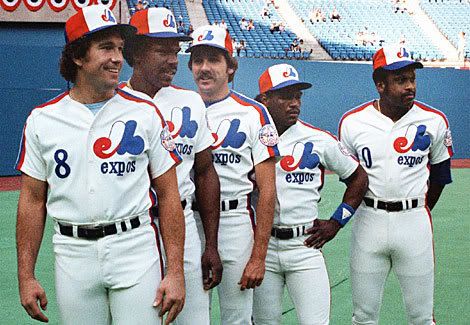
Out of Left Field is looking over the legitimate candidates for the Baseball Hall of Fame during the lead-up to the big vote on Jan. 12. Former Expos great Andre Dawson (second left in picture, beside the next manager of the Blue Jays) is getting closer to induction after receiving 65.9% support in 2008, his seventh try.

The biggest piece of context with Andre Dawson is that he was touched by the Mickey Mantle myth, which is a good thing.

Who knows, maybe sports talk radio has sucked the sympathy out of fans. The biggest piece of context with the great Expos outfielder is that he performed for a generation who had grown up on stories of athletes whose careers were cut short They knew the litany of legends whose careers had been cut short by bad knees -- Mantle, Bobby Orr in hockey, Gale Sayers and Joe Namath in football. It went double for him, since he was playing on the "concretelike turf of Montreal." (Sports Illustrated, June 15, 1987.) That should preface anything said below.

That was a very real phenomena that maybe isn't fully appreciated when you look through a stathead lens and see only the just-okay numbers -- 438 homers, 1,373 runs, 1,591 RBI, .323 on-base percentage. A gut feeling is that Dawson might make in this time. Getting past the 65% mark usually means it's inevitable a player will get the 75% needed for election.

Summing him up in three sentences: Eight-time Gold Glove winner. Won the MVP in 1987; was runner-up in 1981 and '83. One of only six players with 400 career home runs and 300 stolen bases.

Was he ever regarded as the best player in baseball? Did anybody, while he was active, ever suggest that he was the best player in baseball?

No, although he might have been one of the most respected men in the game.

Was he the best player on his team?

Dawson was a full-time player for 16 seasons and led his team in on-base plus slugging (OPS) only five times (1980, '81 and '83 with the Expos and '87-88 with the Cubs), which is low for someone who batted third or cleanup. Gary Carter was the runner-up for MVP in 1980 and Tim Raines had a monster season in 1983 -- 133 runs scored, 90 stolen bases, .393 on-base percentage.

That leaves Dawson with three seasons where he was his team's best player. One was strike-shortened.

Was he the best player in baseball at his position? Was he the best player in the league at his position?

He might been the best centrefielder in the majors in 1981. That was really the only season where he was the dominant player at his position. He was MVP runner-up to another centrefielder, Dale Murphy, in '83. In 1987, when Dawson was MVP (by that time, he had moved to rightfield), Darryl Strawberry was far more productive (.284/.398/.583) in Shea Stadium than Dawson (.287/.328/.568) did playing at Wrigley Field.

Did he have an impact on a number of pennant races?

He had an impact on four -- 1979, '80, '81 and '89. He had strong Septembers in '79-80 when the Expos were nosed out for the NL East pennant in the final days of the season (no one remembers it this way, but the team had strong finishes). He had a so-so final month in 1981, but on Sept. 21, homered in the 17th inning to give the Expos a 1-0 win over the Pirates; by the margin of that victory, they beat the Cardinals out by a half-game to win the second-half title.

Was he a good enough player that he could continue to play regularly after passing his prime?

Yes, he played until he was 41 years old and had his last season as a regular at age 39. The last six seasons of his career basically broke down to two average seasons with the Cubs, two seasons DHing about 80% of the time for the Red Sox and two seasons as a part-timer with the expansion Florida Marlins.

Is he the very best player in baseball history who is not in the Hall of Fame?

No. Raines, Ron Santo and Alan Trammell among others would rank ahead of him.

Are most players who have comparable career statistics in the Hall of Fame?

Five of Dawson's 10 comparables are in Cooperstown: Ernie Banks, Al Kaline, Dave Winfield, Billy Williams and Tony Pérez. Banks hit more than 500 homers, while Kaline and Winfield each made it to 3,000 hits, so they had no problems being inducted, plus they each played in big makrets. Williams needed six years to be elected and Pérez, who was a controversial, borderline case, got in on his ninth try in 2000.

Do the player's numbers meet Hall of Fame standards?

The magic 8-ball would say, "Outlook kind of hazy." His Triple Crown stats -- .279 average, 438 homers (only three seasons with more than 30), 1,591 RBI -- are such that you'd be looking for other stuff to put him over the top.

He's in a no-man's land when it comes to the HOF Standards test, scoring 44.1 -- not a lock, but more than a non-starter, and better than Jim Rice. He fares better on the HOF Monitor.

Is there any evidence to suggest that the player was significantly better or worse than is suggested by his statistics?

The testimonials to how he played through pain and had a throwing arm that was "legendary" (to quote Scott Miller, who's apparently a big Barney Stinson fan) suggest he was better than the numbers indicate. Contemporary evidence, namely that garden-variety .323 OBP, help make the case for "worse."

Joe Posnanski has debunked the myth that players of Dawson's vintage would have walked more if they had just appreciated the value of base on balls and a good on-base percentage. Poz found that walk rates have not budged in the past 30 years. The argument also falls apart when you compare Dawson's career OBP to other home run and RBI champions from the 1980s and early '90s. You could look it up.

Is he the best player at his position who is eligible for the Hall of Fame but not in?

No. Among centrefielders who played at the same time, there's Murphy, and there's Dwight Evans among rightfielders, to name just a couple. In the New Historical Baseball Abstract, James lists him as the 19th-best rightfielder, behind non-Hall of Famers Dave Parker, Bobby Bonds, Bobby Murcer and Ken Singleton.

How many MVP-type seasons did he have? Did he ever win an MVP award? If not, how many times was he close?

He had a MVP-like season in '81 (.302, 24 homers, 64 RBI, .553 slugging in the strike year) and again in '83 (.299-32-113, plus 104 runs scored and a Gold Glove). He won the award in the 1987, but in this day and age, he might not have won.

Nineteen eighty-seven was actually a watershed moment when it came to MVP voting: It was the last time that RBI champs were both MVPs. Neither Dawson of the Blue Jays' George Bell was the best player in their league.

Dawson had a ridiculous home/road split (1.041/.768). That was also the last full season of day baseball in Chicago, and he OPSed 1.016 by day and a .687 -- paltry -- by night. Sportswriters now would have made a much more informed choice.

How many All-Star-type seasons did he have? How many All-Star games did he play in?

He probably had about nine All-Star-type seasons. He was not picked in 1980 when he hit .308, scored 96 runs and had 41 doubles for a 90-win Expos team, but he was a near-automatic pick until he reached the other side of the hill.

Did most of the other players who played in this many go to the Hall of Fame?

Probably.

If this man were the best player on his team, would it be likely that the team could win the pennant?

A lot would have to go right for that to be the case -- like having Gary Carter and Tim Raines on your team.

What impact did the player have on baseball history? Was he responsible for any rule changes? Did he introduce any new equipment? Did he change the game in any way?

There was the matter of that blank contract he showed up at spring training with in 1987. It did prove to be a smoking gun in the players' collusion case against the owners.

Did the player uphold the standards of sportsmanship and character that the Hall of Fame, in its written guidelines, instructs us to consider?

He would not have got this close without it and there is not a thing wrong with that statement, other than the poor quality of the narration. Keep your fingers crossed he goes in at the same time as Jim Rice, to mitigate the Masshole love-in.

Post-script: Rob Neyer tackled Raines vs. Rice in an interview yesterday with Fire Brand of the American League.
"I can't support Jim Rice's Hall of Fame candidacy because I don't believe he's among the 20 best left fielders in major league history, or even among the five best corner outfielders who are today not in the Hall of Fame. Just to make the most obvious argument, Rice wasn't nearly the ballplayer that Tim Raines was. That's objectively true, and it's frustrating to me that so many Hall of Fame voters believe that Jim Rice was a great player, but Tim Raines was not."
Related:
Upon further review, Hawk belongs in Cooperstown (Scott Miller, CBS Sportsline)
My Hall of Fame Ballot -- Henderson, Blyleven, Raines, Morris (Dan Graziano, Newark Star-Ledger)
Hall of Fame ballot tests first-time voter (Joe Capozzi, Palm Beach Post)

Tuesday, December 16, 2008

Zen Dayley: Veni, vidi, vici for Vin

It's a trip, on a December afternoon, to watch Vin Scully speak outlined against the backdrop of Dodger Stadium.

Next season will be Scully's 60th calling Dodgers games, and judging from what he's saying, it could be the last one: "Certainly I'm very aware that the wolves are getting closer to the campfire, and I know that I've spent a lot of yesterdays and I have just a certain amount of tomorrows," he said. "I'm taking it day by day and year and year, so God willing, I will go through 2009 and then we'll just have to wait and see."

It's probably too glib by half to say that he is kind of the broadcast booth's equivalent to Johnny Carson, someone whom everyone knew and respected, even if they didn't tune into him all the time. In Scully's case, he even staked out Southern California 14 years before Carson, since the Dodgers moved west in 1958, 14 years before The Tonight Show.

Hearing Vin Scully string out the word "marvellous" brightens the day, that's for sure (hope this clip embeds properly). Broadcasters have to learn to read and write before they learn to speak (just like writers have to learn to watch and listen), and Scully, in his word, is a marvellous example.

Something is up

The cryptic sentence of the day, from Brew Crew Ball:"The Padres and Blue Jays both might sell for less than the combined contracts of CC Sabathia and A.J. Burnett." (Emphasis mine.) What are you guys saying?


Very Brave

Bringing in the veteran Rafael Furcal and having him displace 26-year-old Yunel Escobar at shortstop seems too chancy by half.

Someone was bound to take a chance that Furcal can play a full season. Escobar, who's going to get moved to either second base or traded, drew good reviews for his fielding last season. His .288/.366/.401 slash stats would have looked better if he hadn't gone in the tank in July.

Furcal is the better player if he can play a full season, but that's a big if to contemplate.

This, that and the other
  • Langley, B.C.'s Brett Lawrie is rated as the third-best prospect in the Milwaukee Brewers system. Minor League Ball notes that he was taken down a peg due to his lack of a defined defensive position, but the Brewers haven't done too badly with bringing along hitters and moving them around in the field (Ryan Braun, Bill Hall).
  • If it's any consolation, Rob Neyer didn't like the Yankees giving a five-year deal to A.J. Burnett: "(Burnett)'s not reliable, and the Yankees have pretty obviously overpaid. Too many dollars, too many years. If the Yankees wanted an impressive fifth starter, they probably could have spent a little less money for a slightly better pitcher. But what's a few million dollars to the Yankees?"
  • The Yankees probably still need to sign Mark Teixeira to really challenge in 2009.
  • The best takedown you will ever read of the sportswriters who are lobbying for Jim Rice to get into the Hall of Fame.
  • A six-word argument for why the Blue Jays should not try to trade Roy Halladay: "The Padres couldn't trade Jake Peavy."
  • No word of a lie, Hall of Famer Rollie Fingers' mustache actually has scared small children.

Friday, November 14, 2008

Zen Dayley: Some real howlers about the underappreciated

The larger point with Cliff Lee vs. Roy Halladay --is that we have no idea where fans' understanding of baseball is heading.

Lee, the Cy Young Award winner over the Jays' talismanic tall right-hander, put up numbers -- 2.54 earned-run average, 22-3 record -- that, if he had not won, you might imagine people looking at in 20 years and saying, "How did he not win the Cy Young?" It's a good ketchup answer that sort of shuts out any fresh insight. In 20 years, it could just as easily be, "How did Halladay not win when he faced the second-toughest hitters and Lee faced the second-weakest?"

Rob Neyer has written a pretty good analysis of Lee vs. Halladay, mostly in reaction to a column out of Toronto on the subject. It appears the latter writer has pulled the same stunt in five years ago when then-Jay Carlos Delgado was edged by Alex Rodríguez for the MVP award, going against his principles to stump for the hometown player.

Neyer's piece might be firewalled. ESPN is doing pretty well financially, so here's what he had to say, in its entirety:
"(Name redacted) somehow has missed the single best argument for Halladay: He faced better hitters. He faced significantly better hitters.

"This year in the American League, 39 pitchers pitched enough innings to qualify for the ERA title.

The hitters Halladay faced finished the season with a .766 OPS, No. 2 out of 39.

"Lee's opposition finished with a .735 collective OPS, No. 38 out of 39.

"There are 14 teams in the American League. Quick and dirty, we can split them down the middle; the top seven teams in the league are the Good Hitting Teams, the bottom seven the Poor Hitting Teams. Of Lee's 27 starts against American League teams, 14 came against Poor Hitting Teams. Of Halladay's 30 starts against American League teams, only 12 were against Poor Hitting Teams.

"The best-hitting teams in the AL were the Rangers and the Red Sox. Halladay started against them seven times; Lee, just three times. The worst-hitting teams in the AL were the Royals, the Mariners, and the Athletics. Lee started against those teams nine times; Halladay, only four times."

(Editor's note: What would Doc have done if he got to face the Jays' hitters?)

"Halladay pitched 23 more innings than Lee, against tougher competition. He walked five more batters than Lee, and struck out 36 more. Halladay completed nine games; Lee completed four.

"Now let me make the argument for Lee, without even mentioning wins and losses.

"There's not much difference between their ERAs: 2.54 for Lee, 2.78 for Halladay. If Lee had given up six more earned runs all season — just one earnie every month — their ERAs would have been identical.

"But unearned runs count on the scoreboard, too. Lee gave up only five of them, and Halladay gave up 12. Add everything up, and Halladay gave up 20 more runs than Lee. Halladay's 'run average' — all runs included — was 3.22; Lee's was 2.74. That's a significant difference, in a conversation like this. We've grown a lot, we baseball fans, over these past 25 years. But we continue to completely ignore unearned runs, and there's really no reason for it.

"There's no wrong answer here, though. Superficially, Lee's numbers are more impressive. Dig a little deeper, and Halladay's are almost exactly as impressive. If you could have one of them for one game tomorrow, you'd have to pick Halladay. But the award's not given for talent. It's given for performance, and Lee's performance was almost exactly as impressive as Halladay's.

"Lee won the award, because baseball writers have traditionally favored Cy Young candidates who win a great number of games and lose very few. Lee won more games than Halladay, and lost many fewer. (Name redacted) is a traditionalist, usually. I can't avoid the sneaking suspicion that if he covered any team but the Blue Jays, he would be throwing his full support behind the guy who went 22-3."(Emphasis mine.)
Not to be too repetitive, but as noted in the summer, Lee winning is like when Brigham Young was voted NCAA football champions in 1984.
"They had to, though, since BYU was the only unbeaten. The baseball writers might not want to vote for Lee ... At the rate he's going, though, they might have to vote for him.
If memory serves, that "how did he not win?" line of argument had some currency in 1997, when the National League MVP debate was between Larry Walker, Mike Piazza and Jeff Bagwell. Walker, who hit .366 with 49 homers and 130 RBI while playing in the thin air of Denver, won in a landslide, taking 22 of 28 first-place votes. The two future Hall of Famers who each played in pitchers' parks split the other six.

It was less understood at the time that Piazza had a better park-adjusted OPS+ (185 to 178) as a catcher than Walker, a corner outfielder (true, Piazza was not much of a catcher, but he still contributed more to his team's overall defence than Walker would have in right field, and more important, he was all man). Walker might have still got the MVP, but with 2008 standards, it might have been a closer vote.

(Update: Joe Christensen and Geoff Baker were two of the writers who gave Halladay a first-place vote.)

O Overbay, where art thou?

Jon Hale
at The Mockingbird has done a takedown on the whole notion of jettisoning Lyle Overbay. So what if he doesn't "do everything?"
"It’ll be a great PR move because it 'goes right after' the main problem of last year, but just like spending 55 million bucks (for B.J. Ryan in 2006) on the most highly overrated position in the game in a knee-jerk reaction to the Miguel Batista closer experience, if J.P. (Ricciardi) forgets that the whole reason he pushed hard for Overbay in the first place was that he is more valuable than he looks to the HR-duhhhh-RBI crowd and wastes money just to get him off the team, it will ... thus be punished accordingly."
A Toronto team make a move with more of an eye to PR than wins and losses? It's never happened.

Related:
Lee, Halladay really performed equally well (Rob Neyer, ESPN.com)

Wednesday, September 10, 2008

Zen Dayley: Method to the madness for the amazin' Rays

The playoff races are fully on, so there will be some Zen Dayley, nightly, from here on out through the World Serious.

It seems like an all-time Deus ex machina.

Dan Johnson arrives directly from Triple-A and hits a game-tying, ninth-inning homer off Jonathan Papelbon at Fenway Park. It ultimately kept the Tampa Bay Rays, who went on to win 5-4, in first place in the AL East, at least for another 48 hours. As a side benefit, it was a wicked burn on the smart alecks who have been forecasting the Rays' demise on a daily basis, since they -- all together new -- don't know how to win. It might be new to their players, but when it comes to robbing the Red Sox, Tampa's front office has the joint cased.

It need not be said that Johnson's hit is the stuff people cling to when they tell and retell the story of dramatic playoff races. He barely got out of Scranton, Pa., where he was with Tampa's Triple-A team, was kept from getting to Fenway when his cab got caught in Boston traffic nd had to be scratched from Tampa's lineup. Also, get this -- Johnson started the season by sitting on the Oakland A's bench when they were the designated opponent for the Red Sox during their trip to Japan. He travelled all that way, didn't get to play in either of the regular-season games in Tokyo and was let go by the A's

There's all that, but last night showed how the best playoff races are these Russian-novel-thick histories. The Rays winning a big game where Johnson and another Triple-A callup, Fernando Perez, who singled and scored the winning run, illustrates what that franchise does so well.

It's kind of convenient to the narrative that the Red Sox were by virtue of a two-run homer in the eighth by Jason Bay, whom the Rays tried and failed to get at the July 31 trade deadline. This is good a time as any to point out that even through he's had 31 RBI in 30 games since going to Boston, Bay's hitting about the same as he usually does. A right-handed hitting RBI man for the Red Sox is always going to have a lot of ribbies -- see Rice, Jim Ed.

The Rays ended up countering through a couple of lesser lights, Johnson and rookie outfielder Fernando Perez, who following the homer doubled and came home with the game-winner on Dioner Navarro's double off the Green Monster.

Honestly, who but the most godforsaken baseball geek knew Johnson was in the Rays system? There are dozens of guys like him floating around between Double-A and the majors. Teams keep them in the system because they have offer just enough in power and on-base percentage that they can hit as well as anybody for a week before they tumble back to earth. The Rays were smart enough to scoop him up and have in Triple-A Durham, almost as if they were saving him for just such a moment in September. That speaks to the kind of roster management they practise, while certain other AL East teams have been farting around with Brad Wilkerson and Kevin Mench.

It's similar with Fernando Perez. His main claim to fame is that he's a rare position player out of the Ivy League (Columbia; other than Doug Glanville a few years ago, the Ivies are more known for producing pitchers and wildly unpopular presidents). He's been blocked by the Rays' surfeit of outfielders. Tampa will probably offer him up in a trade at some point soon and someone will take him, since he's got leadoff guy skills (.361 on-base percentage, 78% stolen-base success rate in Durham this season).

To sum up, there's two subtle moves that paid off for the Rays in lieu of one headline-grabber. It's not terribly sexy, but it got the job done.

There's still the drama, though, which is amped all the more by the fact Dan Johnson was 0-for-15 as a pinch-hitter. On the same day, the Oakland A's also released the Mike Sweeney, the first baseman/DH they kept instead of him.

(It's no, "And all of a sudden the ball was there, like the Mystic River Bridge, suspended out in the black of morning" -- which was Peter Gammons' lede after Game 6 of the 1975 World Series, the Carlton Fisk game, but the unadulterated joy comes through all the same in DRaysBay's account. ShysterBall is also recommending reading this morning.)

Errara
  • Why Carlos Delgado -- two more homers in a big Mets win last night! -- should not be National League MVP, in 25 words or less ... You don't think the New York Mets would have a bigger lead if they had either Lance Berkman or Albert Pujols at first base instead of King Carlos?

    Twenty-five words -- bang on! Here's the numbers:
    King Carlos: .266/.350 /.518, 35 HR, 103 RBI, 83 runs
    Prince Albert: .361/.467/.655, 33 HR, 98 RBI, 89 runs
    Lance: .331/.403/.633, 28 HR, 100 RBI, 109 runs
    There is a precedent for a veteran first baseman on a NL East team being voted MVP by virtue of being absolutely nails in the second half -- Willie Stargell in 1979. It's a bad, terrible precedent, though.
  • The L.A. Dodgers making the playoffs, well, that would be the new definition of obscenity.

    L.A. and the Arizona Diamondbacks are each below .500 outside their terrible division, yet one of them will wake up on Sept. 30 seven wins away from a spot in the World Series.

    With playoff teams like that, it's almost an argument not to care too much about whether the Jays ever make the playoffs again. Making the playoffs out of either West division is like winning a Grammy.
Damn, the Jays
  • Ten wins in a row. Oh right, it doesn't matter.
  • Travis Snider outpolled the Rockies' super-outfielder Dexter Fowler 64-35 in a "Who would you rather have?" poll at Minor League Ball.
  • FanGraphs has some details on the Jays' catcher of the future, J.P. Arencibia. The best way to quit drinking is to do a shot every time Arencibia draws a base on balls.

    (He's a bit of a free swinger. That's the joke.) The Tao has some choice words for anyone who believes that Jays' win streak is moot.

    Winning when the pressure's off is a canard. I got disabused of it several years ago, and man, I had it coming.

    Rob Neyer from ESPN.com had just come out with his Big Book of Baseball Lineups. On his website, he'd set up a page on his website where eagle-eyed baseball obsessives could alert him to tiny factual errors. (What it says about someone who has to be the one to poit out that Tony Batista hit 41 home runs in 2000, not 45 -- who cares, did it take away from the enjoyment of the book, really? -- is best left unsaid.)

    Neyer had flubbed some picayune detail about the 1988 Blue Jays, who as he had written, came within two games of winning the AL East. An e-mail was quickly sent, but it pointed out, "The '88 Jays were never a contender -- they were under .500 at the start of September and went on a window-dressing 22-7 run to get to a final 87-75 record."

    Neyer's rebuttal was that any team which finishes two games out was close to winning the pennant.

    Remember, the better the Jays' record, the more it validates the self-righteous indignation Jays fans will feel in about a month when some National League team is playing for a spot in the World Series.
  • Scott Downs should stay in the bullpen. Don't mess with success.
  • It's sounding like it's not such a sure thing that the Jays will put their farm team in Buffalo. They might end up in New Orleans.

    (It's all hands on deck in Syracuse to get a deal done with the Mets.)

Thursday, July 03, 2008

Top 5: The Best Teams No One Saw Play

The Tampa Bay Rays having the best record in the American League and the second-worst attendance, that fairly demands brushing off the Top 5, doesn't it?

Yes, it's completely arbitrary; no, there isn't a lick of logic to making up this list. Get over it. The Rays attendance is picking up, with 101,000 fans passing through the turnstiles for their three-game sweep of the Red Sox. There's no time like the present to get this list out of the way.

First off, let's lay down some ground rules. Let's keep this to the past 40 years or so -- the sportscape that existed in the first two-thirds of the 20th century is way too labryinth-like for anyone born after 1975 to understand. (The great Negro Leagues teams might not be remembered the same way as the 1927 New York Yankees, but they did draw a crowd wherever they went.) Anyways, here's the Top 5, after the jump.

NFL: St. Louis Rams, 1999
The way it's remembered is that typical Sunday of football-watching in 1999 would include 30-45 seconds of Kurt Warner -- who? wasn't that the guy who played running back for the Seahawks in the '80s? -- humming four touchdown passes through some befuddled defence. That was about all you got to see of the Rams before the playoffs. Surprisingly, a Midwestern team coming off a 4-12 season didn't not scream "dream Monday Night Football matchup to network executives. The Rams weren't slotted for any national TV appearances and the flex scheduling which had the Patriots playing in prime time almost every week last fall was several years away. Unless you lived in Missouri or went to a game, you didn't see St. Louis' best.

These days, with Football Outsiders and such, you probably would have at least read somewhere the Rams, who were 45-99 for the 1990s, might become the New New Thing. If there was any warning, it was largely missed.

COLLEGE FOOTBALL: Oklahoma Sooners, 1973-74

Barry Switzer
's turn at the coach at Oklahoma was bookended by the Sooners spending time on NCAA probation. Funny.

The future Dallas Cowboys coach inherited the top job at Oklahoma in 1973 after an academic scandal led to the turfing of Chuck Fairbanks. The Sooners' punishment included a ban on having any games televised or going to a bowl in '73 and '74, but during that time they racked up a record of 21 wins, zero losses and one tie. The 1974 team, led by brothers Lee Roy and Lucious Selmon, has the sole distinction of being the only team to win a share of the national title while on probation, since one poll refused to rank the Sooners altogether.

That snub, justified as it might have been, might have fired up Oklahoma to win the national title outright the following season. (Incidentally about that 1973 season: Seven teams in major-college football finished the regular season unbeaten. Just imagine the outcry if the Bowl Clusterfuck Series had existed then.)

BASKETBALL: Oakland Oaks, 1968-69

The Oaks weren't the most dominant single-season team in the short life of the ABA, but they were the only one which promptly relocated after the winning the championship, which is good enough. Despite having Hall of Famer Rick Barry during that championship season, the Oaks, competing in the same market against the NBA's Warriors, could only average 2,800 fans per game, hastening a move to Washington.

HOCKEY: Winnipeg Jets, 1977-78

A WHA team has to be in here. The league never had a national TV deal and would feature thirty-two different franchises. The Jets, with Bobby Hull skating alongside Swedish superstars Ulf Nilsson and Anders Hedberg on one of the most potent forward lines in hockey history, must have played in some pretty empty arenas. They were the precursor to both the high-octane Oilers of the 1980s, and with as many nine Scandivanians in their lineup, the 2008 Detroit Red Wings, but most of what they did lives on only in anecdote. (Neither Hedberg or Nilsson is in the Hall of Fame.)

The '77-78 team takes the prize. The Jets of two seasons earlier might have been more dominant in the regular season, but the '78 crew beat the Soviet national team in an exhibition game (the Hull-Hedberg-Nilsson line scored all five goals in a 5-3 win). Thing is, only 10,315 were there to see it. That edition of the Jets, with Kent Nilsson on the second line, also had four 100-point scorers. Factor in that the WHA was down to eight teams by that point and was just trying to hang on for a merger with the NHL, and the Jets are a shoo-in.

BASEBALL: Oakland A's, 1972-74

Charlie O. Finley
was kind of the original Mark Cuban -- a self-made man who could be the worst owner in sports and the best owner in sports within the span of a single day. Convincing the American League to add the DH and having a team that won three straight World Series fell under the heading of "best." Coming up with By 1974, though, despite having a dynasty on the field, they were next-to-last in the American League in attendance, since Finley had the same aptitude for marketing as Kirk Van Houten did for managing a cracker factory.

As Rob Neyer related in his Big Book of Baseball Blunders, Finley "thought he could sell tickets like he sold insurance, so shortly after taking over the A's, he spent $100,000 on brochures mailed out to 600,000 people ... The result? Twenty thousand dollars in ticket sales."

For a time, a student radio station whose broadcast range petered out about 10 miles from the A's ballpark was the team's flagship station. (Just imagine a student station having the rights for an Ontario Hockey League team, never mind a NHL team.)

The A's were great largely thanks to Charlie Finley, and largely unwatched thanks to Charlie Finley.

That's all for now. Send your thoughts to neatesager@yahoo.ca.

Friday, June 20, 2008

The change it had to come, we knew it all along

It's almost as if the Blue Jays have morphed into the Leafs -- reaching back into the past, the one place where it can't get any worse.

There's a strong whiff of cynicism behind this Flashback Friday -- Cito Gaston and Gene Tenace are in as interim manager and bench coach (so is Nick Levya!); John Gibbons out, with coaches Gary Denbo, Marty Pevey and Ernie Whitt are following him out the door.

This has the sickly scent of Paul Godfrey — focusing more on the optics than whether it actually makes sense. Also, the next Flashback Friday game will be a managerial matchup of Gaston vs. the Atlanta Braves' Bobby Cox.

Granted, Gibbons had to go, since any change would do a 35-39 team good. The question becomes what this heralds, ideally beginning with J.P. Ricciardi probably getting the bum's rush after this season and assistant GM Tony LaCava taking the reins of an organization that would actually be serious about scouting and player development. But it's more likely this is just a bit of a facelift, a cosmetic change, something Godfrey would know all too well about.

It just so happens that Jayson Stark of ESPN.com has a handy-dandy list of up-and-coming manager and GM candidates. Personal preferences among the managerial candidates include Brad Mills from the Red Sox (although he', former Cleveland coach Joel Skinner and one-time Ottawa Lynx manager Pete Mackanin, who didn't really get much of a chance with the Reds. Among the GMs, staying in-house for LaCava doesn't seem so bad, especially since the Jays' farm system is improving.

(Update: Rob Neyer was on The FAN 590 around 2:45 Eastern and suggested that it's likely Ricciardi returns in 2009. That doesn't fill one with confidence.)

Tuesday, January 22, 2008

SUPER, THANKS FOR ASKING

A Super Bowl-related post, a couple days late and a couple dollars short (he typed, enveloped in self-loathing):
  • A new word has to be coined to describe the experience, as a Minnesota Vikings fan, of watching Brett Favre blow it big-time: Schadenfreulicious.

    It was easily the biggest flop in a conference championship game by a heavily favoured home team (non-Bill Cowher division) since the 1998 Vikings. It's a pain that never ends.

    Hey, it was said here, after Week 1, that Green Bay "has enough D to get to (the) 10 or 11 wins it will take to win this division before Favre throws it away in the playoffs." Even with the typo, there's proof if you put it vaguely enough, eventually you'll look like a prophet.

    Basically, that meant a long season of being Coach Kilmer from Varsity Blues to Favre's Jonathan Moxon: "Keep it up, a--hole." Obviously, there's more to it than Favre (Mike McCarthy forgot to put running plays in the game plan, the Packers couldn't complete any of those crossing routes like they had all year and it was really too cold to play).

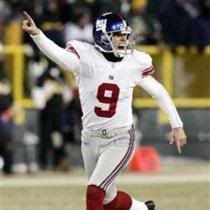
    Still, who knew it would all come together? Favre and the Packers lose to a team that the Vikes destroyed in the regular season. OK, so it means the Giants are playing in their second Super Bowl since 41-doughnut, but Vikings fans can handle the irony, especially since Randy Moss should surpass his numbers from the 2000 NFC title game (two catches, 18 yards) on the Patriots first drive.
  • The irony of spending much of yesterday pointing out the errors and omissions of one Ottawa media outlet was that it pushed back pointing out the errors and omissions of another Ottawa media outlet by a day.

    CTV Ottawa did a fine job with the simulcast of the conference championship games, so long as you didn't expect to be able to see every play of a game or the New England Patriots locker room celebration after becoming the first NFL team to be 18-0 during a season.

    This actually happened: The clowns tried to jam in a newsbreak when CBS went to a commercial after the third Patriots touchdown. That meant viewers got to see a bunch of workers flooding the Rideau Canal instead of the ensuing kickoff, which for all we knew, could have been returned for a touchdown. When they returned to the game, the Chargers offence was already at the line of scrimmage for the next play.

    After the Pats won, CTV immediately cut away from CBS -- without showing the trophy presentation or getting any post-game reaction -- to go to Fox's pre-game for the Packers-Giants NFC game.

    You'll remember, of course, that at the two-minute warning the Giants had the ball and were trying to get in range to kick the winning field goal. CTV Ottawa came back late from the commercial break -- just had in a promo for one of those 250 spin-offs of CSI or Law & Order that had already been shown 63 times that day -- and missed a 14-yard pass play that got the Giants closer to field-goal range.

    It might be moot since the drive ended with a Tynes miss. Still, it's infuriating that year after year that something so simple gets screwed up by the Canadian rights-holders for the NFL, who reap huge profits from simulcasting the games while creating nothing of value.

    On a related tangent, Greg Layson of the Guelph Mercury points this out: What are Canada's three sports networks airing on Saturday night, when Carleton and the U of O will be playing in front of perhaps the largest crowd ever to watch a university basketball game in this country?

    Poker and UFC on Sportsnet, some X games-like thingy on TSN and a NBA game on The Score.

    That said, you can't blame 'em for being small-town-cheap. Canadians tend to look down on watching our own compete against each other, with the exception of the NHL, CFL and curling.
  • Nice of Fox anchor Curt Menefee to diss the CFL when discussing Giants hero Lawrence Tynes, saying, "he went to the CFL, then he went to NFL Europe." Not only was it incorrect (Tynes played in NFL Europe before joining the Ottawa Renegades), but implied the CFL is a poorer brand of football than the since-discontinued developmental league.
  • No word of a lie: Eli Manning's quarterback rating in the regular season was exactly the same as Rex Grossman's in 2006. Try not act too surprised if he regresses badly next season.
  • You can't make this up: Brett Favre's wife's maiden name? Tynes.

(How's this for synchronicity? On Sunday, Favre messes up the playoff game, which is great to watch as a Vikings fan. Monday, Rob Neyer from ESPN.com links to a post here. Tuesday, upon finally getting around to writing a post about it, a Google search reveals an article where Neyer, a baseball guy, professes that he too is a Vikings fan, even though he didn't grow up in Minnesota.)

Tuesday, December 11, 2007

Blog blast past: Rob Neyer don't need no stinking badge to Rock the vote

As noted below, the Baseball Writers' Association of America took a big step today by letting in web-based writers -- Rob Neyer and Keith Law from ESPN.com, along with Will Carroll and Christina Kahrl from Baseball Prospectus. From Dec. 11, 2007, here's a look at how having a few more "neostatistican" writers -- Murray Chass' word -- consider the candidates could influence who gets into the Hall of Fame in future years.

Tim Raines is caught in the middle of baseball's culture war.

As you know, the patron saint of Canadian seamheads (check out the writing chops of the creators of raines30.com, a catchbasin for all the Raines arguments), is on the Baseball Hall of Fame ballot for the first time. It comes as the pitched battle between the new-gen web writers -- most of whom would put Raines in the Hall in a heartbeat -- and the old guard among the BBWAA who vote for Cooperstown has hit its all-time pissiest.

It's taken until now for the BBWAA to add Internet-based writers to its badge list (you have to be a member for 10 years before you can vote for the Hall). It's a step forward, and if you care about baseball, it matters. In the same breath, though, last week the BBWAA denied entry to two of the best out there, including Rob Neyer of ESPN.com. The weak defence offered up was that Neyer and his colleague Keith Law, who was also denied, supposedly don't attend many games in person to do their work. Well, two Ottawa Citizen writers are on the BBWAA badge list, and while they earned it, they're likely not attending man games as working journalists these days.

(Note: This was right after Ottawa ceased to be a Triple-A city.)

Neyer especially eats, drink and sleep baseball 24/7/365 and probably spends more time on any given day trying to think of how to define a good or great ballplayer than a dozen newspaper guys who just cherry-pick whatever stats fit their arguments (they know who they are). Yet he can't join the BBWAA and thus vote for who to let into the game's shrine.

Figure that one out. Anyway, Neyer hasn't needed a BBWAA badge to write his acclaimed books (check out page 346 of Baseball Dynasties, where he says, "Any baseball writer who doesn't think Tim Raines is a Hall of Famer should turn in his laptop computer.") However, Tim Raines and other underappreciated players need Neyer, since it's the new-gen writers who understood Raines' greatness best and have been most responsible for spreading the gospel and popularizing the use of stats that explain him better than the traditional ones. (If they stopped counting RBI altogether, I wouldn't lose any sleep.)

When Raines goes into the Hall of Fame, he'll be one of the first inductees who had his on-base percentage, a lifetime .385, cited as a major part of his Hall of Fame argument. He also scored more runs than anyone else eligible for the Hall of Fame who hasn't been inducted.

Just go to baseball-reference.com and check out the annual National League leaders in offensive winning percentage from 1983-87, Raines' peak period. Raines was the only player in the NL who finished in the top five in the NL every year during that stretch.

He did that while playing in a league that included Hall of Famers such as Gary Carter, Tony Gwynn, Ryne Sandberg and Mike Schmidt (who to be fair, was a veteran player by then).

It's not even an argument for the new-gen writers, but meantime, judging from the (just my luck) column Sports Illustrated's Tom Verducci published today, Raines will only get about 50 per cent support, far shy of the needed 75%, this year. It takes time.

The point is that the early adopters, including those who created the Raines site (John Brattain, Craig Burley, Jonah Keri and Tom M. Tango, who were nice enough to cite Out of Left Field) have been a big part of helping people get it with Tim Raines.

The BBWAA did brush off Rob Neyer. There are a few of the old guard who are very threatened by the geeks with their computers. However, they are adapting and it looks like that will help Tim Raines get his rightful place in Cooperstown. It still sucks that it might not happen sooner.

Related:
A Rock-solid case (Tom Verducci, SI.com)
Vote the Rock; Raines absolutely deserves call from Cooperstown (Jay Jaffe, SI.com, Nov. 29, 2007)

(Much obliged to Pete Toms for the links.)