Please skip the cross-border shin-kicking and go straight to what was left out of the contrived debate about Andre Dawson's Hall of Fame plaque.
Dawson went there when, in conversation with a couple Chicago sports talk radio chuckleheads, he said he told the powers-that-be in Cooperstown: "I tried to explain, perhaps, the impact of what really catapulted me to Hall of Fame status, and pretty much what my preference was."
Typically, the articles have stated Dawson played longer with the Montreal Expos (1976-86), but won a National League MVP award with the Cubs. Being a former MVP probably did factor into the BBWAA's Chicago outfit, so-called, keeping his name in the discussion.
However -- and no one seems to talk about this -- Dawson or any Cubs player of that era had one huge advantage in MVP voting. In that era, from the late 1970s through the early '90s, the Chicago Cubs and Atlanta Braves each had almost all of their games broadcast on superstations (WGN and TBS) which were available to most U.S. cable subscribers and parts of Canada. Hear this out.
That wrinkle of the pre-digital era has probably been forgotten. It's been on my mind for a few weeks, but what hat a player has on his plaque is a trifle. I know that, because even as a serious baseball nut, I had to check whether Nolan Ryan represents the Texas Rangers, California Angels or Houston Astros on his plaque.
Everyone has the Internet and can compare traditional and advanced statistics. Serious Seamheads shell out for the MLB Extra Innings package. In Dawson's day, most teams only got North America-wide exposure if they were featured on the NBC Game of the Week, or ABC's equivalent, Monday Night Baseball.
The two franchises' ubiquity on cable TV even seeped into popular culture. There's a circa 1990 Simpsons episode where Homer, moved by Lisa's infectious moralizing, decides to cut the family's illegal cable hookup. Bart rhymes off all the reasons not to, "Monster trucks! Tractor pulls! Atlanta Braves baseball! Joe Franklin!"
Will Ferrell once said he got the idea for a Harry Caray impersonation, because when he came home for lunch around noon California time, he would flip on the Cubs telecasts on WGN.
Before MLB went to three divisions in 1994, it briefly discussed keeping two divisions and having the Cubs and St. Louis Cardinals play in the National League West with Atlanta and Cincinnati moving to the NL East. The Cubs' ownership refused because it would hurt their local TV revenues.
Coincidentally or perhaps not, the Braves and Cubs were overrepresented in the post-season awards in those days. In a 10-year span, 1982-91, those two franchises accounted for five MVP awards, even though only the '91 Braves reached the World Series. Dawson, as you need no reminder, won his award while playing on a last-place Cubs team. The BBWAA also votes for the Cy Young Award. The Cubs had three during that rough timespan (Bruce Sutter in 1979, Rick Sutcliffe in '84 and Greg Maddux in '92 before he won three more with guess who, the Braves).
Picture a hard-working beat grunt from an eastern city in 1987 on a West Coast road swing. He wakes up around 11 a.m. Pacific, understandable after covering a night game. The Cubs, who still played all day games at home, would be on TV. He would see Andre Dawson hitting all those home runs (49 that season, the most any player had hit since George Foster slammed 52 in 1977) and driving in all those runs, and it's not hard to go from there to casting a MVP vote for him, even though the Cubs could have finished last without him.
That is not meant to call out anyone well after the fact. The very definition of availability bias is people tend to go with the first information they receive. It's good to dig or try to build a more layered argument, but who has the time? They went with what they got first and it has carried down the line.
You can even see it in the coverage now, which typically has omitted that Dawson was second in MVP voting twice while with the Expos (1981 and '83 behind Dale Murphy of, wait for it, the Atlanta Braves). His only other top-10 finish also came in Montreal. That has been left out, even in Canada, since many media outlets just run the same wire service articles as every other website as part of their strategy for giving users something unique.
Dawson being MVP runner-up in Montreal twice, in a sense, is more impressive than winning it once in Chicago. The Expos were an afterthought to U.S. media and fans. Allen Barra once wrote that Tim Raines being selected to seven all-star teams while playing for Montreal was like winning the Pulitzer Prize while writing for a newspaper in North Dakota. It is somewhat Sisyphean to explain this to most Americans, who tend not to realize the one-sided natures of their conversations of the rest of the world (Eddie Izzard: "... in other countries; you do know there are other countries?).
The short answer is Cooperstown got this right and if you want to go there, it is a little pathetic for Chicago media to put a waiver claim in on Dawson's legacy. Far be it to say that's their egotism talking. Just now, Chicago media personality (and former Raptors TV voice) Chuck Swirsky was on the FAN 590 in Toronto, his former station, saying "the majority of baseball fans" remember Dawson as a Cub and that he performed "on the biggest stage in baseball, Wrigley Field," which hasn't hosted a World Series game since the year the Second World War ended. Please. That's just a reflection of selective memory.
Canadian sports likers get to see the Expos get a day in the sun. (Colby Cosh had the best line on Twitter: "The Andre Dawson news is great. Haven't been this happy since Ugueth Urbina announced he would enter prison as an Expo.")
The larger point is that in honouring past greats, baseball writers and fans tend to let themselves be controlled by factors they should be controlling for. They get caught up in whether someone lasted long enough to reach some arbitrary round number (300 wins, 500 home runs, 3,000 hits), or how he fared in MVP voting. We are well-aware how media members who votes for awards of this nature are fallible.
However, there probably hasn't been enough attention devoted to how playing for a team which had games aired coast-to-coast helped Dawson in 1987. He got a MVP award, and that helped keep his name out there until he was finally elected. Not that there's anything wrong with that, so long as it's properly acknowledged.
Related:
Dawson may wear Cubs hat for speech (ESPNChicago.com)
Showing posts with label Andre Dawson HOF. Show all posts
Showing posts with label Andre Dawson HOF. Show all posts
Wednesday, January 27, 2010


Tuesday, January 05, 2010
Confidence bordering on obnoxiousness with Alomar, Dawson
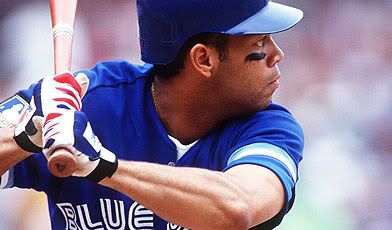
Roberto Alomar and Andre Dawson, a Blue Jay and an Expo, forming the Baseball Hall of Fame's 2010 induction class — it could happen.Thank goodness Cooperstown is only a four-hour drive from a border crossing, eh!
— some fat, dumb and bald guy this time last year
Roberto Alomar is overqualified for the Baseball Hall of Fame, if anything. It is almost like you can't feel an euphoria because it's his just desserts.
A gut feeling is he and Dawson receive somewhere around 80% support, which is all it takes. (Terence Moore, one U.S. columnist, says it will be only those two, apologies to Bert Blyleven if that is the case.)
Anyway, Stephen Brunt found the words to evoke the Blue Jays' early-1990s salad days and it is a must-read. Meantime, some Canadian OMDs have finally clued in about two years too late about Expos great Tim Raines' bona fides, and then there are those how try to be authoritative while misrepresenting the facts (Ryne Sandberg was elected in his third year on the ballot).
Throw in the late, great Tom Cheek finishing first in the fan balloting for the Ford C. Frick Award and well, Cooperstown could have that Canada-rama in August, which probably has the people at the Hall of Fame quaking a bit over their bottom line.
Alomar received 11-of-12 votes from staffers at the Chicago Tribune and USA Today, if that is any kind of straw poll.
Just for fun, here is a Keltner test for Alomar which should remove all doubt.
Was he ever regarded as the best player in baseball? Did anybody, while he was active, ever suggest that he was the best player in baseball?
Some time around 1993, Sport magazine ran one of those Barry Bonds vs. Ken Griffey Jr. comparison articles that monthly sports magazines ran to compensate for the time lag (and you wonder why they folded). Tony La Russa said neither, Alomar was the best player in the game. And he's a genius.
Retrospectively speaking, Alomar topped the AL in win shares in 1992 (34) and 1999 (35). That's cribbed from a 2004 Matthew Namee article that notes that around '93, "with the possible exception of Barry Bonds, Roberto Alomar was the most complete package in baseball. He was a switch-hitter who hit for a great average, drew a bunch of walks, had good power. He stole a ton of bases and was rarely caught, and he was a Gold Glove middle infielder.
Was he the best player on his team?
He was the best player on the 1991, '92, and '95 Jays (the latter because someone had to be), the 1996 Baltimore Orioles and 1999 and 2001 Clevelands.
Was he the best player in baseball at his position? Was he the best player in the league at his position?
Yes. He won 10 consecutive Gold Gloves at second base (1991-2000) and added four Silver Slugger awards.
Did he have an impact on a number of pennant races?
He was on seven post-season teams during an 11-year stretch, plus a 90-win Cleveland team which fell one win short of the post-season in 2000.
The '00 Indians were a .500 team at the end of July. They went 40-22 (.645) across the last two months to almost catch the Oakland Athletics, with Alomar hitting a practically Pujolsian .370/.437/.557 to spur the charge.
In 1997, he hit .500/.532/.800 in September to help the Orioles finish two games ahead of the Yankees for the AL East flag.
Was he a good enough player that he could continue to play regularly after passing his prime?
No. The New York media has never let it drop that Alomar hit a wall at age 34 and endured "a discouraging turn with the Mets in 2002 and 2003, when he hit just .265 over 222 games." Ryne Sandberg was 34 when he quit the Chicago Cubs mid-season in 1994; he returned to play two middling seasons.
Is he the very best player in baseball history who is not in the Hall of Fame?
Toss-up between him and Raines.
Are most players who have comparable career statistics in the Hall of Fame?
Five of his 10 most comparable players are in the Hall of Fame and the very much active Derek Jeter is one of the other five, so yes. Alomar and, wait for it, Tim Raines are the only post-1950 players with 1,500 runs scored who have not been inducted.
Do the player's numbers meet Hall of Fame standards?
Alomar's 193 on Bill James' HOF monitor is 47th-best all-time, the highest of anyone who played entirely in the expansion era and entirely at second base. (Joe Morgan is 60th.) Alomar is 50th in HOF standards, putting him in a class with Morgan and Craig Biggio.
Only Bonds scored more runs during Alomar's first 14 seasons in the majors (ESPN.com).
Is there any evidence to suggest that the player was significantly better or worse than is suggested by his statistics?
The fielding stats which are now taken for granted were not readily available in the 1990s. Alomar's fielding reputation might have been inflated, especially since he had benefit of playing more than half his games on artificial turf from 1991-95.
People over the last 10 years have accepted that stolen-base success rates are more important than just raw steal totals, so Alomar's 81% success rate counts for more than his total, 474.
Is he the best player at his position who is eligible for the Hall of Fame but not in?
Biggio is not yet eligible.
How many MVP-type seasons did he have? Did he ever win an MVP award? If not, how many times was he close?
Put it this way: Dustin Pedroia was the American League MVP in 2008 as a second baseman who OPS-plused 122. Alomar had six seasons where he OPS-plused 129 or better, scored 100 runs and received a Gold Glove.
God only knows why he had little traction with MVP voters during his Toronto years, when he finished sixth three years in a row.
He never won the MVP Award. His best finish was third in 1999 (tied with Manny Ramirez and ahead of sixth-place Derek Jeter, who should have won), followed by a fourth in 2001. He also finished sixth from 1991-93 with the Jays, largely since the voters of the day tended to go for RBI guys.
How many All-Star-type seasons did he have? How many All-Star games did he play in? Did most of the other players who played in this many go to the Hall of Fame?
He had 13 all-star type seasons, 1988 and 1990-2001. He was selected 12 times; in 1988 he had the best season ever by a 20-year-old second baseman (The Hardball Times), but was overlooked for the All-Star Game since he started the season in the minors and was playing for a going-nowhere San Diego Padres team.
Off-hand, the 12 appearances ranks well with several first-ballot inductees who played in the AL in the 1980s and '90s: George Brett made 13 all-star teams, then there are Wade Boggs (12), Dave Winfield (12), Rickey Henderson (10), Eddie Murray (8) and Paul Molitor (7). The other same-era second baseman who's in the Hall, Ryne Sandberg, had 10 selections. Barry Larkin played in 12, but one was a courtesy invite in his final season.
Most people who went to the All-Star Game as often as Alomar have gone to Hall of Fame, usually with not much debate.
If this man were the best player on his team, would it be likely that the team could win the pennant?
The '91-92 Blue Jays each won 90-plus games and the AL East. The '96 Baltimore team, the first wild-card entry to win a playoff series, reached the American League championship series. In 1999, Alomar tied for third in MVP balloting while helping Cleveland to a 97-65 record one win off the AL's best.
What impact did the player have on baseball history? Was he responsible for any rule changes? Did he introduce any new equipment? Did he change the game in any way?
None especially, although he was among the many great Puerto Rican players who have reshaped the sport. He would be the first elected (the late Roberto Clemente was a special case).
Did the player uphold the standards of sportsmanship and character that the Hall of Fame, in its written guidelines, instructs us to consider?
Yeah, the spitting incident. Only two lives were really affected by it and John Hirschbeck moved on long ago, telling the New York Daily News recently, "It's long over with and a lot more good has come out of it than you can ever believe. If that was to cost Robbie the Hall of Fame, I would feel awful."
Wednesday, February 11, 2009
Cooperstown crisis; spare the schadenfreude
As an addendum to one of the 317 Alex Rodriguez posts that have run here in the past 96 hours, the Baseball Hall of Fame is a hurtin' unit.
The Hall voters' prefence for one-team ballplayers is also rearing its head here. Ripken helped get 75,000 people because he was a timeless ballplayer identified with one franchise, the Baltimore Orioles. It's telling that Rovell wrote, "Andre Dawson, Roberto Alomar" — this was before the tabloid furore — "and Fred McGriff probably don't get me to make the inconvenient trip up to Cooperstown anytime soon."
(And what country did all those players spend a signficant chunk of their careers in?)
Related:
Biggest Loser From A-Rod Story? (Darren Rovell, CNBC, Feb. 9)
"Induction weekend has the potential to make up more than 10 percent of annual attendance. So you can imagine what happens if you have more weekends like you did last year with Goose Gossage (14,000 people) versus the year before (2007) when Cal Ripken Jr. and Tony Gwynn were enshrined (75,000 people)."The obvious temptation is turn this around and point out the Baseball Hall of Fame is in such a fix because the voting system wasn't totally broken. Don't try to blame this on juice monkey ballplayers and moralizing sports writers. It is certainly valid that the tourist trade in Cooperstown has plenty of reason to worry. The Hall of Fame is kind of built around being a draw for families who piled into the station wagon or Aerostar for a long driving trip, something that is probably going to become less commonplace to due to cost of gas.
— Darren Rovell, CNBC, Feb. 9
The Hall voters' prefence for one-team ballplayers is also rearing its head here. Ripken helped get 75,000 people because he was a timeless ballplayer identified with one franchise, the Baltimore Orioles. It's telling that Rovell wrote, "Andre Dawson, Roberto Alomar" — this was before the tabloid furore — "and Fred McGriff probably don't get me to make the inconvenient trip up to Cooperstown anytime soon."
(And what country did all those players spend a signficant chunk of their careers in?)
Related:
Biggest Loser From A-Rod Story? (Darren Rovell, CNBC, Feb. 9)
Monday, January 12, 2009
Raines '09 — That's the kind of day it's been
Rob Neyer has a post up saying "all hope should not be lost" with respect to Tim Raines' Baseball Hall of Fame chances.
Block-quoting from it almost doesn't do it justice and neither does excerpting anything from Joe Posnanski's post, other than what he said about Tim Raines getting only 22.6%. It would be nice to be as sanguine as FanGraphs ("I can no longer get emotionally invested in it. The process is too broken, the voters too uninformed"). There is so much so much Neyer hits on, especially the cold, hard truth of how Raines and Andre Dawson's careers were marked and marred by the labour wars of their era. His contention is without collusion, Raines might have been National League MVP in 1987, and people would have regarded his career differently. What the hell. One blockquote:
It just goes on. The voters want to remember Tony Gwynn as this incredible hitter, they want to remember Dawson as an exemplar of class and dignity. They want to trim the facts to fit their opinions, like most people.
Fair enough. It's fine if you want to have your memories. It's far better to do some homework and make sure.
Related:
Shifting the Hall argument (Rob Neyer, ESPN.com)
Block-quoting from it almost doesn't do it justice and neither does excerpting anything from Joe Posnanski's post, other than what he said about Tim Raines getting only 22.6%. It would be nice to be as sanguine as FanGraphs ("I can no longer get emotionally invested in it. The process is too broken, the voters too uninformed"). There is so much so much Neyer hits on, especially the cold, hard truth of how Raines and Andre Dawson's careers were marked and marred by the labour wars of their era. His contention is without collusion, Raines might have been National League MVP in 1987, and people would have regarded his career differently. What the hell. One blockquote:
".... Raines reached base more times in his career than Tony Gwynn, and that's true: 3,977 times for Raines, 3,955 for Gwynn. Did you know Raines reached base 503 more times than Dawson? That Raines is 41st on the all-time list and Dawson is 96th?OK, a little more. You can read between lines and understand how frustrating this day has been. Take it away, Mike Wilner:
"You might have read somewhere that Dawson finished his career with a .323 on-base percentage — exceptionally low for a 1980s outfielder/Hall of Fame candidate — and that's true, too. Did you know Dawson's .482 career slugging percentage isn't anything special, either? Did you know Dawson's 119 career OPS-plus (OPS adjusted for league and home field) is worse than Raines' 123? Did you know on-base percentage should be weighted more heavily than slugging percentage? Did you know that for all the talk about Dawson's impressive combination of power and speed, Raines stole nearly 500 more bases?"
"My formative years as a baseball fan were from about 1979-1985, and I don’t remember thinking that (Jim) Rice was an incredibly scary guy. That’s one smell test that fails, but the truth is in the performance.Poz was a little more circumspect about the future prospects for Raines:
"You know how you think Scott Rolen was a major disappointment offensively this season and is pretty much done as a good hitter (see how well I know my readers)? Scott Rolen's 2008 was Jim Rice's CAREER away from Fenway Park. Rolen hit .262/.349/.431 this year, for a .780 OPS. Rice hit .277/.330/.459 on the road for his career, for a .789 OPS."
"My biggest disappointment in the voting this year is that Tim Raines actually went BACKWARD. I can't for the life of me figure this out. Maybe it's because Rickey Henderson was on the ballot and a few people felt like they could only vote for one great leadoff hitter at a time. I don’t know. Raines was a great player on so many different levels. I hope that he starts to gain some Hall of Fame traction next year."People want to remember Jim Rice as the mostfearedhitterofhisgeneration. (More than Mike Schmidt and his 548 home runs? More than George Brett, who once hit .390 -- .390 with power -- over an entire season!) As for dominance over a 10-year period, Raines scored the most runs in the National League from 1981-90.
It just goes on. The voters want to remember Tony Gwynn as this incredible hitter, they want to remember Dawson as an exemplar of class and dignity. They want to trim the facts to fit their opinions, like most people.
Fair enough. It's fine if you want to have your memories. It's far better to do some homework and make sure.
Related:
Shifting the Hall argument (Rob Neyer, ESPN.com)
Raines '09 — right back where we started from...
Tim Raines: 22.6% support in the Baseball Hall of Fame voting.
All the screaming and yelling in the world and sitting at home eating can after can of dog food until your tears smell like dog food won't make it better. One of our contributors, who doesn't have the seamhead sickness, probably nailed it just now over MSN: "I think Raines is a lost cause."
Nothing is over until we decide it is, to quote a great man who never actually existed. In our heart of hearts, the belief is people will come around.
Neither Raines, Andre Dawson nor Bert Blyleven budged the needle. Raines' support dipped by 1.7%, while the Hawk and Rik Aalbert each jumped by 1%. It looks terrible, especially as a harbinger of what might be in store for Roberto Alomar in 2010, but everything looks clearer in time.
Congratulations are due to Rickey Henderson and Jim Ed Rice. The latter, thanks to the politicking of Masshole nation -- there's a mental image of Donny from Southie writing mostfearedhitterinthegame mostfearedhitterinthegame mostfearedhitterinthegame all over the walls of his duplex -- squeaked in by seven votes on his final try. Good for him. It's a baffling choice and it's just loser talk to point out, as Poz did, that a team of Rices, over a 162-game season, would score only 30 more runs than a team of Raineses, even though one played in Fenway Park and the other played at the Big O and was a much better defensive outfielder.
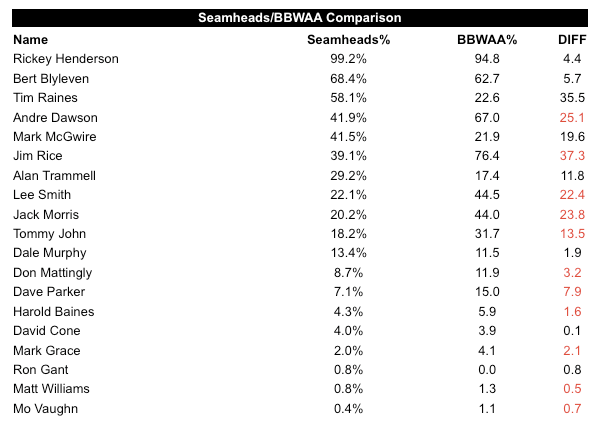
Mike Lynch at Seamheads did the calculating, based on a straw poll done through Facebook (full disclosure: I participated). No player had a bigger difference between his support in the Seamheads poll and the BBWAA vote than Rice, only his worked out in his favour in the official vote (76.4%, compared to 39.1% support among us geeks). Raines had the second-biggest (35.5%), only it worked against him.
Who knows where it goes from here. It's always better to veer away from being a drama queen. One comparable in Cooperstown voting for Raines is Billy Williams, the Chicago Cubs outfielder of the '60s and '70s. Williams polled in the low 20s in his first time on the ballot, 1982. On his second try, he jumped to 40.9% in '83, and was eventually elected in 1987. Raines didn't jump at all.
What can you say? Politics trumps ability.
All the screaming and yelling in the world and sitting at home eating can after can of dog food until your tears smell like dog food won't make it better. One of our contributors, who doesn't have the seamhead sickness, probably nailed it just now over MSN: "I think Raines is a lost cause."
Nothing is over until we decide it is, to quote a great man who never actually existed. In our heart of hearts, the belief is people will come around.
Neither Raines, Andre Dawson nor Bert Blyleven budged the needle. Raines' support dipped by 1.7%, while the Hawk and Rik Aalbert each jumped by 1%. It looks terrible, especially as a harbinger of what might be in store for Roberto Alomar in 2010, but everything looks clearer in time.
Congratulations are due to Rickey Henderson and Jim Ed Rice. The latter, thanks to the politicking of Masshole nation -- there's a mental image of Donny from Southie writing mostfearedhitterinthegame mostfearedhitterinthegame mostfearedhitterinthegame all over the walls of his duplex -- squeaked in by seven votes on his final try. Good for him. It's a baffling choice and it's just loser talk to point out, as Poz did, that a team of Rices, over a 162-game season, would score only 30 more runs than a team of Raineses, even though one played in Fenway Park and the other played at the Big O and was a much better defensive outfielder.
Mike Lynch at Seamheads did the calculating, based on a straw poll done through Facebook (full disclosure: I participated). No player had a bigger difference between his support in the Seamheads poll and the BBWAA vote than Rice, only his worked out in his favour in the official vote (76.4%, compared to 39.1% support among us geeks). Raines had the second-biggest (35.5%), only it worked against him.
Who knows where it goes from here. It's always better to veer away from being a drama queen. One comparable in Cooperstown voting for Raines is Billy Williams, the Chicago Cubs outfielder of the '60s and '70s. Williams polled in the low 20s in his first time on the ballot, 1982. On his second try, he jumped to 40.9% in '83, and was eventually elected in 1987. Raines didn't jump at all.
What can you say? Politics trumps ability.
Saturday, January 10, 2009
Cooperstown: Vote two days away
- John Brattain over at Baseball Digest Daily about how an Andre Dawson supporter can rationalize away his dreadful .323 on-base percentage. John's point that Richie Ashburn, with a career slugging percentage of .382, was eventually inducted, is valid:
"Ashburn would likely have been a lesser player if he sacrificed contact for power and in the same way, Dawson probably would have lost value had he sacrificed power for better contact since they were focusing on their weaknesses rather than building on their strengths. Ashburn was 5′10” 170 lb. Dawson, 6′3” 200 lb–one had a smaller strike zone, the other a more powerful physique–generally one plays the cards they are dealt."
- It is disappointing to see Tim Raines included on only 33% of the 51 ballots counted by Home Run Derby. Dawson received 70.6%.
As noted, it would be great if he could get in the 40% range, but at least it's a nice jump from last season. It's not all bad, considering the inevitable Rickey Henderson comparisons. - Seamheads has posted a Q&A with HOF voter Dave Kindred. It's worth reading if you want a window into a closed mind.
Q: How about the statistical revolution? Do you still rely on traditional stats to make your selections or have you branched out to include newer measures like Win Shares, VORP, WARP, DIPS or any other sabermetric measure?
A: All those are fun, and someday, when I grow up, I hope to have my elders explain them to me. - Chad Finn at Touching All The Bases says if he had the chance, he would vote for a certain former Expo: "The second-best leadoff hitter of his era, I'd love to see him inducted the same year as friend and fellow ex-Expo Andre Dawson, who would be No. 6 on this list."
- One of the same writers in Tampa Bay who was responsible for selecting light-hitting shortstop Jason Bartlett as the Rays' MVP -- when he was their fourth-best infielder -- also says Raines is "just not good enough" to merit induction. Arrrrrgh.
Monday, January 05, 2009
Seven days till Cooperstown...
All of the baseball posts you're going to see in the next seven days are enveloped in an air of apology.
The Baseball Hall of Fame vote is in seven days. For some of you, it's about as pertinent to your day-to-day life as Yosemite Sam mudflaps on a Learjet. Sorry, but for some of us, it's like a U.S. presidential election which happens every year -- like a Canadian election.
Joe Posnanski appeared on Mount Olympus late last night holding a couple stone tablets bearing the names of the players he voted for, in no particular order. Mike Lynch at Seamheads has been taking mock ballots from the hardest of the hardcore baseball geeks, who suffice to say, are proving to be a tougher crowd than the Baseball Writers' Association of America. That site also ranks this year's candidates by Win Shares, which might be eye-opening for anyone who is on the fence about a certain former Montreal Expos leadoff hitter.
Poz says he will vote for Bert Blyleven, Rickey Henderson, Tommy John (who's on the ballot for the final time), Mark McGwire, Dale Murphy, Alan Trammell, and of course, Tim Raines. He voted for Raines last time.Andre Dawson not on that list:
Blyleven, the best pitcher not in Cooperstown, was polling around 70% and Raines was around 65%. As for Jim Rice, don't ask.
Elsewhere around the web, Chicago sportswriter Rick Telander said he voted for Dawson but not for Raines. Paul Sullivan at the Chicago Tribune voted for both former Expos, without mentioning that they played for the Expos, but a win's a win. The Tribune had all of its writers who votes talk about their ballots, but alas, Sullivan seems to be the only one who voted for Raines.
Sean McAdam at the Boston Herald has the ballot that might exactly reflect the BBWAA vote -- Henderson, Dawson and Jim Rice.
Seriously, what else is there to get excited about in the first full of January
The Baseball Hall of Fame vote is in seven days. For some of you, it's about as pertinent to your day-to-day life as Yosemite Sam mudflaps on a Learjet. Sorry, but for some of us, it's like a U.S. presidential election which happens every year -- like a Canadian election.
Joe Posnanski appeared on Mount Olympus late last night holding a couple stone tablets bearing the names of the players he voted for, in no particular order. Mike Lynch at Seamheads has been taking mock ballots from the hardest of the hardcore baseball geeks, who suffice to say, are proving to be a tougher crowd than the Baseball Writers' Association of America. That site also ranks this year's candidates by Win Shares, which might be eye-opening for anyone who is on the fence about a certain former Montreal Expos leadoff hitter.
Poz says he will vote for Bert Blyleven, Rickey Henderson, Tommy John (who's on the ballot for the final time), Mark McGwire, Dale Murphy, Alan Trammell, and of course, Tim Raines. He voted for Raines last time.Andre Dawson not on that list:
"I have the utmost respect for the guy, but I just can’t do it. That .323 on-base percentage … it would be lower than all but five Hall of Famers — Bill Mazeroski, Joe Tinker, Luis Aparicio, Rabbit Maranville and Brooks Robinson. And none of them went in for their bats. I guess the way I look at it, this is a bit like voting in a .255 hitter. I will say I wish I could get past it."Anyway, the Seamheads polling has been a minor revelation. Out of almost 150 respondents so far -- and we're talking hardcore baseball geeks, completely unredeemable people -- Rickey Henderson was the only who got the magic 75% support. Henderson drew 99.3% -- yeah, one person had to be the one who didn't vote for him.
Blyleven, the best pitcher not in Cooperstown, was polling around 70% and Raines was around 65%. As for Jim Rice, don't ask.
Elsewhere around the web, Chicago sportswriter Rick Telander said he voted for Dawson but not for Raines. Paul Sullivan at the Chicago Tribune voted for both former Expos, without mentioning that they played for the Expos, but a win's a win. The Tribune had all of its writers who votes talk about their ballots, but alas, Sullivan seems to be the only one who voted for Raines.
Sean McAdam at the Boston Herald has the ballot that might exactly reflect the BBWAA vote -- Henderson, Dawson and Jim Rice.
Seriously, what else is there to get excited about in the first full of January
Sunday, January 04, 2009
Canada and Cooperstown: It's all about 2010
Roberto Alomar and Andre Dawson, a Blue Jay and an Expo, forming the Baseball Hall of Fame's 2010 induction class — it could happen.
One is hopeful for Dawson that his wait ends a week from tomorrow when the Baseball Writers Association of America vote is announced. The former Expos slugger told MLB Home Plate recently that the Hall of Fame has "lost its luster. I feel it (induction) is inevitable ... how I will react to it, I just don't know." Jeez, does that sound like the way someone should look at his sport's highest individual honour? Meantime, looking ahead, Alomar is the best of the lot among the first-timers for the 2010 ballot. He would be the first player from a Canadian-based team to go into Cooperstown on the first ballot (OK, so it's not as exciting as the Jays winning the AL East, whatever).
Dawson should make it this season or next, although Jim Rice got 64% in 2006 and is still waiting, three years later. Alomar, meantime, is probably the lone first-ballot Hall of Famer who comes up in 2010. Among the others, Barry Larkin seems doomed to the same area of purgatory as Alan Trammell, another shortstop who did almost everything well, but didn't have one or two areas where he stood out. The ballplayers got Larkin; statheads got him; the media might not.
Fred McGriff, who of course the Jays traded for Alomar on Dec. 6, 1990, is probably better than some of the first baseman/corner outfielder types enshrined in Cooperstown. His career numbers in the traditional categories probably aren't what voters would like to see from someone who played through the heavy-hitting '90s (although McGriff's total of 491 homers jumps to 511 when put in a stat-neutral context). The long-time Seattle Mariners designated hitter Edgar Martinez is also going to provide a good test case for whether someone who was a full-time DH can be elected.
It could happen. Alomar's credentials are beyond reproach. Only five players accumulated more Win Shares between 1984 and 2003. He
As for Tim Raines, it comes down to setting a target. It would be satisfactory if he can get into the 40-45% range this. It is absurd that players get more worthy in sportswriters' eyes even though they have not swung a bat or thrown a ball for years, but the media tends to be lemming-like with their thought process. Jim Rice hovered around 50% support for several years, before the New England hype machine went to work.
So it goes. Nevertheless, Alomar and Dawson in 2010. It could happen.
(It's acknowledged that I spend way too much time obsessing over the Baseball Hall of Fame.)
Related:
Raines hoping for big jump in HOF vote; Game-changing leadoff man believes he earned enshrinement (Bill Ladson, MLB.com)
One is hopeful for Dawson that his wait ends a week from tomorrow when the Baseball Writers Association of America vote is announced. The former Expos slugger told MLB Home Plate recently that the Hall of Fame has "lost its luster. I feel it (induction) is inevitable ... how I will react to it, I just don't know." Jeez, does that sound like the way someone should look at his sport's highest individual honour? Meantime, looking ahead, Alomar is the best of the lot among the first-timers for the 2010 ballot. He would be the first player from a Canadian-based team to go into Cooperstown on the first ballot (OK, so it's not as exciting as the Jays winning the AL East, whatever).
Dawson should make it this season or next, although Jim Rice got 64% in 2006 and is still waiting, three years later. Alomar, meantime, is probably the lone first-ballot Hall of Famer who comes up in 2010. Among the others, Barry Larkin seems doomed to the same area of purgatory as Alan Trammell, another shortstop who did almost everything well, but didn't have one or two areas where he stood out. The ballplayers got Larkin; statheads got him; the media might not.
Fred McGriff, who of course the Jays traded for Alomar on Dec. 6, 1990, is probably better than some of the first baseman/corner outfielder types enshrined in Cooperstown. His career numbers in the traditional categories probably aren't what voters would like to see from someone who played through the heavy-hitting '90s (although McGriff's total of 491 homers jumps to 511 when put in a stat-neutral context). The long-time Seattle Mariners designated hitter Edgar Martinez is also going to provide a good test case for whether someone who was a full-time DH can be elected.
It could happen. Alomar's credentials are beyond reproach. Only five players accumulated more Win Shares between 1984 and 2003. He
As for Tim Raines, it comes down to setting a target. It would be satisfactory if he can get into the 40-45% range this. It is absurd that players get more worthy in sportswriters' eyes even though they have not swung a bat or thrown a ball for years, but the media tends to be lemming-like with their thought process. Jim Rice hovered around 50% support for several years, before the New England hype machine went to work.
So it goes. Nevertheless, Alomar and Dawson in 2010. It could happen.
(It's acknowledged that I spend way too much time obsessing over the Baseball Hall of Fame.)
Related:
Raines hoping for big jump in HOF vote; Game-changing leadoff man believes he earned enshrinement (Bill Ladson, MLB.com)
Wednesday, December 31, 2008
Zen Dayley: You know what? The Hawk's a lock
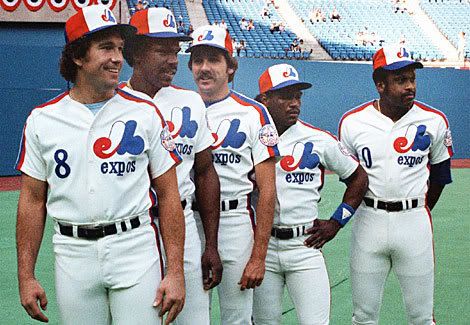 Out of Left Field is looking over the legitimate candidates for the Baseball Hall of Fame during the lead-up to the big vote on Jan. 12. Former Expos great Andre Dawson (second left in picture, beside the next manager of the Blue Jays) is getting closer to induction after receiving 65.9% support in 2008, his seventh try.
The biggest piece of context with Andre Dawson is that he was touched by the Mickey Mantle myth, which is a good thing.
Who knows, maybe sports talk radio has sucked the sympathy out of fans. The biggest piece of context with the great Expos outfielder is that he performed for a generation who had grown up on stories of athletes whose careers were cut short They knew the litany of legends whose careers had been cut short by bad knees -- Mantle, Bobby Orr in hockey, Gale Sayers and Joe Namath in football. It went double for him, since he was playing on the "concretelike turf of Montreal." (Sports Illustrated, June 15, 1987.) That should preface anything said below.
That was a very real phenomena that maybe isn't fully appreciated when you look through a stathead lens and see only the just-okay numbers -- 438 homers, 1,373 runs, 1,591 RBI, .323 on-base percentage. A gut feeling is that Dawson might make in this time. Getting past the 65% mark usually means it's inevitable a player will get the 75% needed for election.
Summing him up in three sentences: Eight-time Gold Glove winner. Won the MVP in 1987; was runner-up in 1981 and '83. One of only six players with 400 career home runs and 300 stolen bases.
Was he ever regarded as the best player in baseball? Did anybody, while he was active, ever suggest that he was the best player in baseball?
No, although he might have been one of the most respected men in the game.
Was he the best player on his team?
Dawson was a full-time player for 16 seasons and led his team in on-base plus slugging (OPS) only five times (1980, '81 and '83 with the Expos and '87-88 with the Cubs), which is low for someone who batted third or cleanup. Gary Carter was the runner-up for MVP in 1980 and Tim Raines had a monster season in 1983 -- 133 runs scored, 90 stolen bases, .393 on-base percentage.
That leaves Dawson with three seasons where he was his team's best player. One was strike-shortened.
Was he the best player in baseball at his position? Was he the best player in the league at his position?
He might been the best centrefielder in the majors in 1981. That was really the only season where he was the dominant player at his position. He was MVP runner-up to another centrefielder, Dale Murphy, in '83. In 1987, when Dawson was MVP (by that time, he had moved to rightfield), Darryl Strawberry was far more productive (.284/.398/.583) in Shea Stadium than Dawson (.287/.328/.568) did playing at Wrigley Field.
Did he have an impact on a number of pennant races?
He had an impact on four -- 1979, '80, '81 and '89. He had strong Septembers in '79-80 when the Expos were nosed out for the NL East pennant in the final days of the season (no one remembers it this way, but the team had strong finishes). He had a so-so final month in 1981, but on Sept. 21, homered in the 17th inning to give the Expos a 1-0 win over the Pirates; by the margin of that victory, they beat the Cardinals out by a half-game to win the second-half title.
Was he a good enough player that he could continue to play regularly after passing his prime?
Yes, he played until he was 41 years old and had his last season as a regular at age 39. The last six seasons of his career basically broke down to two average seasons with the Cubs, two seasons DHing about 80% of the time for the Red Sox and two seasons as a part-timer with the expansion Florida Marlins.
Is he the very best player in baseball history who is not in the Hall of Fame?
No. Raines, Ron Santo and Alan Trammell among others would rank ahead of him.
Are most players who have comparable career statistics in the Hall of Fame?
Five of Dawson's 10 comparables are in Cooperstown: Ernie Banks, Al Kaline, Dave Winfield, Billy Williams and Tony Pérez. Banks hit more than 500 homers, while Kaline and Winfield each made it to 3,000 hits, so they had no problems being inducted, plus they each played in big makrets. Williams needed six years to be elected and Pérez, who was a controversial, borderline case, got in on his ninth try in 2000.
Do the player's numbers meet Hall of Fame standards?
The magic 8-ball would say, "Outlook kind of hazy." His Triple Crown stats -- .279 average, 438 homers (only three seasons with more than 30), 1,591 RBI -- are such that you'd be looking for other stuff to put him over the top.
He's in a no-man's land when it comes to the HOF Standards test, scoring 44.1 -- not a lock, but more than a non-starter, and better than Jim Rice. He fares better on the HOF Monitor.
Is there any evidence to suggest that the player was significantly better or worse than is suggested by his statistics?
The testimonials to how he played through pain and had a throwing arm that was "legendary" (to quote Scott Miller, who's apparently a big Barney Stinson fan) suggest he was better than the numbers indicate. Contemporary evidence, namely that garden-variety .323 OBP, help make the case for "worse."
Joe Posnanski has debunked the myth that players of Dawson's vintage would have walked more if they had just appreciated the value of base on balls and a good on-base percentage. Poz found that walk rates have not budged in the past 30 years. The argument also falls apart when you compare Dawson's career OBP to other home run and RBI champions from the 1980s and early '90s. You could look it up.
Is he the best player at his position who is eligible for the Hall of Fame but not in?
No. Among centrefielders who played at the same time, there's Murphy, and there's Dwight Evans among rightfielders, to name just a couple. In the New Historical Baseball Abstract, James lists him as the 19th-best rightfielder, behind non-Hall of Famers Dave Parker, Bobby Bonds, Bobby Murcer and Ken Singleton.
How many MVP-type seasons did he have? Did he ever win an MVP award? If not, how many times was he close?
He had a MVP-like season in '81 (.302, 24 homers, 64 RBI, .553 slugging in the strike year) and again in '83 (.299-32-113, plus 104 runs scored and a Gold Glove). He won the award in the 1987, but in this day and age, he might not have won.
Nineteen eighty-seven was actually a watershed moment when it came to MVP voting: It was the last time that RBI champs were both MVPs. Neither Dawson of the Blue Jays' George Bell was the best player in their league.
Dawson had a ridiculous home/road split (1.041/.768). That was also the last full season of day baseball in Chicago, and he OPSed 1.016 by day and a .687 -- paltry -- by night. Sportswriters now would have made a much more informed choice.
How many All-Star-type seasons did he have? How many All-Star games did he play in?
He probably had about nine All-Star-type seasons. He was not picked in 1980 when he hit .308, scored 96 runs and had 41 doubles for a 90-win Expos team, but he was a near-automatic pick until he reached the other side of the hill.
Did most of the other players who played in this many go to the Hall of Fame?
Probably.
If this man were the best player on his team, would it be likely that the team could win the pennant?
A lot would have to go right for that to be the case -- like having Gary Carter and Tim Raines on your team.
What impact did the player have on baseball history? Was he responsible for any rule changes? Did he introduce any new equipment? Did he change the game in any way?
There was the matter of that blank contract he showed up at spring training with in 1987. It did prove to be a smoking gun in the players' collusion case against the owners.
Did the player uphold the standards of sportsmanship and character that the Hall of Fame, in its written guidelines, instructs us to consider?
He would not have got this close without it and there is not a thing wrong with that statement, other than the poor quality of the narration. Keep your fingers crossed he goes in at the same time as Jim Rice, to mitigate the Masshole love-in.
Post-script: Rob Neyer tackled Raines vs. Rice in an interview yesterday with Fire Brand of the American League.
"I can't support Jim Rice's Hall of Fame candidacy because I don't believe he's among the 20 best left fielders in major league history, or even among the five best corner outfielders who are today not in the Hall of Fame. Just to make the most obvious argument, Rice wasn't nearly the ballplayer that Tim Raines was. That's objectively true, and it's frustrating to me that so many Hall of Fame voters believe that Jim Rice was a great player, but Tim Raines was not."Related:
Upon further review, Hawk belongs in Cooperstown (Scott Miller, CBS Sportsline)
My Hall of Fame Ballot -- Henderson, Blyleven, Raines, Morris (Dan Graziano, Newark Star-Ledger)
Hall of Fame ballot tests first-time voter (Joe Capozzi, Palm Beach Post)
Tuesday, January 09, 2007
WHAT'S GOOD FOR THE GOOSE IS BAD NEWS FOR "THE HAWK"
No surprise here -- Mark McGwire was rebuffed with extreme prejudice by the Baseball Hall of Fame voters, getting just 23.5% support in the balloting. Hey, why don't we see if those professional sportswriters ever took anything stronger than coffee to stay awake through all those night games they had to cover.
(Scott Carefoot has a great take, by the way, and so does Sportsnet.ca's Scott Carson.)
What's disappointing to Canadian baseball fans is that former Expos star outfielder Andre Dawson dropped to 56% support after getting 61% in 2006. And no one in the Canadian media seems to be writing about the raw deal "The Hawk" is getting, year after year. Look on the bright side: There's a chance, however slim, that he and former teammate Tim Raines, who becomes eligible next year, will be inducted together. (OK, so it's really slim.)
One positive note is the strong support for Goose Gossage (71.2, just short of the 75% needed for induction), who had a much better career than fellow relief pitcher and 2006 inductee Bruce Sutter.
Congrats to a pair of great ballplayers who played their entire career in mid-sized markets -- Tony Gwynn and Cal Ripken. I'm at work right now, so unfortunately there isn't time for a full post.
(Scott Carefoot has a great take, by the way, and so does Sportsnet.ca's Scott Carson.)
What's disappointing to Canadian baseball fans is that former Expos star outfielder Andre Dawson dropped to 56% support after getting 61% in 2006. And no one in the Canadian media seems to be writing about the raw deal "The Hawk" is getting, year after year. Look on the bright side: There's a chance, however slim, that he and former teammate Tim Raines, who becomes eligible next year, will be inducted together. (OK, so it's really slim.)
One positive note is the strong support for Goose Gossage (71.2, just short of the 75% needed for induction), who had a much better career than fellow relief pitcher and 2006 inductee Bruce Sutter.
Congrats to a pair of great ballplayers who played their entire career in mid-sized markets -- Tony Gwynn and Cal Ripken. I'm at work right now, so unfortunately there isn't time for a full post.
Subscribe to:
Posts (Atom)


 Posts
Posts



