Showing posts with label MLB. Show all posts

Monday, March 21, 2011

Ultimate baseball league: Texas Rangers

The all-time Rangers should score some runs, with a starting nine that includes four MVPs and two table-setters who each on-based above .400 during the representative seasons.
The pitching, on the other hand, stinks like some of Dallas Cowboys owner Jerry Jones' business dealings.
The Rangers have historically never been much on developing pitching in-house, so most of the best pitching seasons, by Ferguson Jenkins, Nolan Ryan, John Matlack, et al., belong to pitchers whose best work came with another franchise. Suffice to say, having Ken Hill as a staff ace is a bit dodgy.

That said, between a pitcher who threw no-hitter on LSD and a reliever who pitched with both hands, the Rangers are colourful. So they have that going for them, which is nice.
STARTING LINEUP
  1. SS Toby Harrah, 1975 (6.6). He would have been a fantasy baseball darling if it had been invented, since the majors' leading palindrome was a middle infielder who was an on-base machine (he on-based .403 during his representative season). Sportswriter Mike Shropshire once wrote that he played an entire game in Tiger Stadium with congealed vomit in his hair.

  2. 2B Julio Franco, 1991 (7.0). Played forever and had an awesome, never-duplicated batting stance where he pointed his bat directly at the pitcher.

  3. 1B Rafael Palmeiro,* 1993 (7.4). He will forever live in infamy, period. Hit like a machine for a time.

  4. LF Juan González, 1993 (6.7). The most forgotten two-time MVP in history. Was it Steroid Era guilt-by- association, being a bit of a one-dimensional run producer or just radiating little personality? He was a terror during his peak years.

  5. CF Josh Hamilton,* 2010 (6.0). Still wincing at Rick Reilly's, "It's a bad night to be an atheist." Guh.

  6. RF Rubén Sierra,# 1989 (5.7). The poor, lacking-in-taste's man Roberto Clemente, or at least he seemed like it for a few years in the late 1980s.

  7. DH Jeff Burroughs, 1974 (5.7 oWAR). There was a time when Texas batters did not have a great home park factor; Burroughs won the MVP in '74 while losing about 150 points in OPS to the adverse winds at old Arlington Stadium.

  8. C Iván Rodríguez, 1998 (6.6). Realizing he's still playing is akin to finding out Sony still manufactured Walkmans as late as 2010. The upshot is the longer he plays, the more it helps his Cooperstown case, since there'll be some tacit resolution over what to do about suspect players.

  9. 3B Buddy Bell 1979 (6.9). Played his entire career in Cleveland in the 1970s, Texas in the 1980s and also managed some godawful teams. Great glove man, though.

STARTING PITCHERS

  • RHS Ken Hill, 1996 (6.5). The de facto ace since someone has to be.

  • RHS Charlie Hough, 1985 (5.7). A knuckleballer who is threat to put up a double-double (10 walks, 10 strikeouts), just in the wrong sport. Kept his dignity intact even when hanging on while wearing a teal cap.
  • LHS Kenny Rogers, 1995 (5.2). Keep a safe distance, camera operators.

  • LHS C.J. Wilson, 2010 (4.6)

  • RHS Jim Bibby, 1973 (4.3). A human footnote; he pitched the Rangers first no-hitter, served in Vietnam and was the uncle of the NBA guard Mike Bibby. He was 6-foot-7 and his younger brother topped out 6-foot-1, so naturally the latter was the one who took up basketball.

  • RHS Dock Ellis, 1977 (3.6). His place in history was long assured by the time he ended up with the Rangers.


BENCH

BULLPEN

  • RHR Jim Kern, 1979 (5.0). Was fortunate enough to enjoy his peak years in the late 1970s, when relief pitchers became famous, to paraphrase Sam Malone. Was once concussed by his own catcher.

  • CL Francisco Cordero, 2004 (4.2). There are two other pretty good closers

  • RHR Jeff Zimmerman, 1999 (3.6). You knew there would have to be a place for the Canadian whose career was much too short after he persevered against long odds to make the majors. His 1999 season is one of the best by a Rangers reliever.

  • RHR Jeff Russell, 1992 (3.4). In '89, Dennis Eckersley issued three unintentional walks all season. Why is that being brought up right now? Because the Rolaids Relief Man Award that season went to Russell, who had the most saves in the AL.

  • RHR Greg A. Harris, 1985 (3.1). Since he played in the 1980s before relief pitching was specialized, he'd be the long man of the staff. If he gets tired, he can always switch to using his left arm.

(* left-handed hitter; # switch-hitter)

Tuesday, January 04, 2011

Blog blast past: The annual Tim Raines rant ...

Robbie Alomar should take his rightful place in Cooperstown on Wednesday when the Baseball Hall of Fame vote is announced. What of another table-setting switch-hitter who played in Canada? From Jan. 5, 2010 ... apologies to the people mentioned by name. The meds are doing their job, thank you for asking!

Seeing as, "Numbers can be presented so many ways, folded into so many origami shapes," so it's understandable a baseball writer might twist it around after being bombarded with an "avalanche of numbers" during the lead-up to Wednesday's Baseball Hall of Fame election results. Jeremy Sandler should get the BBWAA honour for being a wee bit off-base.

"The obsession over numbers 'proving' Hall of Fame worthiness also leads to inauthentic comparisons. Tony Gwynn was a first-ballot selection with a .388 on-base percentage, 1,383 runs and 319 steals. Thus, one could argue Tim Raines should not be languishing with 22% support with his .385 OBP, 1,571 runs and 808 stolen bases."

(Two paragraphs later)

"Every player needs to be evaluated on his own merits against the best players of his era and of all time. To do this, numbers will tell part of the story, but will never tell the whole story."
Did anyone else see that? It seems as if (and please don't read this as a personal attack, it just happens to be one article that came to attention) the argument is for wanting to one day live in a world where we rate each ballplayer against the best players of his era, but without making "inauthentic comparisons" such as one between Tim Raines and Tony Gwynn. You should just be able to find "what lies beyond what the mere calculations can show."

From the department of, "yeah ... no," you cannot compare Raines to Gwynn just because one was a National League outfielder born in 1959 and the other was a National League outfielder born in 1960, a whole eight months apart! You may not compare a player who was a MLB regular from 1981-98 with someone who was a regular from 1984-99 just because they each:
  1. Played a corner outfield spot and some centrefield;
  2. Spent their peak years in the NL at about the same time (1983-87 for Raines, '84-89 for Gwynn);
  3. Usually batted in a similar place in the lineup (91% of Gwynn's career plate appearances and 90% of Raines' were hitting first, second or third);
  4. Hit similarly well in the leadoff spot (Gwynn OPSed .823, Raines OPSed .813)
  5. Hit similarly well in the 3-hole (Gwynn OPSed .860, Raines .856)
  6. Had similar short-and-squat builds (Raines was listed at 5-foot-8, 178 lbs.; Gwynn, 5-11, 199);
  7. Batted from the left side (Raines was a switch-hitter);
  8. Had a son of the same name make the major leagues;
  9. Had a son of the same name make the major leagues as an outfielder;
  10. Went into coaching after retiring as a player. Yep, totally inauthentic.
This is half about a fondly remembered former Expo getting his due (Jeff Blair: "... the lack of support for Raines is embarrassing") and half about media types who, present company included, get uber-defensive whenever something complex crops up. It is understandable. Some people don't like trying out new ways of seeing. Some cannot wait to see what's next.

Staying barely on-point, the argument is not that Tim Raines was better than Tony Gwynn.

The point is that they had contemporary careers where they each fulfilled the same role about equally well. Except Gwynn was not just a first-ballot inductee, as Sandler describes it, he was elected with 97.6% support three years ago. If you picture the Baseball Hall of Fame as the trendy new nightspot, Gwynn was let inside the velvet rope post-haste. Raines is standing out in the cold while the doorman pretends to scan a clipboard. Raines ... Raines ... Raines ... don't see it.

As Joe Posnanski, whom Sandler cites in his column without even a hint of irony, noted," ... there are only 26 players in baseball history who have received 90% of the vote, and that list does NOT include: Frank Robinson, Joe DiMaggio, Al Kaline, Mickey Mantle, Sandy Koufax, Yogi Berra, Bob Gibson, Walter Johnson and Warren Spahn."

Gwynn had the high batting average and the 200-hit seasons (a hitting feat you know is vital since Barry Bonds, Babe Ruth and Ted Williams accomplished it a combined never). Raines had the bases on balls, sick stolen-base success rate and scored more runs. Same aims, different means.

Raines' argument is not airtight; no one's is. However, the same out clauses that are applied to him have been overlooked for other players. For instance, one sympathetic sportswriter said of Raines, "Should get more votes than he does, but unfortunately his peak years were mostly spent on mediocre teams." Raines' teams finished above .500 in 12 of his 15 seasons as a regular, compared to 8-of-16 for Gwynn. For pity's sake, Ryne Sandberg played on only three winning teams in his whole career. No one ever mentioned that when he was on the ballot, since he played for the Chicago Cubs and was a clean-cut white guy.

Anyway, the song remains the same with Tim Raines. He received 24.3% support in 2008, 22.6 in 2009. Billy Williams, the 1960s and '70s Chicago Cubs outfielder, received similar support (23.4%) in his first go-around in 1982 and was elected five years later. For some reason, he kept gaining about 10% each year. It has not happened for Raines. It needs to this year or next.

The second part of this is feeling personally frustrated at working in the media and being surrounded by people who are rigid when fluidity is needed, especially when people can call BS so conveniently. It is disappointing to hear Jeff Blair, who is always a great read, say he "will not vote for a player on subsequent ballots if I didn't vote for him on the first."

There are issues with how some ballplayers have crept up to around 20% support to eventually getting the necessary 75% (Jim Rice was a classic example), but come on, Jeff. What, no one should ever re-evaluate their critical opinion, especially if new shit has come to light, man? In other fields, academe, film and literary criticism, people change their minds all the time. They decide they liked a book or movie, or that they hated it. about a book or movie they didn't like the first time around. It's called being human.

Getting back to baseball, you have to be careful not to beat people over the head with sabremetrics. It has found its rightful place. It is just a gas to see poor Jeremy Sandler projecting that he's threatened. Sorry to come off like a graduate of the Harry Neale School of Knowing What Everyone Is Thinking, but here is a grown man who says, "People do not live and die with their favourite players because of mathematical formulae. Adjusted ERA or VORP never made a kid put a poster on his wall." One, as if that proves anything and two, did anyone argue that we should hang our arses on trying to see the world through a child's eyes?

Yeah, when you were a kid, you were drawn to specific ballplayers for all sorts of reasons, but no one voted to put George Bell into the Hall of Fame because he had an awesome Jheri-curl and once tried to do a flying karate kick on a Boston Red Sox pitcher named Bruce Kison.

You grew up, kind of, and you learned to use your mind, instead of losing it when faced with complexity.

Enjoy election day. Please keep an eye on how big a leap Mark McGwire takes. By 2 p.m., Roberto Alomar should be a Hall of Famer. Sweet.

Tuesday, August 24, 2010

Damien Cox strikes out, but why is José Bautista hitting all those homers?

Saying someone doesn't know rate stats from counting stats is the new "doesn't know his ass from second base." Put another way: it's tough to trust a journalist with semantic data if her/his age exceeds José Bautista's home-run total — 40.

That's a gross generalization intended it makes the point. Greater minds have hit Damien Cox's weak-ass cheese about the Blue Jays' Bautista out of the park -- Cox Bloc even came out of retirement -- but whatthehell.

A couple points: One is that Cox showed what can happen when the perpetuation of PED hysteria is combined with an age of digital democracy. It's possible for anyone to write a So-And-So Must Be On Steroids post any day of the week. (Bleacher Report must exist for some reason, people.)

Every sport is in play (Mike Wilner: "You can either choose to believe those who have passed [drug] tests are clean or you can choose to believe that cheating is still rampant in the game and enjoy the game anyway.").

That makes it awfully curious that since every sport is fair game, a hockey writer such as Cox went out of his way to ding a ballplayer. Just saying.

The second point is that Lloyd Dobler principle from Say Anything, "I know that I don't know." One of daily journalism's old saws is the "good at English, bad at math" stereotype. Speeding up the sports culture hasn't changed that; it's only served to reveal it. And it's not any more prevalent among older journos than younger ones.

The difference, though, is some realize journalism is not the totality of one's personal experience and general knowledge. As a former mediocre math student, I know I am the wrong person to come up with all-encompassing, quintessential answer for why Bautista has been such an outlier, with 40 homers and counting through Monday. (His previous single-season high in the majors was 16.)

(Update: Dave Cameron, who might be that right person, has looked at it over at Fangraphs.)

At the very least, you gotta make an effort, you know?

Cox's first mistake, of course, was focusing only on the raw sum, Bautista's home-run total. It's not about the counting stats. It's about the rate stats.

At a glance, Bautista seems to be on a unique if unsustainable run. Only two everyday players in the majors have had a higher percentage of their batted balls become fly balls than Bautista (53.2%, according to what was posted at Fangraphs as of 12 a.m. Eastern on Aug. 24).

Only three had had a higher percentage of their fly balls go out of their park than Bautista (20.8% home run/fly ball rate). You want to question anything, question why he's able to get more loft on the ball, and hit it so far (although we know steroids don't make you hit the ball farther).

Rogers Centre, according to Hit Tracker, is the homerdome this season, yielding a MLB-high 2.86 gopher balls per game. New Yankee Stadium is next at 2.78, then there's a huge drop-off down to the 2.5 range.

Bautista has hit 25 of his 40 homers at home, in about 50 fewer at-bats than on the road.

That helps make the case Bautista is just an outlier. It doesn't give us all the answers, but it gives us a good framework.

Only one other everyday player hits more of his batted balls in the air and has also seen at least 20% of his fly balls sail over outfield fences — the Arizona Diamondbacks' Mark Reynolds. But you know where this is heading. Reynolds, who had 27 homers through Monday, is famous for striking out in a 40% about of his at-bats, nearly twice Bautista's whiff rate. Reynolds' home park is also a launching pad.

Who else is beating Bautista in home run/fly ball rate? The Cincinnati Reds' Canadian first baseman, Sports Illustrated cover boy Joey Votto (26.1%), leads the majors. Votto doesn't hit the ball in the air with any great frequency, which is part of why he's vying for a batting title in the National League while also being up with the leaders in home runs (and guess what, Votto's home park in Cincy also is notoriously generous for homers, 2.39 per game).

Tampa Bay's Carlos Pena (23.5%), has a ratio of almost three strikeouts for every two base hits he collects, for pity's sake. Next up is another Three True Outcomes slugger, the Washington Nationals' Adam Dunn (21.7%).

Bautista has struck out 95 times in 522 times at-bat this season, which isn't a lot for a cleanup hitter. He's more of 2 1/2 True Outcomes & mdash home run, base on balls, a few strikeouts.

A mathematician, I am not, but there is some plausibility to saying Bautista is on a roll, derived from changing his approach to produce more fly balls in his home run-friendly home stadium. The increase in his home run/fly ball rate from 2009 over the past season (12.3% to 20.8) is almost identical to that enjoyed by Votto (17.5% to that aforementioned 26.1). But no is wondering how that came to be for Votto, even in his hometown of Toronto. Nor should they.

None of this completely explains away why Bautista made it to 40 homers this season before anyone else reached 35. He did show signs when he put up a .339 on-base / .606 slugging with 10 homers in 125 times at-bat in Septemeber. It wasn't meant to, since I ain't that smart. The point is it's not that hard to at least be in the ballpark, so to speak, when an ballplayer's performance improves markedly. It's asinine and reductionist, not to mention played-out, to just automatically mention steroids. You could even say it's pathetically naive to think going for shock value for its own sake works.

The truth is out there if you care to learn how others are looking for it. Perhaps Damien Cox will learn to do that someday.

(The gist of Cameron's post:
"For the most part, he’s been hitting bombs like the two he drilled [Monday] night. If we look at his HR/FB rate, you can see that his frequency of getting balls to clear the wall isn’t that unusual: 21.5 percent of his flyballs have left the park this year, which still ranks him behind Joey Votto (25.7%), Carlos Pena (23.7%), and Adam Dunn (21.7%). Over the past three years, five players have averaged a HR/FB rate of 21.5% or better, which isn't exactly uncharted territory.

"Bautista will likely never have a year like this again, but there’s no reason to think he’s going to revert back to the version we saw before last September."
Good stuff.

(Image credit: The Canadian Press.)

Tuesday, July 13, 2010

Hugh Laurie 1, Bud Selig 0

For anyone a little taken aback by Major League Baseball and FOX's self-serving pabulum about the "spirit of philanthropy" prior to the MLB All-Star Game.


Ironic, considering which network House airs on.

Tuesday, June 08, 2010

Ottawa's Chris Bisson drafted by San Diego

Some of you might have noticed: second baseman-shortstop Chris Bisson of Orleans, the east end of Ottawa, was drafted by the San Diego Padres in the fourth round of the MLB first-year player draft out of the University of Kentucky.

It was a treat to write about Chris for the Ottawa Sun in 2009, and tip off readers to the likelihood he was going to be a relatively early pick.

Bisson hit .329 as a junior at Kentucky this season and led the Wildcats in base-stealing (32 in 39 tries) and bases on balls (28). He could be good fit for a National League team, especially if he adds another positions. He has the option of not signing and playing his senior season in the NCAA.

Congratulations are due to Chris' Ottawa-Nepean Canadians coaches, Don Campbell and Tim Nelson. It's pretty special to see a Canadian who is not a pitcher or corner player drafted.

Sunday, May 09, 2010

Totally projecting: Roy's record reaffirming realignment

It turns out there are a couple convenient lame justifications for diving into MLB realignment, even if it's making this blog more single-issue than a fringy mayoral candidate.

The one spur is Roy Halladay, as you know, has been credited with six wins in seven starts with the Philadelphia Phillies, with an ill FIP (two home runs allowed and a 48-to-7 strikeout-to-walk ratio in 56 innings). It seems like Doc, with another 27 or so starts ahead on his 2010 docket, could be on his way to the 25-win season some in Canada predicted when he went from an American League also-ran to a National League power. Some people might not even be sated with 25. Couldn't he win 28, matching what the recently passed Hall of Famer Robin Roberts did for the Phillies in 1952?

(Another way to pose the question is to ask how few losses Halladay will have at season's end. It's the same query yet it avoids parroting the media overemphasis on a pitcher's win total. Bonus!)

The perceived gulf between the AL and NL is obviously a big part of why people are predicting Halladay could hit a statistical mark only one NL pitcher, since divisional play was created in 1969, has reached while working in a five-man rotation. And Tom Seaver did it in 1969, no less.

That segues right into the second spur, the Wall Street Journal piece that pointed out, for the million and sixth time, how MLB's current alignment has screwed over Halladay's old team. It would not do to accuse Canadian ball fans of having ulterior motives, but perhaps we want Halladay to finish a record such as 24-2 or 28-1 since it would help prove the NL is really, really bad. As the Journal put it:
" ... The American League is clearly the stronger of the two, based on interleague records and the differences in performance of players who jump from one league to the other. Since interleague play began in 1997, AL teams have won eight of 13 World Series and 12 All-Star Games (there was a tie in 2002). They have compiled a .566 winning percentage against NL clubs over the past five years. Now that (MLB commmissioner Bud) Selig has blurred the line between the two leagues — he's abolished their separate league offices and umpiring crews — the time may be ripe to go all the way.

" ... if the leagues were united in one 30-team league, and each team had to play all the others a similar number of games, no more than two National League franchises would have even qualified for the postseason in the past five years.

"In 2008, the Toronto Blue Jays finished well out of the playoffs and in fourth place in the brutal AL East, which includes the powerful Boston Red Sox and New York Yankees. But in an adjusted schedule where all teams played one another, Toronto's actual .531 winning percentage that year would have been .564, with the improvement coming from playing the National League teams more often.

"That would have put Toronto in seventh place in the 30-team league, good enough to make the playoffs. That year's World Champions, the Philadelphia Phillies, would have finished in ninth place, out of the playoffs.

"The 2006 Blue Jays, Chicago White Sox and Los Angeles Angels suffered a similar fate, missing the playoffs despite weighted winning performances that placed them ahead of three National League playoff teams — the Los Angeles Dodgers, San Diego Padres and (World Series champion) St. Louis Cardinals." (emphasis mine)
The Journal's argument was for one 30-team league. That ain't happenin'. (The very notion has been well-parried by Jason Rosenberg at It's About The Money.)

It's for the best to ignore any blue sky realignment scenario such as a promotion-relegation system. The chance of that being installed in a North American league is remote for the same reason the National Football League won't adopt college rules for overtime and pass interference. Ego and simple chauvinism will not permit acknowledging someone else might have a better idea.

Major League Baseball is also married to having the AL and NL and calling its final the World Series. And there is no such thing as "pretty married." Maybe they do it that way over in Europe where they call soccer "football" (them and everyone except Canada, Australia and the U.S.) and teams get promoted and related at the end of the season. We don't know. Frankly, we don't want to know.

A personal theory, though, is MLB is due to make some change to zazz up its product. All this talk about realignment might really be over the shelf life of the current format.

Baseball is coming up on 20 years since it went to a six-division format in 1994. It had four divisions and a balanced schedule (those were the days) for 25 seasons, from 1969-93.

Look at the other leagues:
  • The NHL was split into two conferences and four divisions for 25 seasons (1974-75 through '98-99).

  • The NBA adopted two-and-four format a bit earlier and maintained a little later (34 seasons, '70-71 through '03-04).

  • The NFL had six divisions for 32 seasons (1970-2001), before it went to eight in 2002 after expansion to 32 teams.
So, tongue firmly in cheek, there is more to realignment talk than the attendant issues of addressing competitive balance, revenue disparities and AL East widows having a hard shell of cynicism that all the Blue Jays' ninth-inning comebacks against AL Central teams can't crack.

They should remedy the fact that a Blue Jays fan can only be anhedonic about the team being 19-14, since it has yet to face the Yankees and is 10-4 against the AL Central. Granted, it's impossible not to enjoy Fred Lewis' ninth-inning three-run homer that decided today's game against the Chicago White Sox. There's an off-chance it forced Joe Cowley to madly revise his game story at the last minute, after all.

Beyond that, Major League Baseball is bored. The other two major leagues and the NHL have had the fun of fighting off competitor leagues, ill-advised expansion and franchises hopping from one city to another and possibly back.

They must feel left out. Using 1970 as a baseline, since that was the year Bud Selig bogarted Seattle's team and made it the Milwaukee Brewers, MLB has 22 teams which have continuously played in the same city for the past 40 years. That compares pretty well to the NFL (17), NHL (12) and NBA (11).

Those pro sports operators are like the rest of us. They like to switch it up every so often.

MLB is pretty locked into its traditional league lines, but keep in mind those are more happenstance, accidents of history. Baltimore, Boston, Cleveland and Detroit had National League teams once upon a time. Milwaukee, Philadelphia, St. Louis and Washington were in the American League. Baseball would look much different on the west coast if the Pacific Coast League had succeeded in establishing itself as a major league in the 1950s. Vancouver could have had the first team in Canada. There was also the Continental League threat in the early '60s.

Toronto was almost a National League city. The San Francisco Giants were thisclose to moving there before the Blue Jays franchise was granted.

Point being, it's all very elastic if you take a long enough view, and there's enough reason to believe the situation might change for the Jays sooner rather than later. It seemed best to mention this with the club holding a 19-14 record (built mostly on a 10-4 mark vs. the AL Central) with 51 games yet to come against the Boston Red Sox, New York Yankees and Tampa Bay Rays.

Someday, MLB will have some alignment and scheduling that will prompt one to look at a team's actual record without first checking how it breaks down by division. Ooh, look, the team which leads the AL Central has also played 21 of its first 32 games within the AL Central. Gotta be a coincidence.

Meantime, Halladay's record for the Phillies might be the story of the summer for a Jays fan, even if the team manages to play .500 baseball. (Tip for Rob Neyer's Jays essay in his "eras" project: 2005-10 is the Roy Halladay era.)

A baseball fan of a certain vintage, with the exception of Pedro Martínez' 23-4 season in 1999, only knows gaudy won-loss records through old baseball cards. It's been exactly two decades since the last 25-win season and that by Bob freakin' Welch, who was the third-best pitcher on his own team.

One has to go back a few more years to the last time a pitcher earned 24 wins while being charged with less than five losses (Dwight Gooden in 1985 and Roger Clemens in '86 each managed 24-4 marks. Ron Guidry was 25-3 in 1978). No pitcher in the modern era has had 20 wins with two or fewer losses, although Greg Maddux was 19-2 in a strike-shortened 144-game schedule in 1995.

Small wonder it seems like every Seamhead of my acquaintance is riveted by whether Halladay could end up in that aforementioned Tom Seaver territory. Part of that is baseball being an exercise in statistic memorization by nature. Part of that is pride of having appreciated Halladay before he went to a big-market team and last but not least, being reminded it won't always be this way for the Jays. There is yet hope.

Tuesday, April 27, 2010

Rob's rational, reasonable swing at realignment

Everyone wants a piece of the realignment action, trying to resolve MLB's unbalanced schedule, unbalanced divisions and disparities in local revenue (which the media revolution might exacerbate). Yahoo! Sports baseball scribe Jeff Passan has floated the notion of unalignment, two 15-team leagues, no divisions, balanced schedule. Some called it a "writearound" with respect to the revenue issues (the Yankees will always make the most money, which is fine, but how do you control for that on the field?). Joe Posnanski wants the Pittsburgh Pirates and Kansas City Royals to trade leagues. Toronto Blue Jays president Paul Beeston has scenarios out the wazoo.

A little while back, after a desperate plea for a balanced schedule, cisblog.ca chief cook and a number-cruncher Rob Pettapiece offered to improve this writer's half-assed math. Here's his explanation:


So I took the 2008 results and built the RPI/SRS rankings, just like I do for CIS football and basketball and so on. From that I get each team's "true" winning percentage.

Then I figured out the odds that each team would beat every other team (e.g., Toronto and Kansas City is about 60-40 for the 2008 Jays). The divisions are the same as in 1990, except Tampa Bay replaces Milwaukee, so we have 13 games against divisional teams and 12 against the other half of the league. Then we can use the odds and the number of games to get an expected number of wins (again using Toronto-Kansas City), it's 7.3 wins for Toronto and 4.7 for Kansas City).

Add up everyone's wins and you get their record for this new season, below the jump:

Below are the standings, with "balanced wins" on the left and the actual wins from 2008 on the right.
AL East
94.2 BOS 95
92.9 TBA 97
87.2 TOR 86
86.8 NYA 89
80.2 CLE 81
72.8 DET 74
71.6 BAL 68

AL West
90.9 LAA 100
86.3 MIN 88 (in 163 games)
85.9 CHA 89 (in 163 games)
75.3 TEX 79
74.1 OAK 75
72.7 KCA 75
63.2 SEA 61
From 86 wins and fourth place to 87 wins and third place. Hooray.

(Neate: Yes, but with the league's fourth-best record.)

The problem isn't with an unbalanced schedule, it is with unbalanced divisions.

The "true" W-L record (RPI/SRS-based) of the seven teams in the new AL East was .553. For the new AL West, it was .521. The reason both are above .500 is that the AL was better than the NL in 2008. That difference is huge: five wins over the course of a season. So, just because you balance the schedule doesn't mean you balance the quality of competition.

Moreover, moving back to reality for a second, the five real AL East teams from 2008 averaged 92.2 wins (in "true" terms). Not only is that five wins higher than their actual 2008 average of 87, it's way higher than every other division:
92.2 ALE
85.7 ALC
82.0 ALW
79.4 NLC
76.5 NLW
71.0 NLW
Again, the solution isn't simply balancing the schedule, because your W-L record is compared against better competition to determine who finishes first, second, etc.

And getting rid of that problem is easy: just get rid of the divisions.

Okay, so that's not going to happen. But you could realign divisions each few years based on quality: No. 1 to the East, Nos. 2 and 3 to the West, Nos. 4-5 to the East, and so on. Rename the divisions to "Robinson" and "Koufax," similar to the NHL once upon a time. If we did that based on this "true" record, the 2009 divisions would look like:
Robinson Division: Red Sox, Blue Jays, Yankees, Indians, Rangers, Royals, Orioles
Koufax Division: Rays, Angels, Twins, White Sox, A's, Tigers, Mariners
The expected results don't change much, but at least they're more equal.

And hey, if you took all 30 teams, divided them in the same way for the 2010 season, made the DH home manager's choice (to remove the AL-NL difference), you'd have these five divisions:
Robinson: Red Sox, Cubs, White Sox, Indians, Mets, Nationals
Koufax: Yankees, Rangers, Cardinals, Mariners, Giants, Pirates
Ruth: Angels, Phillies, A's, Braves, Orioles, Padres
O'Neil: Rays, Dodgers, Tigers, Rockies, D-Backs, Reds
Clemente: Twins, Blue Jays, Marlins, Brewers, Astros, Royals
Each team would play 13 games against your own division (65 games) and four or five against three of the other four (adding up to 75 more). The five division winners and an at-large wild card would advance to NFL-style playoffs (3 seed vs. 6 seed 4 vs. 5 in the first round, top two seeds receive byes). The season is down to 140 games, which you could run from April 19 to Sept. 19. Playoffs go Sept. 21 to Oct. 10 and the World Series would be Oct. 15-23.

The first- and second-place teams would get about two weeks off before starting the playoffs, which is wonderful for them after a five-month season.

And that's a three-quarters-assed look at the situation.

Monday, March 22, 2010

Jusssst a bit outside: the Kansas City Royals preview

Duty calls to preview the MLB season. In the spirit of that, we'll have 30 bits of notes and errata very tangentially related to each team, in reverse order of PECOTA projection. At bat: the Kansas City Royals.
  1. Take the under on win total: One small reason for this is their fielding alignment is somewhat less than optimized, especially if they carry through on a plan to entrust shortstop and centrefield to Yuniesky Betancourt and Rick Ankiel.

    A few extra hits and runs will push that win total down.
  2. Tough act to follow: A mental illness is seldom a blessing in disguise, but K.C. ace Zack Greinke's much-publicized bout with social anxiety four years ago did save a lot of miles on his arm and shoulder.

    It's also a misunderstanding to think that just because of what he's been through, he's more likely to regress this season.

  3. Zack Greinke's but: The ace's ERAs broken down by division last season: 3.56 vs. the AL East, 1.99 vs. the AL Central, 1.13 vs. the AL West and 3.00 in interleague.

    The full run and a half figure vs. the East came while pitching a grand total of six innings vs. the Red Sox and none against the Yankees. The day is close when we figure out a good way to get awards voters to account for strength of schedule.

    Greinke's Cy Young was the fourth in a row for an AL Central pitcher. No wonder Roy Halladay is now in the other league.

  4. Young arms! True, TINSTAAPP, but left-hander Mike Montgomery and righty Aaron Crow are ones to watch in Kansas City's improved farm system.

  5. Dark confessions: Pretty much the whole point of this exercise is to see what is out there after a 25-year marriage to the Jays.

    The Toronto baseball concern isn't offering a lot to to the romanticist-masochist type of seamhead who misses J.P. Ricciardi as much as Roy Halladay. What good is following a baseball team if you can't hate the management? Trust Rogers to get this wrong when it put fresh-faced Canadian Alex Anthopolous in charge. Rag on him and you're ragging on yourself.

    Kansas City might not have much going for it, but it does have a great blogosphere. Exhibit A is Royals Review's "D.A.Y.T.O.N. system" post from back in the winter ("O: Overpay for Freely Available Talent").

  6. How bad has it been? The Royals have broken .500 once in the past 15 years. That season, they played .512 ball. It hurt too much to make this No. 5, George Brett's number. Apologies to Al Cowens!

  7. Lucky No. 7: The most productive spot in the Royals lineup (relative to the league) was the seventh hole, which should be no shock since their lineup is basically Billy Butler and seven or eight guys who should be hitting seventh. Or eighth.

  8. What might have been: They took Luke "6.55 ERA" Hochevar with the No. 1 overall draft choice in '06 instead of two-time NL Cy Young winner Tim Lincecum. Of course, eight other teams passed up Lincecum.

  9. Far be it to point this out: If the Royals wanted a catcher so badly, they could have taken Orioles star-in-waiting Matt Wieters with the No. 2 pick in '07. Now there's speculation about K.C.'s best hitting prospect, Mike Moustakas, converting there from third base.

  10. Will Butler do it: First baseman-DH Billy Butler is coming off a .362/.492 season with 73 extra-base hits, pretty good for a 23-year-old player. Keep an eye on how many those move from the doubles column (51 last season) over to home runs (21).

  11. They also mess up the small stuff: Fans are apoplectic over the new design on the back of Kauffman Stadium's scoreboard, which is a blue insignia on a white background instead of a white on blue.

  12. Since this is John Wathan's number, it must be pointed out: All the best to former Ottawa Lynx Dusty Wathan this season managing Clearwater in the Florida State League.

  13. It's the first eight innings that are problematic: Closer Joakim Soria is about the third-best closer in the AL.

  14. One small improvement: They were second-last in the league in drawing bases on balls last season, after finishing last in 2008.

  15. Three-baggers: They led the AL with 51 triples, no mean feat for the losingest team of the aughties (948 losses, or just less than 95 a season).

  16. Oops: They also led the AL in errors, always a good thing for a team which doesn't score many runs.

  17. Silver lining: The Royals are marking the 25th anniversary of their ill-gotten 1985 World Series title. That was the team which had Frank White, who is black, Bud Black, who is white, Jamie Quirk, who was quite normal, and also inspired the immortal bedsheet sign, "Give me a loaf of Brett, a pound of Biancalana and a slice of Balboni."

  18. That's right, they used to matter: Once upon a time, 70 per cent of TVs in the Kansas City area would be tuned to Royals games.

  19. Twenty years since: July 17 marks the 20th anniversary of former Royal Bo Jackson's famous three-homer game at Yankee Stadium. You likely remember that Bo homered his first three times up, injured his shoulder attempting a diving catch on a sinking line drive in the sixth inning. He came back 40 days later and homered in his first at-bat off a guy named Randy Johnson.)

    The real shame of it all, though, isn't that Bo didn't get a chance to hit a fourth (or fifth) home run in that game. It's that no one remembers Bill Pecota hit one of his 22 career homers in that night.

  20. Where there's a Wil: They're starting to invest in young talent instead of low-ceiling college players (i.e.,types). That's a bold strategy.

  21. Have to say it: Powder-blue jerseys and white pants look so much nicer for a home team.

  22. Won't get fooled again, until the next time: The Tao of Stieb admitted to drafting Royals third baseman Alex Gordon (one those prospects fast becoming suspect) in a roto league.

  23. Seriously, how is he still playing? Ladies and gentlemen, 36-year-old catcher Jason Kendall (tabloid furore and all) is still playing. You might remember him from good seasons in 1998 and 2000.

  24. The other good pitcher: Right-hander Robinson Tejeda rates a chance to be the No. 3 starter, although after the first two (Greinke and Gil Meche), there's a real steep drop-off.

  25. Who are Mike Stodolka, Jeff Austin and Kyle Snider? "Three people who have never been in my kitchen" is correct in theory, but more to the point, they're three Royals first-round draft choices from recent years.

    The Royals are what they are because they draft worse than a person who ends up with Vernon Wells on a fantasy team.

  26. Final farewell: The triple-A Omaha Royals are playing their last season at Rosenblatt Stadium, also home of the College World Series. Call it crazy, but there's an argument the CWS is at least the most accessible NCAA event to attend, since attending a Final Four or a BCS title game is so bloody expensive.

  27. Obligatory hockey reference: The Casey Wellman who is now playing for the NHL's Minnesota Wild is son of Brad Wellman, a utility infielder who played for the Royals in the 1980s.

    The elder Wellman was spurred to have his kids learn to skate after being invited on to the ice by the New Jersey Devils before a playoff game in Boston in 1988. He didn't know how, so he was determined that wouldn't happen to his kids.

  28. Shallow, obvious joke: With the Jayhawks losing to Northern Iowa in the NCAA tournament last Saturday, it's the first time in a while the Kansas University basketball team has been eliminated earlier than the Royals.

  29. PECOTA says: 77-85, fifth AL Central, 738 runs scored, 787 runs allowed.

  30. In English, please: They could almost win the Comedy Central.

Friday, March 05, 2010

Jusssst a bit outside: the San Diego Padres preview

Duty calls to preview the MLB season. In the spirit of that, we'll have 30 bits of notes and errata very tangentially related to each team, in reverse order of PECOTA projection. At bat: the San Diego Padres.
  1. Call when you trade Adrian Gonzalez: The Padres better not drag this out longer than The Office did with Pam's pregnancy.

    Just send Gonzo and his redonk park-adjusted OPS from the hitters' graveyard that is Petco Park to some bandbox in the AL. The only reason to keep him in San Diego an entire season is to see if he can draw 162 bases on balls.

  2. What bandbox would that be? Padres GM Jed Hoyer is used to work under with Boston's Theo Epstein. Just sayin'.

  3. He is San Diego's answer to Dany Heatley, or Vince Carter: At least former Cy Young-winning ace, Jake Peavy, is playing in another league. Padres diehards are less than impressed Peavy is apparently pushing his new team, the Chicago White Sox, to trade for his former club's best player.

  4. They'll be bad for a while: A thin farm system, an ownership change and a dried-up free-agent market will do that to a franchise. They're basically the Blue Jays with a real ballpark and year-round beach weather.

  5. Ridiculous spring training optimism, thy name is: Tony Gwynn Jr., the Ben Mulroney of leadoff men (he's gone a long way on a surname and taken that as evidence of actual talent), says, "A .400 on-base percentage is my target."

    His famous father might have a better shot at doing that this season. Gwynn Jr.'s lifetime on-base is .331.

  6. Simile time: Kevin Correia being a team's best starter is like having Kevin Corrigan be the lead in a movie. Both are good in a secondary role, but can't carry the whole show.

    Correia was a nice redemption story last season after being cut adrift by San Fran.

  7. Come on, Stairsy: Canada's own Matt Stairs, still swinging at 42 years old, would be the first position player in modern baseball history to play for 12 teams if he can make San Diego's Opening Day roster.

  8. Not exactly the Miracle speech: The Wall Street Journal had an article on author David Shenk and the idea, "the new science tells us that it's equally foolish to think that mediocrity is built into most of us, or that any of us can know our true limits before we've applied enormous resources and invested vast amounts of time. Our abilities are not set in genetic stone."

    That's too complicated to work as a motivational slogan for the talent-deprived Padres. However, the article references Red Sox Hall of Famers Bobby Doerr and Ted Williams, who played for the original minor-league incarnation of the Padres.

  9. They're kind of under the radar: L.A. Lakers forward Ron Artest did a radio interview last year wearing a Padres hat. When it was pointed out, he said he didn't know there was a baseball team in San Diego.

  10. Some dead spots in the lineup, like six of them: They hit only 141 home runs last season, and 40 came from one guy. Their second-leading four-ply swatter, Kevin Kouzmanoff, was traded to Oakland.

  11. The house the Mantle rookie card built: A former Padres equipment manager named Clyde Bone is offering to trade his baseball card collection (valued at 500 grand) for a house.

  12. If you believe in luck: Rookie outfielder Aaron Cunningham (.382 on-base, .493 slugging in the minors) turns 24 on April 24, so it's his lucky year.

  13. Good thing Petco is a pitchers' park: Their starting rotation had a 4.78 ERA last season. That's like 6.00 in another park.

  14. Not up for discussion! Tony Gwynn was marginally better than Tim Raines, but got elected to the Hall of Fame with almost 98% support and the latter has needed three years just to crack the mythical 30% barrier in BBWAA balloting.

    Gwynn, the quote-unquote best hitter since Ted Williams, usually batted third, where his career OPS was. 860. Tim Raines' career OPS hitting third? .856. Almost exactly the same.

  15. Root for this guy! SD has a 20-year-old outfield prospect named Jaff Decker who on-based .442 last season in Single-A ball. His body type is described as resembling John Kruk and Matt Stairs, so there's a visual.

  16. Perish the thought: Remember the sad story of Matt Bush, the former No. 1 overall pick who bombed out spectacularly? Yeah, the Padres took him ahead of Justin Verlander, last season's AL Cy Young Award winner.

    The No. 1 pick rotated between leagues then. Verlander's Detroit Tigers should not have been picking second in 2004 after losing a league-record 119 games the previous summer. What happened might have been just, plus the Padres went for the signable guy who didn't have Darth Vader for an agent.

  17. Now it's just sad: Infielder David Eckstein was the 2006 World Series MVP just days before the Republicans got hammered in the U.S. midterm elections. Both have had similar fortunes since.

  18. Third base to outfield conversions? When will people learn? Chase Headley, one of the team's few league-average hitters, is back at his regular fielding position.

  19. Discuss: Shortstop Everth Cabrera is entertaining, if you like shortstops who call to mind the days when teams lived with erratic fielding, low stolen-base success rates and utter lack of plate discipline.

  20. One simple request: Will Ferrell's Anchorman sequel should include some reference to the Padres' 1984 pennant.

  21. Record watch: Stairs is one pinch-hit home run from tying former Jay Cliff Johnson's record of 20.

  22. Drawing a Blanc to come up with 30 things about a struggling small-market team: Left-hander Wade LeBlanc shares a birthday with Sidney Crosby, Aug. 7.

  23. Smart guy: You might have heard Dick Enberg is calling Padres games on TV. He even hired an aide to help him communicate with the Latino players. How many broadcasters do that?

  24. Only saying this once: It is officially passe for sportswriters to refer to a coach or GM who is under 40 as "Doogie Howser." That show was cancelled 15 years ago and some would say it's in use among sportswriters who have hangups about answering to someone who's younger than them.

    Hoyer, the Padres' 36-year-old GM, has the Doogie tag. It gets dragged out with the 40-year-old Ottawa Senators coach Cory Clouston.

    Granted, the latter is allowable. Cory Clouston bears more than a passing resemblance to Neil Patrick Harris, and as a hockey coach, probably has a special room just for his suits.

  25. Fun fact: Leftfielder Kyle Blanks, who is 6-foot-6, 285 pounds, is the heaviest player to ever hit an inside-the-park home run. There's no truth to the rumour the Chargers are signing him as a blocking tight end.

  26. Fun coincidence: The Jays have Buck Martinez, who once went from the broadcast booth to managing the team, back as their TV guy. Coleman did the same thing in 1980. He lasted one season.

  27. Now you know the rest of the story: Why does San Diego's NFL team consistently underwhelm in the playoffs, while its baseball team disappoints. Blame the desperation that inspired the San Diego Sockers of indoor soccer fame to make a very 1980s music video:


    Do you need a winning team for a winning town? Did they rent Edmonton's inferiority complex?

  28. Plus we all know he'll end up in Boston: It's a violation of the "renovating the restaurant you don't own, or spending the 200 million dollars you don't have" rule to suggest a trade destination for Gonzalez.

  29. PECOTA says: 73-89, fifth NL West, 654 runs scored, 738 runs allowed.

  30. In English, please: San Diego's lucky it has hot women.

Wednesday, January 27, 2010

Andre Dawson and availability bias

Please skip the cross-border shin-kicking and go straight to what was left out of the contrived debate about Andre Dawson's Hall of Fame plaque.

Dawson went there when, in conversation with a couple Chicago sports talk radio chuckleheads, he said he told the powers-that-be in Cooperstown: "I tried to explain, perhaps, the impact of what really catapulted me to Hall of Fame status, and pretty much what my preference was."

Typically, the articles have stated Dawson played longer with the Montreal Expos (1976-86), but won a National League MVP award with the Cubs. Being a former MVP probably did factor into the BBWAA's Chicago outfit, so-called, keeping his name in the discussion.

However -- and no one seems to talk about this -- Dawson or any Cubs player of that era had one huge advantage in MVP voting. In that era, from the late 1970s through the early '90s, the Chicago Cubs and Atlanta Braves each had almost all of their games broadcast on superstations (WGN and TBS) which were available to most U.S. cable subscribers and parts of Canada. Hear this out.

That wrinkle of the pre-digital era has probably been forgotten. It's been on my mind for a few weeks, but what hat a player has on his plaque is a trifle. I know that, because even as a serious baseball nut, I had to check whether Nolan Ryan represents the Texas Rangers, California Angels or Houston Astros on his plaque.

Everyone has the Internet and can compare traditional and advanced statistics. Serious Seamheads shell out for the MLB Extra Innings package. In Dawson's day, most teams only got North America-wide exposure if they were featured on the NBC Game of the Week, or ABC's equivalent, Monday Night Baseball.

The two franchises' ubiquity on cable TV even seeped into popular culture. There's a circa 1990 Simpsons episode where Homer, moved by Lisa's infectious moralizing, decides to cut the family's illegal cable hookup. Bart rhymes off all the reasons not to, "Monster trucks! Tractor pulls! Atlanta Braves baseball! Joe Franklin!"

Will Ferrell once said he got the idea for a Harry Caray impersonation, because when he came home for lunch around noon California time, he would flip on the Cubs telecasts on WGN.

Before MLB went to three divisions in 1994, it briefly discussed keeping two divisions and having the Cubs and St. Louis Cardinals play in the National League West with Atlanta and Cincinnati moving to the NL East. The Cubs' ownership refused because it would hurt their local TV revenues.

Coincidentally or perhaps not, the Braves and Cubs were overrepresented in the post-season awards in those days. In a 10-year span, 1982-91, those two franchises accounted for five MVP awards, even though only the '91 Braves reached the World Series. Dawson, as you need no reminder, won his award while playing on a last-place Cubs team. The BBWAA also votes for the Cy Young Award. The Cubs had three during that rough timespan (Bruce Sutter in 1979, Rick Sutcliffe in '84 and Greg Maddux in '92 before he won three more with guess who, the Braves).

Picture a hard-working beat grunt from an eastern city in 1987 on a West Coast road swing. He wakes up around 11 a.m. Pacific, understandable after covering a night game. The Cubs, who still played all day games at home, would be on TV. He would see Andre Dawson hitting all those home runs (49 that season, the most any player had hit since George Foster slammed 52 in 1977) and driving in all those runs, and it's not hard to go from there to casting a MVP vote for him, even though the Cubs could have finished last without him.

That is not meant to call out anyone well after the fact. The very definition of availability bias is people tend to go with the first information they receive. It's good to dig or try to build a more layered argument, but who has the time? They went with what they got first and it has carried down the line.

You can even see it in the coverage now, which typically has omitted that Dawson was second in MVP voting twice while with the Expos (1981 and '83 behind Dale Murphy of, wait for it, the Atlanta Braves). His only other top-10 finish also came in Montreal. That has been left out, even in Canada, since many media outlets just run the same wire service articles as every other website as part of their strategy for giving users something unique.

Dawson being MVP runner-up in Montreal twice, in a sense, is more impressive than winning it once in Chicago. The Expos were an afterthought to U.S. media and fans. Allen Barra once wrote that Tim Raines being selected to seven all-star teams while playing for Montreal was like winning the Pulitzer Prize while writing for a newspaper in North Dakota. It is somewhat Sisyphean to explain this to most Americans, who tend not to realize the one-sided natures of their conversations of the rest of the world (Eddie Izzard: "... in other countries; you do know there are other countries?).

The short answer is Cooperstown got this right and if you want to go there, it is a little pathetic for Chicago media to put a waiver claim in on Dawson's legacy. Far be it to say that's their egotism talking. Just now, Chicago media personality (and former Raptors TV voice) Chuck Swirsky was on the FAN 590 in Toronto, his former station, saying "the majority of baseball fans" remember Dawson as a Cub and that he performed "on the biggest stage in baseball, Wrigley Field," which hasn't hosted a World Series game since the year the Second World War ended. Please. That's just a reflection of selective memory.

Canadian sports likers get to see the Expos get a day in the sun. (Colby Cosh had the best line on Twitter: "The Andre Dawson news is great. Haven't been this happy since Ugueth Urbina announced he would enter prison as an Expo.")

The larger point is that in honouring past greats, baseball writers and fans tend to let themselves be controlled by factors they should be controlling for. They get caught up in whether someone lasted long enough to reach some arbitrary round number (300 wins, 500 home runs, 3,000 hits), or how he fared in MVP voting. We are well-aware how media members who votes for awards of this nature are fallible.

However, there probably hasn't been enough attention devoted to how playing for a team which had games aired coast-to-coast helped Dawson in 1987. He got a MVP award, and that helped keep his name out there until he was finally elected. Not that there's anything wrong with that, so long as it's properly acknowledged.

Related:
Dawson may wear Cubs hat for speech (ESPNChicago.com)

Tuesday, January 05, 2010

Confidence bordering on obnoxiousness with Alomar, Dawson

Roberto Alomar and Andre Dawson, a Blue Jay and an Expo, forming the Baseball Hall of Fame's 2010 induction class — it could happen.
— some fat, dumb and bald guy this time last year
Thank goodness Cooperstown is only a four-hour drive from a border crossing, eh!

Roberto Alomar is overqualified for the Baseball Hall of Fame, if anything. It is almost like you can't feel an euphoria because it's his just desserts.

A gut feeling is he and Dawson receive somewhere around 80% support, which is all it takes. (Terence Moore, one U.S. columnist, says it will be only those two, apologies to Bert Blyleven if that is the case.)

Anyway, Stephen Brunt found the words to evoke the Blue Jays' early-1990s salad days and it is a must-read. Meantime, some Canadian OMDs have finally clued in about two years too late about Expos great Tim Raines' bona fides, and then there are those how try to be authoritative while misrepresenting the facts (Ryne Sandberg was elected in his third year on the ballot).

Throw in the late, great Tom Cheek finishing first in the fan balloting for the Ford C. Frick Award and well, Cooperstown could have that Canada-rama in August, which probably has the people at the Hall of Fame quaking a bit over their bottom line.

Alomar received 11-of-12 votes from staffers at the Chicago Tribune and USA Today, if that is any kind of straw poll.

Just for fun, here is a Keltner test for Alomar which should remove all doubt.

Was he ever regarded as the best player in baseball? Did anybody, while he was active, ever suggest that he was the best player in baseball?

Some time around 1993, Sport magazine ran one of those Barry Bonds vs. Ken Griffey Jr. comparison articles that monthly sports magazines ran to compensate for the time lag (and you wonder why they folded). Tony La Russa said neither, Alomar was the best player in the game. And he's a genius.

Retrospectively speaking, Alomar topped the AL in win shares in 1992 (34) and 1999 (35). That's cribbed from a 2004 Matthew Namee article that notes that around '93, "with the possible exception of Barry Bonds, Roberto Alomar was the most complete package in baseball. He was a switch-hitter who hit for a great average, drew a bunch of walks, had good power. He stole a ton of bases and was rarely caught, and he was a Gold Glove middle infielder.

Was he the best player on his team?

He was the best player on the 1991, '92, and '95 Jays (the latter because someone had to be), the 1996 Baltimore Orioles and 1999 and 2001 Clevelands.

Was he the best player in baseball at his position? Was he the best player in the league at his position?

Yes. He won 10 consecutive Gold Gloves at second base (1991-2000) and added four Silver Slugger awards.

Did he have an impact on a number of pennant races?

He was on seven post-season teams during an 11-year stretch, plus a 90-win Cleveland team which fell one win short of the post-season in 2000.

The '00 Indians were a .500 team at the end of July. They went 40-22 (.645) across the last two months to almost catch the Oakland Athletics, with Alomar hitting a practically Pujolsian .370/.437/.557 to spur the charge.

In 1997, he hit .500/.532/.800 in September to help the Orioles finish two games ahead of the Yankees for the AL East flag.

Was he a good enough player that he could continue to play regularly after passing his prime?

No. The New York media has never let it drop that Alomar hit a wall at age 34 and endured "a discouraging turn with the Mets in 2002 and 2003, when he hit just .265 over 222 games." Ryne Sandberg was 34 when he quit the Chicago Cubs mid-season in 1994; he returned to play two middling seasons.

Is he the very best player in baseball history who is not in the Hall of Fame?

Toss-up between him and Raines.

Are most players who have comparable career statistics in the Hall of Fame?

Five of his 10 most comparable players
are in the Hall of Fame and the very much active Derek Jeter is one of the other five, so yes. Alomar and, wait for it, Tim Raines are the only post-1950 players with 1,500 runs scored who have not been inducted.

Do the player's numbers meet Hall of Fame standards?

Alomar's 193 on Bill James' HOF monitor is 47th-best all-time, the highest of anyone who played entirely in the expansion era and entirely at second base. (Joe Morgan is 60th.) Alomar is 50th in HOF standards, putting him in a class with Morgan and Craig Biggio.

Only Bonds scored more runs during Alomar's first 14 seasons in the majors (ESPN.com).

Is there any evidence to suggest that the player was significantly better or worse than is suggested by his statistics?

The fielding stats which are now taken for granted were not readily available in the 1990s. Alomar's fielding reputation might have been inflated, especially since he had benefit of playing more than half his games on artificial turf from 1991-95.

People over the last 10 years have accepted that stolen-base success rates are more important than just raw steal totals, so Alomar's 81% success rate counts for more than his total, 474.

Is he the best player at his position who is eligible for the Hall of Fame but not in?

Biggio is not yet eligible.

How many MVP-type seasons did he have? Did he ever win an MVP award? If not, how many times was he close?

Put it this way: Dustin Pedroia was the American League MVP in 2008 as a second baseman who OPS-plused 122. Alomar had six seasons where he OPS-plused 129 or better, scored 100 runs and received a Gold Glove.

God only knows why he had little traction with MVP voters during his Toronto years, when he finished sixth three years in a row.

He never won the MVP Award. His best finish was third in 1999 (tied with Manny Ramirez and ahead of sixth-place Derek Jeter, who should have won), followed by a fourth in 2001. He also finished sixth from 1991-93 with the Jays, largely since the voters of the day tended to go for RBI guys.

How many All-Star-type seasons did he have? How many All-Star games did he play in? Did most of the other players who played in this many go to the Hall of Fame?

He had 13 all-star type seasons, 1988 and 1990-2001. He was selected 12 times; in 1988 he had the best season ever by a 20-year-old second baseman (The Hardball Times), but was overlooked for the All-Star Game since he started the season in the minors and was playing for a going-nowhere San Diego Padres team.

Off-hand, the 12 appearances ranks well with several first-ballot inductees who played in the AL in the 1980s and '90s: George Brett made 13 all-star teams, then there are Wade Boggs (12), Dave Winfield (12), Rickey Henderson (10), Eddie Murray (8) and Paul Molitor (7). The other same-era second baseman who's in the Hall, Ryne Sandberg, had 10 selections. Barry Larkin played in 12, but one was a courtesy invite in his final season.

Most people who went to the All-Star Game as often as Alomar have gone to Hall of Fame, usually with not much debate.

If this man were the best player on his team, would it be likely that the team could win the pennant?

The '91-92 Blue Jays each won 90-plus games and the AL East. The '96 Baltimore team, the first wild-card entry to win a playoff series, reached the American League championship series. In 1999, Alomar tied for third in MVP balloting while helping Cleveland to a 97-65 record one win off the AL's best.

What impact did the player have on baseball history? Was he responsible for any rule changes? Did he introduce any new equipment? Did he change the game in any way?

None especially, although he was among the many great Puerto Rican players who have reshaped the sport. He would be the first elected (the late Roberto Clemente was a special case).

Did the player uphold the standards of sportsmanship and character that the Hall of Fame, in its written guidelines, instructs us to consider?

Yeah, the spitting incident. Only two lives were really affected by it and John Hirschbeck moved on long ago, telling the New York Daily News recently, "It's long over with and a lot more good has come out of it than you can ever believe. If that was to cost Robbie the Hall of Fame, I would feel awful."

Sunday, December 20, 2009

Cooking the books: 'Evaluating Baseball's Managers'

Evaluating Baseball’s Managers: A History and Analysis of Performance in the Major Leagues, 1876–2008
Chris Jaffe
333 pg., McFarland Publishing, $39.95 (due out winter 2010)


Thanks to Chris Jaffe, you might never look at the men in the dugout the same way.
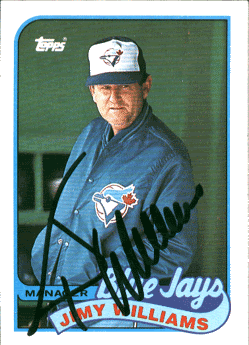
Most baseball fans today focus their venom on general manager and front office. The manager position is practically an anachronism, an ex-player who puts a uniform and tries not to get in the way of what's been put in place. How managers shape a ballclub sometimes gets downplayed.

That is why, based on two chapters he furnished, it seems like Jaffe's Evaluating Baseball's Managers is destined to become a big part of any baseball library. You might need a bit of the seamhead sickness to get into it, but Jaffe, who writes for The Hardball Times, has made some big strides.

Jaffe explains how changes in the sport have changed the job. It's much more professional now: Only two current MLB GMs actually played major-league ball and one of them is Billy Beane of Moneyball fame. His second big idea is rebutting the belief a skipper has the same impact in all areas of a ball club ("Place a man in a situation that fits his strengths, and he will look like a savant. Put that same individual on a team that highlights his weaknesses and people will call him a dullard.").

Jaffe's conclusions about the great Montreal Expos manager Felipe Alou and late-1980s Jays skipper Jimy Williams may be eye-opening for Canadian ball fans. There's some stuff about Cito Gaston, too. Since this is a Canadian sports blog, that is a good place to focus.

Jaffe sent me excerpts on the four Blue Jays managers who were active for at least a decade (Gaston, Williams, Bobby Cox and Jim Fregosi) and a section on managers from the 1998-to date era. The book, which is intended as a reference guide, has capsules on 89 managers who lasted at least 10 seasons.

The 1998-to date section was like an unexpected gift, just for the appreciation it provided of Alou. Not to give away too much, but Jaffe shows how MLB's racial issues kept Alou from having a longer managerial run. Major League Baseball is self-congratulatory about having more African-American and Latino managers than in the past, but qualified candidates often don't get a chance until well into middle age. I never thought about this, but when Alou took over the Expos, he was at an age (57) when some Hall of Fame managers were already out of the game.

Most people know about all the young players Alou had, such as Vladimir Guerrero and Pedro Martínez. Few probably know Alou's reliance on pitch counts kept Martínez happy and healthy and on the path toward the Baseball Hall of Fame. They might not also realize Alou set a great example for other managers. It is worth noting that in the much-praised article Seattle baseball writer Larry Stone wrote about new Mariners DH Milton Bradley, present-day manager Ken Macha, told Stone "he got advice on handling Bradley from a good friend, Felipe Alou." It is no surprise to hear that.

SBN's Houston Astros blog, The Crawfish Boxes notes, "What Jaffe does ... is highlight why (managers) were good or why they weren't successful. He does an excellent job of it, providing stats to back it up in each manager's capsule, but also backing it up with solid analysis. Bullpen usage, hitting for power, walks, and more are shown as trends for each manager as Jaffe does a good job of describing what kind of team each guy oversaw. It's exactly what history buffs would want and provides the kind of source material that analysts will be using for years."

The section on Cito Gaston was fairly familiar ground, so it had fewer surprises. It turns out Gaston's rep as the "ultimate minimalist," is spot-on. Jaffe uses stolen base success rates to show Gaston is not totally out of it during games.

As a 30-something Jays fan, Jaffe's method really hit home with the section on Jimy Williams, who managed Toronto from 1986-89. The next time you're talking to a serious baseball nut, ask her/him what manager in recent history got the most from the bullpen. One response might be, "Probably Tony La Russa" (perhaps sarcastically) or, "Well, I know it wouldn't be (insert someone who ran his favourite team)."

Jaffe finds that Williams put all of the so-called genius managers to shame when it came to using the bullpen. He never managed in a World Series, so this was largely lost on people. It also didn't help that the teams he ran each played in hitter-friendly ballparks that obscured the excellent work of their relievers. As Over The Monster noted in its review,, "Williams handled the pitching staff like no other manager has in big league history. Williams' tendencies to yank pitchers early kept his starters healthy, meaning down the line they were that much better. Williams didn't try to stretch his starters; he knew what they were capable of and didn't push them. As a result, his Red Sox teams in the second half always seemed to do better than in the first half."

It was a similar story with the Jays. According to baseball-reference.com, during Williams' three full seasons with the Jays, they were a .528 team before the all-star break and played .584 ball in the second half.

Williams, though, was fated to get fired before a team hit it big. The Blue Jays let him go in 1989 and won the World Series three seasons later. The Red Sox canned him in 2001 and, wait for it, won the World Series three seasons later. During that season, 2004, Williams was fired by the Astros, who made it to the Series the following season.

He certainly had a role in that, of course. Still, Jaffe findings are a bit of a requiem and, for readers, put their personal baseball history in a new light.

Jimy Williams had his brilliant points, who knew. It's a reminder of how people, not just the media, get an idea about someone and massage the facts selectively. Williams seemed like a crusty baseball lifer. (One of his habits in the dugout when he managed the Jays was putting his hand down the front of his pants, almost like Al Bundy.) Those guys tend to be viewed as replaceable.

Good sportswriting should increase understanding or stimulate thought. Evaluating Baseball's Managers hits it out of the park on each count.

(Over The Monster also noted Jaffe's writing didn't suffer even when he was discussing the game from decades ago:
"I didn't know actually how much information Chris would be able to get for most of the older managers. But to my surprise, every writeup was quite detailed. If the writeups were any indication of the rest of the book, it seems to be quite extensive."
Evaluating Baseball's Managers is available for pre-order; the Stone link is via Jonah Keri.)