Showing posts with label Robbie Alomar HOF. Show all posts

Tuesday, January 05, 2010

Confidence bordering on obnoxiousness with Alomar, Dawson

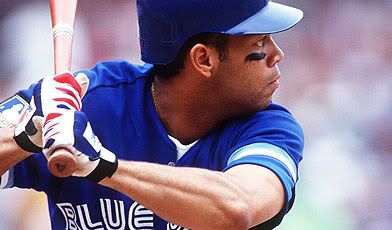
Roberto Alomar and Andre Dawson, a Blue Jay and an Expo, forming the Baseball Hall of Fame's 2010 induction class — it could happen.
— some fat, dumb and bald guy this time last year
Thank goodness Cooperstown is only a four-hour drive from a border crossing, eh!

Roberto Alomar is overqualified for the Baseball Hall of Fame, if anything. It is almost like you can't feel an euphoria because it's his just desserts.

A gut feeling is he and Dawson receive somewhere around 80% support, which is all it takes. (Terence Moore, one U.S. columnist, says it will be only those two, apologies to Bert Blyleven if that is the case.)

Anyway, Stephen Brunt found the words to evoke the Blue Jays' early-1990s salad days and it is a must-read. Meantime, some Canadian OMDs have finally clued in about two years too late about Expos great Tim Raines' bona fides, and then there are those how try to be authoritative while misrepresenting the facts (Ryne Sandberg was elected in his third year on the ballot).

Throw in the late, great Tom Cheek finishing first in the fan balloting for the Ford C. Frick Award and well, Cooperstown could have that Canada-rama in August, which probably has the people at the Hall of Fame quaking a bit over their bottom line.

Alomar received 11-of-12 votes from staffers at the Chicago Tribune and USA Today, if that is any kind of straw poll.

Just for fun, here is a Keltner test for Alomar which should remove all doubt.

Was he ever regarded as the best player in baseball? Did anybody, while he was active, ever suggest that he was the best player in baseball?

Some time around 1993, Sport magazine ran one of those Barry Bonds vs. Ken Griffey Jr. comparison articles that monthly sports magazines ran to compensate for the time lag (and you wonder why they folded). Tony La Russa said neither, Alomar was the best player in the game. And he's a genius.

Retrospectively speaking, Alomar topped the AL in win shares in 1992 (34) and 1999 (35). That's cribbed from a 2004 Matthew Namee article that notes that around '93, "with the possible exception of Barry Bonds, Roberto Alomar was the most complete package in baseball. He was a switch-hitter who hit for a great average, drew a bunch of walks, had good power. He stole a ton of bases and was rarely caught, and he was a Gold Glove middle infielder.

Was he the best player on his team?

He was the best player on the 1991, '92, and '95 Jays (the latter because someone had to be), the 1996 Baltimore Orioles and 1999 and 2001 Clevelands.

Was he the best player in baseball at his position? Was he the best player in the league at his position?

Yes. He won 10 consecutive Gold Gloves at second base (1991-2000) and added four Silver Slugger awards.

Did he have an impact on a number of pennant races?

He was on seven post-season teams during an 11-year stretch, plus a 90-win Cleveland team which fell one win short of the post-season in 2000.

The '00 Indians were a .500 team at the end of July. They went 40-22 (.645) across the last two months to almost catch the Oakland Athletics, with Alomar hitting a practically Pujolsian .370/.437/.557 to spur the charge.

In 1997, he hit .500/.532/.800 in September to help the Orioles finish two games ahead of the Yankees for the AL East flag.

Was he a good enough player that he could continue to play regularly after passing his prime?

No. The New York media has never let it drop that Alomar hit a wall at age 34 and endured "a discouraging turn with the Mets in 2002 and 2003, when he hit just .265 over 222 games." Ryne Sandberg was 34 when he quit the Chicago Cubs mid-season in 1994; he returned to play two middling seasons.

Is he the very best player in baseball history who is not in the Hall of Fame?

Toss-up between him and Raines.

Are most players who have comparable career statistics in the Hall of Fame?

Five of his 10 most comparable players
are in the Hall of Fame and the very much active Derek Jeter is one of the other five, so yes. Alomar and, wait for it, Tim Raines are the only post-1950 players with 1,500 runs scored who have not been inducted.

Do the player's numbers meet Hall of Fame standards?

Alomar's 193 on Bill James' HOF monitor is 47th-best all-time, the highest of anyone who played entirely in the expansion era and entirely at second base. (Joe Morgan is 60th.) Alomar is 50th in HOF standards, putting him in a class with Morgan and Craig Biggio.

Only Bonds scored more runs during Alomar's first 14 seasons in the majors (ESPN.com).

Is there any evidence to suggest that the player was significantly better or worse than is suggested by his statistics?

The fielding stats which are now taken for granted were not readily available in the 1990s. Alomar's fielding reputation might have been inflated, especially since he had benefit of playing more than half his games on artificial turf from 1991-95.

People over the last 10 years have accepted that stolen-base success rates are more important than just raw steal totals, so Alomar's 81% success rate counts for more than his total, 474.

Is he the best player at his position who is eligible for the Hall of Fame but not in?

Biggio is not yet eligible.

How many MVP-type seasons did he have? Did he ever win an MVP award? If not, how many times was he close?

Put it this way: Dustin Pedroia was the American League MVP in 2008 as a second baseman who OPS-plused 122. Alomar had six seasons where he OPS-plused 129 or better, scored 100 runs and received a Gold Glove.

God only knows why he had little traction with MVP voters during his Toronto years, when he finished sixth three years in a row.

He never won the MVP Award. His best finish was third in 1999 (tied with Manny Ramirez and ahead of sixth-place Derek Jeter, who should have won), followed by a fourth in 2001. He also finished sixth from 1991-93 with the Jays, largely since the voters of the day tended to go for RBI guys.

How many All-Star-type seasons did he have? How many All-Star games did he play in? Did most of the other players who played in this many go to the Hall of Fame?

He had 13 all-star type seasons, 1988 and 1990-2001. He was selected 12 times; in 1988 he had the best season ever by a 20-year-old second baseman (The Hardball Times), but was overlooked for the All-Star Game since he started the season in the minors and was playing for a going-nowhere San Diego Padres team.

Off-hand, the 12 appearances ranks well with several first-ballot inductees who played in the AL in the 1980s and '90s: George Brett made 13 all-star teams, then there are Wade Boggs (12), Dave Winfield (12), Rickey Henderson (10), Eddie Murray (8) and Paul Molitor (7). The other same-era second baseman who's in the Hall, Ryne Sandberg, had 10 selections. Barry Larkin played in 12, but one was a courtesy invite in his final season.

Most people who went to the All-Star Game as often as Alomar have gone to Hall of Fame, usually with not much debate.

If this man were the best player on his team, would it be likely that the team could win the pennant?

The '91-92 Blue Jays each won 90-plus games and the AL East. The '96 Baltimore team, the first wild-card entry to win a playoff series, reached the American League championship series. In 1999, Alomar tied for third in MVP balloting while helping Cleveland to a 97-65 record one win off the AL's best.

What impact did the player have on baseball history? Was he responsible for any rule changes? Did he introduce any new equipment? Did he change the game in any way?

None especially, although he was among the many great Puerto Rican players who have reshaped the sport. He would be the first elected (the late Roberto Clemente was a special case).

Did the player uphold the standards of sportsmanship and character that the Hall of Fame, in its written guidelines, instructs us to consider?

Yeah, the spitting incident. Only two lives were really affected by it and John Hirschbeck moved on long ago, telling the New York Daily News recently, "It's long over with and a lot more good has come out of it than you can ever believe. If that was to cost Robbie the Hall of Fame, I would feel awful."

Friday, August 07, 2009

Top 5: Memory is a strange thing, especially with the '92-93 Jays

Naked appeals to nostalgia — hey-hey, the past is the only place where it is guaranteed not to get worse — are not much of a crank-turner.

It is two-fold when the Rogers Jays have a reunion weekend of the 1992-93 World Series teams. It is a cash ploy, possibly complete with charging $60 for an autograph. However, having those memories of where you were and what you were doing knits us together (Scott Carson, you went for a burger in the ninth inning of Game 6 in '93, really?), even if it was fleeting. For my family, it was the one time all five of us got wrapped up in a sporting event.

It was timing. My sister Trina and brother Shawn were too young to follow the 1987 Canada Cup or the Ben Johnson scandal in '88. I draw a blank when trying to recall who was in the room July 27, 1996 when Donovan Bailey became the world's fastest man.

Such sweetness can never last. It was obvious even at the time Jays fever was a phase. Two days the 1992 playoffs started, you could find people calling the American League Championship Series "the semi-finals," but here are five memories of those years:
  1. Devon White in centrefield: It was how Devo got there, not just what he got to in centrefield, striding after a long fly ball, almost never seeming to be in a hurry as he robbed another hitter of extra bases. It was wings-for-feet stuff.

    White never was much for plate discipline (353 bases on ball, 1,047 strikeouts). Cito Gaston got it right by pencilling him into the leadoff spot. He represented the absolute limit of how a leadoff man could be effective without a great on-base percentage, because he had some pop and was an efficient basestealer (75 swipes with only eight caught stealings in '92-93).

    Of course, he made his name in centre. In a sense, it is almost better to try to remember how it was knowing Devo would catch it rather than go back and check fielding metrics. It is tough to recall the catch he made on Terry Pendleton in Game 3 of the 1992 Series, because my dad had sent me down to the basement to fill the woodstove. That still burns (and it's not the last time the old woodstove will appear in this post).

  2. Rickey Henderson in a Jays uniform: The phrase rooting for laundry had yet to enter the vernacular in the summer of 1993.

    The Jays had been scraping by with Darrin Jackson, Rob Butler, Turner Ward and Willie CaƱate (a Rule 5 pick who was never seen in the majors before or after that season) variously filling in. Any established player would have been upgrade. Pat Gillick went out and acquired the best leadoff hitter ever as a rental player.

    Of course, try being 16 and riding in a car with a mom and sister who mostly knew Rickey Henderson for having torn apart the Jays in the 1989 playoffs, stealing bases, drawing walks, hitting home runs and styling. To them, it probably did come off as the equivalent of the Leafs hiring Kerry Fraser to work in their front office. However, Henderson was on-basing .469 at the time of the trade and what some invariably called "showboating" didn't seem so bothersome. It actually seemed kind of cool.

  3. The return of Tony Fernandez: Getting Tony back in early 1993 meant that one everyday player from the Blow Jays era got to win a ring. Fernandez was punching the clock with the Mets when Gillick acquired him to fill a hole. He raked for the rest of the season, hitting .306/.361/.442. Without him, they maybe don't repeat.

  4. Doug Linton: A common bit of announcer-ese is that it takes 25 players to win a pennant. That is actually off; it usually takes 30-35, with players arriving from the minor leaguers to shore up the roster throughout the season. Remember Dan Johnson arriving from Triple-A last season to hit a game-winning homer for the Tampa Bay Rays at Fenway Park?

    In 1992, the Orioles came into SkyDome for a mid-August series and won the first two, cutting the Jays' AL East lead to one game. With a sense of urgency mounting, it fell to a 27-year-old rookie whose eventual career ERA was 5.78) to be a stopper in the third game.

    Linton went out and held the Orioles at bay with an effort that was practically Halladay-eqsue, throwing eight innings of three-hit ball in a 4-2 win. It was his first win as a Jay. It was also his last.

    The Orioles made a push in early September, but somehow that stands out as the "sorry, Baltimore, not this year" game.

    Doug Linton is now a pitching coach in the minors with the Modesto (Calif.) Nuts. One of his sayings is that the same pitches which get batters out at one level will also get them out at the next. It was true in '92.

  5. The Alomar game: The personal story of Oct. 11, 1992, actually began in 1989.

    There was a game at Yankee Stadium in late July when the Jays lost 7-6 on a walk-off hit in the ninth inning. A quick check reveals it was July 30. They had been ahead 6-1, so it was the kind of loss that turns people into inanimate-object kickers.

    Dad was going on it about how the Jays, who were below .500, were done. Of course, being 12 years old and thus inclined to side with sports heroes instead of than the man who put a roof over your head, I bet my dad $5 they would win the AL East.

    Twelve-year-old me did not know all the math, but the Jays were only four games out. They had a plus-26 run differential, plus they had a run of games coming up against the dregs of the AL (they went 6-0 vs. the White Sox, 5-1 vs. the Tigers, 6-1 vs. Cleveland). They clinched, and Dad paid off.

    So Oct. 11, 1992 rolls around, with the Jays having won two in a row to take a series lead over the Oakland Athletics. There was that sense of blood in the water, since the team which extends a 2-1 series lead to 3-1 in a best-of-7 almost always wins (except for you-know-when).

    As you'll remember, Jack Morris started in all four of the Jays' losses in the '92 post-season. The A's scored five runs in the fourth inning off ol' Jack to take a commanding 5-1 lead. However, knowing what was at stake, there was a feeling. Who knows why. I made the same $5 bet, this time at 10-to-1 odds.

    I had a Sunday afternoon hockey practice. Off I went. Attendance was kind of sparse that day; everyone was skipping practice to watch the game. As I came off the ice, the radio broadcast was on the arena's PA system, so I heard in passing that it was 6-4 in the bottom of the eighth. I was standing in the doorway to the dressing room changing clothes, straining to hear the play-by-play. Anyone who walked down that hall would have seen me doing a fist pump while wrapped in a towel when Roberto Alomar took Dennis Eckersley over the wall for tying two-run homer.

    My mom picked me up (I was only 15, so I hadn't started driving). We got home in time to see Pat Borders cash in the winning run. The Jays had gone from trailing 6-1 to winning 7-6, which not that I realized at the time, was a reversal of that game three years earlier.

    A lot of other stuff had to happen for the Jays to win that World Series and the next one. That was the point of no return, the defining moment. When I free-associate with that period, what comes to mind is Alomar throwing his hands up after he connected off The Eck, not Joe Carter after he touched 'em all. That was a pretty good day too.

    As for the bet, my dad paid off the $50. However, my dad didn't become a contractor who could make Mike Holmes look like a hack by throwing money away. We had the wood stove. It seems in retrospect there was an inordinate amount of wood that I had to split and stack that winter. And I didn't mind that one bit. You don't get many Roberto Alomar moments in this life.


It would have been nice to be on Yonge St. for all that, but wherever you are is the big time.

Thursday, February 12, 2009

Snark break ...

Roberto Alomar has a girlfriend, named Maripily Rivera. You can all relax now, shame on you for being uncomfortable. How about that Bears game last week? Helluva game, helluva game. Bears got a good team this year.

Don't worry. If you're looking out the window and a falling figure goes shooting past, it's probably just the Montreal Canadiens.

Aussie basketball legend Shane Heal is playing his final pro game Saturday. It means nothing, other than a chance to recall Zander Hollander's summation of Heal's one full season in the NBA, where he shot 26.8%: "Maybe the ball rotates differently in his hemisphere."

You are not alone in thinking the Globe & Mail and TSN are word-flogging the Olympics so badly that everyone will have five-ring fatigue before they even light the flame. Two columns in the same day from Stephen Brunt is more obvious than a three-dollar bill. (Granted, two Brunt columns are better than 200 from a lot of writers.)

Mike Wilner, Sun Media's Steve Simmons, in a brawl to settle it all. It has happen. Wilner noted last night that Simmons' suggession "that a distinction has to be made between (Alex) Rodriguez and (Barry) Bonds because Bonds 'abused' steroids, but Rodriguez only 'used' steroids ... might just be the most ridiculous thing that I have ever read."

And they say newspapers don't know their readers anymore. The Hamilton Spectator notes the Hammer's $94-million contribution to a stadium for the 2015 Pan-Am Games could buy "195 Tim Hortons franchises or 43,300,000 medium coffee and donut combinations."

It is ridiculous when college basketball coaches don't trust a player to stay on the court despite foul trouble.

More great moments in fantasy sports: Manu Ginobili scored 32 points against the Raptors, but missed the game-winning shot with 10 seconds left. The beauty of being a Canadian playing fantasy hoops is you can blame your team's record, if need be, on the TSN2 controversy. Granted, it hasn't hurt the other 11 owners in the Rockhard Fantasy League.

Last but not least: Try to get, "How was your time with the Unabomber?" into conversation at some point today.


This post is worth nothing, but this is worth noting:
  • Toronto-area hoops hotshot Cory Joseph (Devoe's brother), who's playing high school ball down in Nevada, scored 20 points last night. He had a better night than fellow Canadian up-and-comer Tristan Thompson, who's been thrown off his New Jersey high school team.
  • The Score has cancelled The Score In The Morning, the show that was co-hosted by good Kingston lad Adnan Virk and Nikki Reyes.
  • Down Goes Brown has some random early 1990s Leafs playoff memories. Guy Hebert would be the goalie for the Pierre Garcon All-Stars (pro athletes with French names who aren't French-Canadian).

Wednesday, February 11, 2009

Cooperstown crisis; spare the schadenfreude

As an addendum to one of the 317 Alex Rodriguez posts that have run here in the past 96 hours, the Baseball Hall of Fame is a hurtin' unit.
"Induction weekend has the potential to make up more than 10 percent of annual attendance. So you can imagine what happens if you have more weekends like you did last year with Goose Gossage (14,000 people) versus the year before (2007) when Cal Ripken Jr. and Tony Gwynn were enshrined (75,000 people)."
— Darren Rovell, CNBC, Feb. 9
The obvious temptation is turn this around and point out the Baseball Hall of Fame is in such a fix because the voting system wasn't totally broken. Don't try to blame this on juice monkey ballplayers and moralizing sports writers. It is certainly valid that the tourist trade in Cooperstown has plenty of reason to worry. The Hall of Fame is kind of built around being a draw for families who piled into the station wagon or Aerostar for a long driving trip, something that is probably going to become less commonplace to due to cost of gas.

The Hall voters' prefence for one-team ballplayers is also rearing its head here. Ripken helped get 75,000 people because he was a timeless ballplayer identified with one franchise, the Baltimore Orioles. It's telling that Rovell wrote, "Andre Dawson, Roberto Alomar" — this was before the tabloid furore — "and Fred McGriff probably don't get me to make the inconvenient trip up to Cooperstown anytime soon."

(And what country did all those players spend a signficant chunk of their careers in?)

Related:
Biggest Loser From A-Rod Story? (Darren Rovell, CNBC, Feb. 9)

Not a great week for ballplayers in New York City

The allegations against Roberto Alomar will probably get some play up here in Canada today. It would be nice if everyone could turn up their nose and this turns out that Chuck D was right about the New York tabs, but if there's any truth, to it, holy crap.

Alomar's ex is claiming that he has full-blown AIDS and insisted on having unprotected sex, and both New York tabloids gave it huge play this morning, with the Village Voice exhuming the gay rumours from five years ago. Putting on the Jays fan hat (a blue and white throwback), the only part that should really be upsetting is that one publication referred to Alomar having a "borderline Hall of Fame career."

Whatever happens, happens. Alomar was a childhood idol for what he did in Toronto from 1991 to '95. Anything which came after that, John Hirschbeck incident notwithstanding, has the quality of epilogue. It's a shame his personal life is being dragged through the mud, and yes, it just so happens that he's going on the Baseball Hall of Fame ballot for the first time in January. Yikes.

It feels dirty just dignifying tabloid of New York City, but it beats chortling over undated photos from ex-Senators goalie Ray Emery's Facebook page, or reporting other things that might not be true, like that Brett Favre is finally going to retire, for real this time, or not. You're welcome, Earth.


Related:
Alomar in 'AIDS' shock (New York Post)
Alomar Ex Says He Has AIDS (Village Voice)
$15M Lawsuit claims ex-Met Roberto Alomar had sex knowing he had AIDS (New York Daily News)
