Thank you, Mark McGwire, for giving me a reason to watch TV with my kids again. The endless image of the president hugging Lewinsky has been replaced by McGwire hugging his son, hugging the tear-filled family of Roger Maris, and hugging his rival, Sammy Sosa. Thank you, Mark McGwire, for giving us back the hug.
-- Letter to the editor of the Boston Globe, published Sep. 10, 1998
This should be fun.
Warm up the Keltner List Machine!
Was he ever regarded as the best player in baseball? Did anybody, while he was active, ever suggest that he was the best player in baseball?
Regarded as such? Maybe. He won the Associated Press Athlete of the Year in 1998 and was named along with Sammy Sosa as Sports Illustrated's Sportsman of the Year. He led the league in on-base average twice and slugging average four times, and should have won more MVPs than he did (zero). The entire SI staff loved him dearly and he was often portrayed as a proud California boy doin' good by God.
He wasn't the best all-around player, but it's possible that he went first overall in many fantasy drafts.
Was he the best player on his team?
It's tough to be the best when your teammate has 42 homers and 40 steals. Or is also eligible to go into the Hall. (Or is already there.) But once the A's got awful in the mid-90's, McGwire was definitely the best player on his team, and remained so until his final days in St. Louis.
Was he the best player in baseball at his position? Was he the best player in the league at his position?
Probably. Either him or Jeff Bagwell. Maybe Frank Thomas. But they're also Hall-worthy, so I'm not sure it matters.
Did he have an impact on a number of pennant races?
If that number is "four" then yes. Oakland went to three World Series in three years and McGwire, as one of the Bash Brothers, played a big part in getting them there. There's also 1992, when Oakland won 96 games and lost in the first round to some team from up north, but as he kept hitting, the A's stopped winning and that was about it for his pennant-race experience.
Was he a good enough player that he could continue to play regularly after passing his prime?
We're hinting at the answer to a future question, but either he wasn't or he just chose to stop. McGwire only played two years after age 35 and didn't appear in 100 games in either. 35 is typically past the end of a player's prime years anyway, but McGwire's career path is...atypical.
Is he the very best player in baseball history who is not in the Hall of Fame?
No. Among eligible players, Rickey Henderson is ahead of him and maybe Tim Raines is too. (Tim Raines should be in the Hall. Write your MP.)
Are most players who have comparable career statistics in the Hall of Fame?
This is where it starts to get nutty.
Whatever list you want to use, you'll find Harmon Killebrew as a moderate match and a bunch of other guys who don't really compare. His career was pretty much only possible in the era he played in, and he was far above most of his contemporaries.
I know what you are all thinking and we will handle that in a moment.
Do the player's numbers meet Hall of Fame standards?
McGwire could really, really hit. Home runs especially. Fifth-best all-time, by some measure, and second only to Barry Bonds in modern times. 583 isn't a small number. Top-ten in slugging average, too.
But, really, he's just a home-run hitter. A guy with his batting average can't possibly be a Hall of Famer.
...oh, please. Let's not be lazy. Because of his incredible home-run skill, he was able to achieve excellence in other areas. Like on-base average. His is higher than Rod Carew and Joe Morgan, two Hall-of-Famers primarily known for getting on base, and also better than recent Hall-of-Famer and noted singles hitter Tony Gwynn. But McGwire did more than hit singles. He outslugged and outhit many current (legitimate) Hall-of-Famers. His numbers meet the standards, full stop.
Is there any evidence to suggest that the player was significantly better or worse than is suggested by his statistics?
Just give me a second--the doorbell's ringing and I have to go let the elephant into the room...
Okay, let's consider the home-run-by-age graphs at Batter's Box here, and in particular how bizarre McGwire's career is. And how bizarre some of the other sluggers from this era look, relatively speaking.
Clearly McGwire played in an exceptional time and took advantage of it. There's no way his numbers would have been that good otherwise, right?
(pause)
I hope you didn't believe that, or else I'd have to use the same rhetorical device twice in a row. But just to clear things up, McGwire is not Bret Boone. If you neutralize his stats at Baseball-Reference, he gets better. About 10 points are added to each of his averages, and he ends up with 610 homers instead of 583. Meaning, he was not an androstenic mirage. Or at least not any more than the average player was at the time. And I don't consider that to be an issue with his candidacy.
Is he the best player at his position who is eligible for the Hall of Fame but not in?
Yes, indeed. His ranking in Bill James' New Historical Baseball Abstract is third among first basemen, behind Lou Gehrig and Jimmie Foxx, both inner-circle, absolute slam-dunk Hall of Famers.
How many MVP-type seasons did he have? Did he ever win an MVP award? If not, how many times was he close?
Oddly enough, he never won the MVP award, even in 1998. He finished second that year, because Sosa's Cubs made the playoffs. In 1992 he finished fourth when Dennis Eckersley won the award for some reason. 1987, his rookie year, was MVP-like, and he finished fifth in 1999.
He probably should have won two or three of those awards and if he played on a winning team in '87 or '98 or '99, he would have.
How many All-Star-type seasons did he have? How many All-Star games did he play in? Did most of the other players who played in this many go to the Hall of Fame?
He was selected to start the All-Star Game six times and made the team six other times. Maybe two of those were undeserved, but six plus six is twelve and most of the players with 12 or 13 appearances are in the Hall. Everyone with at least 14 appearances is either Barry Bonds, Pete Rose, or some Hall of Famer.
If this man were the best player on his team, would it be likely that the team could win the pennant?
Past evidence says maybe, because he wasn't the best player when Oakland won (although he was close) and he was the best player when his teams didn't (but that was hardly his fault). There's no reason to believe that, if the A's had any kind of a supporting cast in the mid-90's, they would have been held back somehow by their power-hitting first baseman.
What impact did the player have on baseball history? Was he responsible for any rule changes? Did he introduce any new equipment? Did he change the game in any way?
Well, his impact on baseball history was enough for Stephen Brunt to stop sending in his Hall of Fame vote.
But McGwire didn't change the game; he just played it, in every sense of the word. If the discovery of androstenedione in his locker forever changed how baseball treats drug users, then it's pretty weird that Bonds not only managed to break McGwire's record but also packed stadium after stadium with fans wanting to see him sock a few dingers, don't you think? (The Giants' attendance dropped off dramatically last year, when Bonds didn't play at all.)
In other words, drug testing, which was long overdue, was not brought in because of Mark McGwire.
Did the player uphold the standards of sportsmanship and character that the Hall of Fame, in its written guidelines, instructs us to consider?
Depends on when you ask the question. If you ask it now, he's a lying bastard who embarrassed himself and the wonderful game of baseball in front of Congress.
But if you ask it in 1998, he's a classy athlete who actually cares deeply about eradicating child abuse. Who cares about over-the-counter drugs in his locker? He's allowed America to move on from Clinton and Lewinsky by being the front man for an historic quest "that reaches deep into our childhood souls." (There's lots, lots more, but ProQuest can only handle so much saccharine.)
Neither answer is entirely true.
Bottom line
Mark McGwire's Hall-worthy accomplishments were not derided and belittled at the time the way they are now. Choosing to punish him for drug use at a time when it was encouraged might be retroactively ethical, but not really what people are supposed to be voting for here. (And giving lame answers in front of a camera would disqualify every athlete, ever, so don't even bother with that one.) His induction cannot tarnish the reputation of the game if, a mere ten years ago, he was the one saving it.
Writers, hold your noses and put McGwire in the Hall. Give us back the hug.
Showing posts with label José Canseco. Show all posts
Showing posts with label José Canseco. Show all posts
Friday, December 05, 2008


Sunday, October 26, 2008
Prince George Axemen pick ... José Canseco?
Today's straight-off-the-Ork cloud scenario: José Canseco playing senior baseball next summer for a team in Prince George, British Columbia.
Kamloops Daily News sports ed. Gregg Drinnan, on his Taking Note blog, reports that "an agent for Canseco has been in touch with organizers of the World Baseball Challenge."
Kamloops Daily News sports ed. Gregg Drinnan, on his Taking Note blog, reports that "an agent for Canseco has been in touch with organizers of the World Baseball Challenge."
That would be the other WBC, an event will be hosted by the Axemen in the northern British Columbia logging town next summer. As best as can be figured out, it's some kind of senior amateur event.
There is that netherworld of organized sport that, to quote the writer Don Marks' description of the Allan Cup level of hockey in Canada, is "mostly a matter of some guy in some town in some province having enough money to cobble together the best players" outside of the pro leagues. Prince George is some town in some province. Canseco is certainly available.
It sounds crazy, I know ... but what's a broken-down, flat-broke ballplayer (recall that devastating article Pat Jordan wrote for Deadspin a while ago?) to do but to try to survive using his one marketable if socially irrelevant skill? It's kind of the plotline of Rocky Balboa come to life. It is not that far-fetched, to use Marks' point, to someone who has been exposed a little to this realm of sport, to think it could happen. Besides, everyone loves a whiff of having a celebrity in their midst. Remember that time in Kingston when everyone was convinced that "Mel Gibson's" boat was docked in the downtown marina?
Theoren Fleury playing in the Allan Cup with the Horse Lake Thunder after his NHL career ended comes to mind. Who knows, maybe Prince George isn't so desperate to win that they would risk an event that clearly means a lot to their community leaders becoming a sideshow centred around the erstwhile steroid-addled slugger. However, they do want to win, and even at 45 years old, Canseco could probably help. It's not clear what the calibre of ball is here, but some of the players lined up to play for P.G. don't have an entry at The Baseball Cube. One who does, a right-handed pitcher named Steve Nielsen, had an ERA above 7 in two years of college baseball and posted a mark of 5.23 in 2007 with the Grays, the erstwhile travelling team in the Can-Am League.
Here's Drinnan's exact report:
At first blush, it sounds crazy, but maybe it doesn't. It is José Canseco and hey, desperation is a stinky cologne.
There is that netherworld of organized sport that, to quote the writer Don Marks' description of the Allan Cup level of hockey in Canada, is "mostly a matter of some guy in some town in some province having enough money to cobble together the best players" outside of the pro leagues. Prince George is some town in some province. Canseco is certainly available.
It sounds crazy, I know ... but what's a broken-down, flat-broke ballplayer (recall that devastating article Pat Jordan wrote for Deadspin a while ago?) to do but to try to survive using his one marketable if socially irrelevant skill? It's kind of the plotline of Rocky Balboa come to life. It is not that far-fetched, to use Marks' point, to someone who has been exposed a little to this realm of sport, to think it could happen. Besides, everyone loves a whiff of having a celebrity in their midst. Remember that time in Kingston when everyone was convinced that "Mel Gibson's" boat was docked in the downtown marina?
Theoren Fleury playing in the Allan Cup with the Horse Lake Thunder after his NHL career ended comes to mind. Who knows, maybe Prince George isn't so desperate to win that they would risk an event that clearly means a lot to their community leaders becoming a sideshow centred around the erstwhile steroid-addled slugger. However, they do want to win, and even at 45 years old, Canseco could probably help. It's not clear what the calibre of ball is here, but some of the players lined up to play for P.G. don't have an entry at The Baseball Cube. One who does, a right-handed pitcher named Steve Nielsen, had an ERA above 7 in two years of college baseball and posted a mark of 5.23 in 2007 with the Grays, the erstwhile travelling team in the Can-Am League.
Here's Drinnan's exact report:
"Jose Canseco, profiled in a TV documentary — Jose Canseco: The Last Shot — that was shown earlier this week, is scared for his health, thanks to steroid use and abuse, and broke. Perhaps it’s because of the latter that an agent for Canseco has been in touch with organizers of the World Baseball Challenge, which is scheduled for Prince George, July 16-26. Canseco, 44, just may end up playing for the local entry in that tournament. . . . The WBC has seven teams confirmed with Bahamas the latest addition. The last spot will go to Cuba or Venezuela. . . . The Cubans were thought to be in but then some baseball players defected in Edmonton in August and Fidel’s baseballers now have cold feet. . . . Hey, Fidel, it’s one thing to defect in Edmonton, but P.G.?"In all honesty, speaking as a certifiable Canadian-based baseball nut, I had never heard of this event until 30 minutes ago. The guys who play in it are obviously very good ballplayers, on some level, but five years ago former Angels reliever Dewayne Buice, at 45 years old, was striking guys out while playing for the Reno Astros, his summertime toy. Buice wasn't that good when he was twenty-five.
At first blush, it sounds crazy, but maybe it doesn't. It is José Canseco and hey, desperation is a stinky cologne.
Friday, September 26, 2008
Blog blast past: Top 5 Simpsons sports episodes, Part 1
The Simpsons -- teacher, mother, secret lover! -- begins it 20th season on Sunday night. From November 2006, here's the top 5 sports-themed episodes from the show's golden age.
Every fan knows The Simpsons had its Golden Age and the Long Plateau, divided precisely at Sept. 28, 1997, The Principal And The Pauper, when it's revealed that Principal Skinner stole another man's identity while in Vietnam. (All together now: Worst. Episode. Ever.)
So, here's the Top 5 sports-themed episodes from the Golden Age:
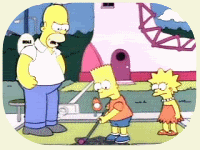 DEAD PUTTING SOCIETY (Season 2)
Homer's resentment toward to Flanders' attempt at friendliness ("Your beer comes from farther away than my beer! Your wife's butt is higher than my wife's butt!) spills over when Homer signs Bart up to play in a mini-golf tournament against Todd Flanders. Homer makes a bet with Flanders that the father of the boy who doesn't win has to mow the other man's lawn wearing his wife's Sunday dress. With the pressure on, Lisa becomes a 4-foot-2 yellow-skinned Phil Jackson, tapping into some Eastern wisdom to help Bart focus.
Lisa: I want you to shut off the logical part of your mind. Bart: OK. Lisa: Embrace nothingness. Bart: You got it. Lisa: Become like an uncarved stone. Bart: Done. Lisa: Bart, you're just pretending to know what I'm talking about! Bart: True. Lisa: Well, it's very frustrating! Bart: I'll bet.
The Funny: Homer gets his at the end of the episode, when Bart and Todd Flanders, after several nerve-wracking playoff holes, decide to call their championship match a draw. This means Homer and Flanders both have to mow the lawn in a dress -- excepts Flanders enjoys it since it "takes me back to my fraternity days."
 BART THE DAREDEVIL (Season 2)
It wouldn't have even been thought of as a sports-themed episode when it debuted in the fall of 1990, but it predated the X Games and extreme sports' movement into the mainstream, a development that spawned a bajillion Blink-182 videos and Mountain Dew commercials in the late '90s.
(It even got to the point where it was an easy parody -- remember the "Extreme!" guys in Harold & Kumar Go To White Castle?)
The Simpsons go to a monster truck show, where unfortunately they arrive late. Lisa, of course, had to have a saxophone recital. Homer drives into the arena, leading to a harrowing encounter with Truckasaurus. (Even funnier is that Homer has to drive the mangled family car home.)
Inspired by Lance Murdoch ("If he's not in action, he's in traction), Bart fantasizes about becoming a daredevil, imagining an intro of, "If he's not in class, he's risking his ass." (Remember, this was 1990. You didn't hear the word "ass" on TV back then, especially if you were a kid living in a cable-free household.)
Bart begins doing a series of skateboard stunts for the neighbourhood kids. He gets the idea to leap Springfield Gorge, but Homer prevents him -- with disastrously hilarious consequences.
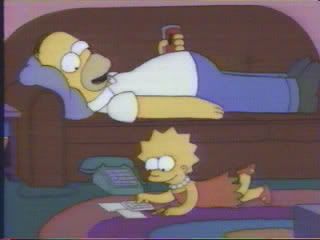 LISA THE GREEK (Season 3)
Homer proclaims NFL Sunday to be Daddy-Daughter Day when he discovers Lisa has an almost eerie prescience for helping him win his bets. Remember, the main reason people watch the NFL is because they have money riding on it. In fact, she's much better at it than the network guys, like Smooth Jimmy Apollo (voiced by the late Phil Hartman): "Well, Chet, when you're right 52 per cent of the time, you're wrong 48 perc ent of the time!"
The humour comes in how Lisa, normally so moral, gets such a rush from helping Homer clean out his bookie (Moe, of course) and turn into an eight-year-old gambling addict. She even incorporates her new hobby into an essay on the happiest day of her life:
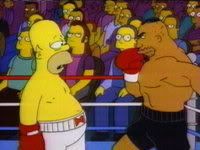 THE HOMER THEY FALL (Season 8)
After Homer gets beaten up by the fathers of school bullies Dolph, Jimbo and Kearney at Moe's, Moe the Bartender decides to revive his failed boxing dreams by putting Homer in the ring. Predictably, Marge objects --"Of all the crazy ideas you've ever had, this one ranks somewhere in the middle." However, it turns out Homer more than meets state requirements to "box, wrestle or be shot out of a cannon." (Apparently whatever state Springfield is in was founded by circus freaks.)
Refusing to fight, and simply waiting for his opponents to punch themselves to exhaustion so he can push them to the canvas, Homer cleans out the ranks of ASSBOX (Association of Springfield Semi-Professional Boxers):
This gets Homer a shot at the champ, Drederick Tatum, who, uh, kind of looks like a certain boxer from real life.
The Funny: You learn more of Moe's backstory, there's a Raging Bull parody, and well, making fun of boxing -- the sham fights, the B-list celebrities, its bottomless capacity for farce -- is like fishing with dynamite.
 HOMER AT THE BAT (Season 3)
Let's see: Parodies The Natural, the song Talkin' Baseball ("Mike Scioscia's tragic illness made us smile / while Wade Boggs lay unconscious on the barroom tile") and George M. Steinbrenner III's micromanaging ways: "Mattingly! I told you to trim those sideburns!"
Writers and baseball are always a natural mesh, and there's enough baseball-fan humour and knowing references to support this episode. Darryl Strawberry's a team player ("Some of these guys have a got a bad attitude, skip") and José Canseco is a glory hog ("Don't worry, ma'am, I'll save your cat"). Plus we find out Mr. Burns is really, really old, since his initial hand-picked team of ringers consists of Cap Anson, Honus Wagner and Mordecai (Three Finger) Brown. In fact, his right fielder has been dead for 130 years.
Waylon Smithers, acting upon Burns' orders to "scour the professional ranks -- the American League, the National League, the Negro Leagues," puts together a team that's more stacked than the late-'90s Yankees. Of course, all of of Waylon's wizards are waylaid by various calamities, meaning the real Power Plant team has to play the championship game -- except for regular right-fielder Homer Simpson, since Strawberry is still OK to play. Naturally, Homer gets his skull-cracking chance at glory.
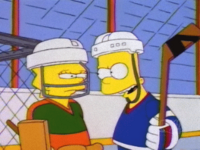 LISA ON ICE (Season 6)
Funny at times -- "Ralph Wiggum lost his shinguard! Hack the bone! Hack the bone!" -- but mostly this episode is a cop-out.
Why? Firstly, the show's writers want to make a point about overly competitive sports parents, and they chose hockey, a foreign game, rather than go after America's triple-threat of baseball, basketball and football. (Granted, they went after youth football in subsequent seasons.)
Secondly, the ending. Bart gets a penalty shot against Lisa with four seconds left in a tie game. The winner will be showered with praise, the loser will be taunted and booed until Homer's throat is sore... but they remember all the good times they've had as siblings, and decide to let the game end in a tie. Except for one thing: In real hockey, the clock doesn't run on a penalty shot, so the ending is a cop-out.
One could argue that the writers played on the average American's ignorance of hockey. It still only makes the ending snort-through-the-nose funny, if not actually funny.
(This post was almost 99% Greg Hughes' idea.)
That's all for now. Send your thoughts to neatesager@yahoo.ca.
Every fan knows The Simpsons had its Golden Age and the Long Plateau, divided precisely at Sept. 28, 1997, The Principal And The Pauper, when it's revealed that Principal Skinner stole another man's identity while in Vietnam. (All together now: Worst. Episode. Ever.)
So, here's the Top 5 sports-themed episodes from the Golden Age:
DEAD PUTTING SOCIETY (Season 2)Homer's resentment toward to Flanders' attempt at friendliness ("Your beer comes from farther away than my beer! Your wife's butt is higher than my wife's butt!) spills over when Homer signs Bart up to play in a mini-golf tournament against Todd Flanders. Homer makes a bet with Flanders that the father of the boy who doesn't win has to mow the other man's lawn wearing his wife's Sunday dress. With the pressure on, Lisa becomes a 4-foot-2 yellow-skinned Phil Jackson, tapping into some Eastern wisdom to help Bart focus.
Lisa: I want you to shut off the logical part of your mind. Bart: OK. Lisa: Embrace nothingness. Bart: You got it. Lisa: Become like an uncarved stone. Bart: Done. Lisa: Bart, you're just pretending to know what I'm talking about! Bart: True. Lisa: Well, it's very frustrating! Bart: I'll bet.
The Funny: Homer gets his at the end of the episode, when Bart and Todd Flanders, after several nerve-wracking playoff holes, decide to call their championship match a draw. This means Homer and Flanders both have to mow the lawn in a dress -- excepts Flanders enjoys it since it "takes me back to my fraternity days."
BART THE DAREDEVIL (Season 2)It wouldn't have even been thought of as a sports-themed episode when it debuted in the fall of 1990, but it predated the X Games and extreme sports' movement into the mainstream, a development that spawned a bajillion Blink-182 videos and Mountain Dew commercials in the late '90s.
(It even got to the point where it was an easy parody -- remember the "Extreme!" guys in Harold & Kumar Go To White Castle?)
The Simpsons go to a monster truck show, where unfortunately they arrive late. Lisa, of course, had to have a saxophone recital. Homer drives into the arena, leading to a harrowing encounter with Truckasaurus. (Even funnier is that Homer has to drive the mangled family car home.)
Inspired by Lance Murdoch ("If he's not in action, he's in traction), Bart fantasizes about becoming a daredevil, imagining an intro of, "If he's not in class, he's risking his ass." (Remember, this was 1990. You didn't hear the word "ass" on TV back then, especially if you were a kid living in a cable-free household.)
Bart begins doing a series of skateboard stunts for the neighbourhood kids. He gets the idea to leap Springfield Gorge, but Homer prevents him -- with disastrously hilarious consequences.
LISA THE GREEK (Season 3)Homer proclaims NFL Sunday to be Daddy-Daughter Day when he discovers Lisa has an almost eerie prescience for helping him win his bets. Remember, the main reason people watch the NFL is because they have money riding on it. In fact, she's much better at it than the network guys, like Smooth Jimmy Apollo (voiced by the late Phil Hartman): "Well, Chet, when you're right 52 per cent of the time, you're wrong 48 perc ent of the time!"
The humour comes in how Lisa, normally so moral, gets such a rush from helping Homer clean out his bookie (Moe, of course) and turn into an eight-year-old gambling addict. She even incorporates her new hobby into an essay on the happiest day of her life:
Ralph Wiggum: ... and when the doctor said I didn't have worms any more, that was the happiest day of my life.Of course, Homer blows it by taking Lisa's gift for granted. Hurt, Lisa offers him this proposition: If Washington wins the Super Bowl, she loves him; if not, Buffalo wins. This creates a very anxious Super Sunday for Homer.
Ms. Hoover: Thank you, Ralph, very graphic ... Lisa Simpson, would you like to read your essay?
Lisa: The happiest day of my life was three Sundays ago. I was sitting on my daddy's knee when the Saints, who were 4½ point favorites, but only up by 3, kicked a meaningless field goal at the last second to cover the spread.
Ms. Hoover: Dear God!
Barfly: "Whaddya got ridin' on this game?"(Also funny: In repeats the following season, "Dallas" was dubbed in for "Washington," and that again correctly predicted the Super Bowl's outcome.)
Homer: "My daughter!"
Barfly: "Whatta gambler!"
THE HOMER THEY FALL (Season 8)After Homer gets beaten up by the fathers of school bullies Dolph, Jimbo and Kearney at Moe's, Moe the Bartender decides to revive his failed boxing dreams by putting Homer in the ring. Predictably, Marge objects --"Of all the crazy ideas you've ever had, this one ranks somewhere in the middle." However, it turns out Homer more than meets state requirements to "box, wrestle or be shot out of a cannon." (Apparently whatever state Springfield is in was founded by circus freaks.)
Refusing to fight, and simply waiting for his opponents to punch themselves to exhaustion so he can push them to the canvas, Homer cleans out the ranks of ASSBOX (Association of Springfield Semi-Professional Boxers):
Moe: OK, you're fighting a guy named Boxcar Bob.
Homer: Brawled his way up from the boxcars, did he?
Moe: Uh, no, not yet, he still lives at the train yard. But he's a hungry young fighter. In fact, he's actually fighting for a sandwich.
This gets Homer a shot at the champ, Drederick Tatum, who, uh, kind of looks like a certain boxer from real life.
The Funny: You learn more of Moe's backstory, there's a Raging Bull parody, and well, making fun of boxing -- the sham fights, the B-list celebrities, its bottomless capacity for farce -- is like fishing with dynamite.
HOMER AT THE BAT (Season 3)Let's see: Parodies The Natural, the song Talkin' Baseball ("Mike Scioscia's tragic illness made us smile / while Wade Boggs lay unconscious on the barroom tile") and George M. Steinbrenner III's micromanaging ways: "Mattingly! I told you to trim those sideburns!"
Writers and baseball are always a natural mesh, and there's enough baseball-fan humour and knowing references to support this episode. Darryl Strawberry's a team player ("Some of these guys have a got a bad attitude, skip") and José Canseco is a glory hog ("Don't worry, ma'am, I'll save your cat"). Plus we find out Mr. Burns is really, really old, since his initial hand-picked team of ringers consists of Cap Anson, Honus Wagner and Mordecai (Three Finger) Brown. In fact, his right fielder has been dead for 130 years.
Waylon Smithers, acting upon Burns' orders to "scour the professional ranks -- the American League, the National League, the Negro Leagues," puts together a team that's more stacked than the late-'90s Yankees. Of course, all of of Waylon's wizards are waylaid by various calamities, meaning the real Power Plant team has to play the championship game -- except for regular right-fielder Homer Simpson, since Strawberry is still OK to play. Naturally, Homer gets his skull-cracking chance at glory.
Lisa: "No, Mom, it counts as a hit! Dad won the game!"WHY NOT...
Marge: "Well, I guess he'll be happy... when he comes to."
LISA ON ICE (Season 6)Funny at times -- "Ralph Wiggum lost his shinguard! Hack the bone! Hack the bone!" -- but mostly this episode is a cop-out.
Why? Firstly, the show's writers want to make a point about overly competitive sports parents, and they chose hockey, a foreign game, rather than go after America's triple-threat of baseball, basketball and football. (Granted, they went after youth football in subsequent seasons.)
Secondly, the ending. Bart gets a penalty shot against Lisa with four seconds left in a tie game. The winner will be showered with praise, the loser will be taunted and booed until Homer's throat is sore... but they remember all the good times they've had as siblings, and decide to let the game end in a tie. Except for one thing: In real hockey, the clock doesn't run on a penalty shot, so the ending is a cop-out.
One could argue that the writers played on the average American's ignorance of hockey. It still only makes the ending snort-through-the-nose funny, if not actually funny.
(This post was almost 99% Greg Hughes' idea.)
That's all for now. Send your thoughts to neatesager@yahoo.ca.
Saturday, April 12, 2008
NO REASON TO GET YOUR SOX SOAKED
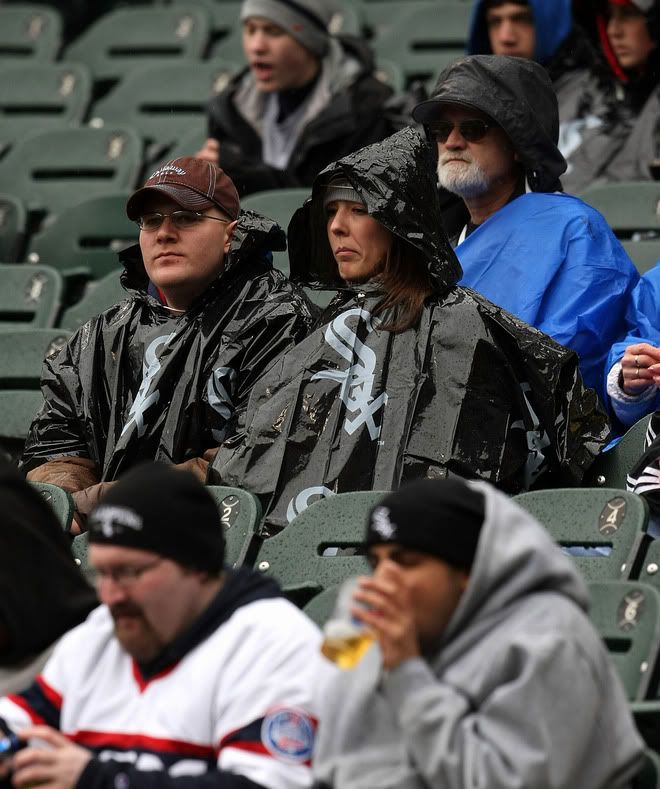 The daily baseball post ... Jays in the sandwich game vs. the Texas Rangers ...
- The past two Tigers-White Sox games have aided the argument for baseball playing fewer games with more scheduled off-days.
It never ceases to amaze that baseball forces teams to play in April when the weather can reduce the game to a farce and put players at physical risk. It's not right for a game that requires such hand-eye co-ordination and precision.
Friday, Dontrelle Willis hyper-extended his right knee when he slipped pitching on a rain-soaked mound. Now he's on the disabled list.
The conditions were fit for neither beast nor ballplayer again today, which played a part in Justin Verlander losing his grip on a pitch and plunking Orlando Cabrera in the back of the head during the eighth inning. (Cabrera wasn't injured, but people walk away from car crashes, too.)
Seriously, why not cut back to 140-145 games and start two weeks later? There would be more open dates to reschedule rained-out games.
The Tigers, now 2-10, could certainly have used a later start. - Cox Bloc referred to Jays shortstop John McDonald as "Johnny McGlovin" a couple weeks ago. Did they not see the movie? It's one name -- like Seal.
(Sorry, someone is protective of his pop-culture reference.) - Toronto Sun baseball writer Bob Elliott has joined the blogosphere. Elliott's Top Canadians Eligible For '08 MLB Draft (canadiandraft08.blogspot.com) picks up from the site he used have at SLAM! Sports.
Elliott is also planning to launch canadianbaseballnetwork.com within a few weeks. No other sports journalist with Elliott's profile spends as much time tracking the up-and-coming Canadian baseball talent. Without him, we wouldn't know that the Jays are high on an infielder, Carter Bell, who is the namesake of two former Jays all-stars. With that name, how could they not be interested in him? - Stephen Brunt hit it out of the park with his Saturday column on Jose Canseco's Vindicated:
"In all of the denials, the scapegoating, the lying, the hypocrisy, the phony Hall of Fame moralizing and the political opportunism, baseball made a 'certifiable nutcase' credible, raised his stock and cast him as an honest whistle-blower — which is quite the feat."
Canseco is a grotesque, but in a morality play, it's often a grotesque who is responsible for exposing a society's ills and hypocrisies. - A figure of interest from the Simcoe Reformer days, right-handed pitcher John Axford, got his first win of the season on Friday for Brevard County, the Brewers' Florida State League team (high class-A). Axford struck out six over four-plus innings, although he walked four and had a couple wild pitches.
- Here's the article where ex-Jays third baseman Ed Sprague admitted using andro during his playing career. There go his Hall of Fame chances (hey, wait a second).
That's all for now. Send your thoughts to neatesager@yahoo.ca.
Friday, December 14, 2007
LAST, LAST, LAST, LAST WORDS ON THE MITCHELL REPORT...
... goes to Babes Love Baseball ...
And Kissing Suzy Kolber, who imagines what NFL commissioner Roger Goodell must be imagining after his league got a free pass on steroids -- again. Remember when it came out that several key guys on Carolina's 2003 Super Bowl team were implicated as dopers? No? Exactly.
Buster in his 'kerchief, and Bud in his cap,
Had just settled down for three hours of crap.
When out in the press room, there arose such a clatter,
Oh, it's just Canseco... he doesn't really matter.
And Kissing Suzy Kolber, who imagines what NFL commissioner Roger Goodell must be imagining after his league got a free pass on steroids -- again. Remember when it came out that several key guys on Carolina's 2003 Super Bowl team were implicated as dopers? No? Exactly.
Friday, December 15, 2006
JEFF BAGWELL: EARLY ADOPTER AND FIRST BALLOT HALL OF FAMER
 (Future Hall of Famer Jeff Bagwell is retiring today. Here's what appeared about him on Nov. 1, the day after it became clear he would retire.)
Jeff Bagwell has been handed a $7 million buyout package by the Houston Astros. Money for nothing -- what else would you expect from a franchise whose ballpark was once called Enron Field?
Very few Bagwell retirement tributes will refer to him and his buddy from the right side of the Astros infield, Craig Biggio, as "early adopters." That's Net lingo for people who can sense a coming change and lead it instead of react to it. Both Bags and Biggio were players who foreshadowed the Moneyball era -- which is why Bagwell's Hall of Fame credentials may be lost some of the Hall of Fame voters of an older generation. (Just look at the people who look like dunderheads for claiming that Mark McGwire's low career hit total is somehow relevant.)
The Hall of Fame voters have all these arbitrary standards -- 3,000 hits, 500 homers, a .300 career batting average, etc. -- that should have been discarded long ago, because they obscure the brilliance of players such as Bags and Biggio. Neither has a .300 career average, but both have excellent on-base percentages -- the all-important stat that teams used to discount before slowly waking up to its most importance over the past few years. Both were great "percentage players."
Both have skills which teams underrate. For Bagwell, that's defence and base-stealing ability from a first baseman. For Biggio, it's his surprising power for a second baseman.
That's lost on some baseball writers who fetishize Triple Crown stats -- batting average, home runs and RBI -- and World Series rings. When Bagwell comes up for the Hall of Fame, they'll look at the .297 career batting average and 449 career home runs -- fewer dingers than Jose Canseco, Fred McGriff and the disgraced Rafael Palmeiro (and Sammy Sosa and Mark McGwire, all of whose hopes for the Hall range from not a chance to iffy at best, for various reasons.)
On a side note, Bags and Biggio's career arc reflects how baseball, in the States, has tried to become (like a lot of U.S. pop culture) this white, Christian right-pandering enterprise — ironically at a time when it's more of a global game than ever before. The '05 Astros were the first pennant winner in 50 years to not have a single African-American on their roster.
A generation ago, baseball had lots of coulda-been-anything guys, black and white, who could easily be pictured playing another sport: Kirk Gibson, Paul Molitor, Eric Davis, Tim Raines, Rickey Henderson or Dave Winfield. Tom Glavine and Orel Hershiser both could have played hockey. Understandably, that could be off-putting to a veteran baseball writer.
Those are just a couple factors in why Bagwell and Biggio have gone so unnoticed. Back in '03, ESPN.com did a poll (unscientific, I know) and respondents didn't think either was a Hall of Famer. People have come around on Biggio, but mainly because he's hung on long enough to approach 3,000 career hits.
(Biggio reached 3,000 secondary bases a couple years ago. Hopefully, voters will perk up to value of secondary bases in a player's Hall of Fame credentials: Tim Raines, the great Montreal Expo, fell short of 3,000 hits due to injuries, but had more than 3,300 secondary bases.)
Bagwell slowed down after 2001 due to an arthritic right shoulder, which along with nine seasons of 81 games a year at the Astrodome cost him a shot at 500 homers. Still, a player should be taken at his peak value, and he managed 449 homers while playing only 14 full seasons. That's a Hall of Famer. He's also had the same strikes against him that Carlos Delgado has had -- played for a team that didn't get a lot of attention, and he was very consistent year-in year-out, so he didn't generate a lot of buzz like Ryan Howard or Justin Morneau did this year.
Plus, in the '90s, there was always a ton of guys putting up these ridiculous home run and RBI totals each year. Brady Anderson once hit 50 home runs in a season. It's tough to sift through the numbers and figure out who was for real during the Steroid Era. The 5-foot-11 Bagwell's body type changed a little but he seems to have escaped scrutiny, since the rules of American sports journalism prohibit steroid allegations from being directed at average-sized Caucasian ballplayers on teams based in Red States.
Nevertheless, Bags was bona fide, all right. His stats list how he fares on a series of litmus tests Bill James devised to measure a player's Cooperstown credentials, and Bagwell passes three of the four, no problem. It's just that his greatness is obscured from some people since:
- He didn't play in a major baseball market
- Wasn't in the post-season every year, and struggled when his team did make it
- Played in a pitcher's park -- it would be a fair guess that he lost 4-5 homers a year while playing in the Astrodome from 1991 to '99
- Didn't get to pad his stats during the "wind-down" portion of his career
- His offensive skills were spread out over several areas, rather than just one or two (like McGwire and his home runs, or Tony Gwynn and his batting average)
Bagwell, like Albert Pujols, was a more complete player than the aforementioned guys who put up big career home run totals and won't get into Cooperstown. That should be taken into account. He's the only first baseman to ever have a 30-homer, 30-stolen base year, and he did win one Gold Glove for his defence.
Take a look at that .408 career on-base percentage -- OBP goes a lot farther toward helping a baseball team win than batting average. Take a look at his all-around game. Oh, and while I don't have the time to put it in historical context, his on-base plus slugging (OPS) of .948 is among the top 25, all time.
A Hall of Famer? Hell yes. There are plenty of early adopters among baseball nuts who realize Bagwell was a brilliant player. If he's not a first-ballot Hall of Famer, then burn the place down.
OK, please don't burn the place down.
Related:
Jeff Bagwell career stats (Baseball-Reference.com)
Quick note on secondary average (extra bases on hits, walks, hit by pitches and steals divided by total at-bats): Craig Biggio has a career batting average of .283, but his secondary average is .329. Fellow middle infielder and sure-fire first-ballot Hall of Famer Cal Ripken hit .276 lifetime, with a secondary average of .278. (I'm including hit-by-pitches in these figures, although some people don't.)
Tony Gwynn hit .338 for his career, but his secondary average is only .242. Again, none of this has been put in the context of eras or home parks.
Talk you later. Send your thoughts to neatesager@yahoo.ca.
Friday, September 01, 2006
ALEX RIOS MAKES BLOOPER REEL; WHERE'S LONNIE SMITH WHEN YOU NEED HIM?
 In 22 years of watching Blue Jays baseball, that was a first, and considering that span has included watching George Bell and Jose Canseco have the outfield play them, that's saying something.
Sure, the Red Sox were due for their luck to change, but this was ridiculous. Right-fielder Alex Rios turned a warning-track fly ball into the game-winning home run in Boston's 6-4 win, by dropping Alex Cora's deep fly, then slapping it over the fence when he tried to recover by bare-handing the ball. It was Cora's first homer since Aug. 15, 2005. So not only did Alex Rios commit the biggest fielding gaffe in Jays history, but the guy who got the gift homer hadn't hit one since people still had confidence in FEMA.
There's an item for J.P. Ricciardi's to-do list: Find Lonnie (Skates) Smith, wherever he is, and bring him in to teach Rios "Defensive Recovery and Cost Containment." (Hat tip to Bill James.)
Can't remember who Rob Neyer picked as the right-fielder on the Jays' "Iron Glove" team in his Big Book of Baseball Lineups, but if he's revising it, Rios probably earned the spot.
Oh, well. At least Rios' goof-up took attention away from the fact that even with ace Roy Halladay pitching, the Jays beat themselves (three double plays grounded into) against a team that trotted out a spring training-esque lineup and was so enthused about their scheduled starting pitcher that they traded him 3,000 miles away before the game. (David Wells was sent to San Diego, to be exact.)
Just another day in the life of the Blue Jays, eh. That's baseball. There's always a game the next day, but if the remnants of tropical storm Ernesto could move up the Eastern seaboard quickly and cause a rainout at Fenway tonight, it would be much appreciated.
That's all for now. Send your thoughts to neatesager@yahoo.ca.
Friday, June 23, 2006
A PARADISE LOST KIND OF FEELING: CARLOS COMES BACK TO TORONTO
 (Note: This originally appeared Thursday, June 22.)
Once in a great while, we are privileged to experience a television event so extraordinary, it becomes part of our shared heritage. 1969: Man walks on the moon. 1971: Man walks on the moon... again. Then, for a long time, nothing happened.
Until tonight, when Carlos Delgado, now a member of the New York Mets, plays in Toronto for the first time as a visiting player. (Richard Griffin had a superb column in yesterday's Toronto Star.)
Not to go all Bill Simmons and write some 20,000-word rambling screed about Carlos' place in the Toronto Sports Pantheon, but the occasion demands it.
Toronto has a bad track record with how it treats and receives its superstars. Nothing Mats Sundin has done has ever been good enough for the bulk of Leafs fans, but lesser players like Tie Domi and Darcy Tucker are worshipped. Go figure.
It was the same with Darryl Sittler, who got booed when it was obvious he was on his way out of town, and the same with Frank Mahovlich back in the '60s.
Part of it that Toronto is an easy-gratification kind of place with a very unsophisticated sports-watching public. (That goes for the great Canadian sport of hockey as well as those U.S. imports, basketball and baseball.)
It's also very insular, so it's assumed, Hey, if this guy is a superstar, he should be able to win a championship by himself. It's also hard for certain fans to fathom why anyone would want to live and make his money elsewhere than in the self-proclaimed Centre of the Universe. Doesn't everyone want to come to Toronto?
So when Vince Carter's fortunes turned sour, and it was as much the fault of inept Raptors management as it was his own emotional immaturity, VC forever became anathema in Toronto. That also happened to Roberto Alomar, the greatest player ever to wear a Jays uniform, whom the team went out of its way to portray as a petulant prima donna when he was on his way out in 1995.
(Alomar probably was a petulant prima donna. He's a baseball player. It goes without saying. Yet people can't seem to accept this.)
So yes, the worry is that Delgado is going to get booed when he comes to bat for the first time tonight, and by more than the usual beered-up contingent who show up at any ballpark on a Friday night. He doesn't deserve it.
WRONG TIME, WRONG PLACE
Still, there's always going to be a Paradise Lost kind of feeling with respect to Delgado's Jays days. Here was a ballplayer who should have owned Toronto.
What was not to like? A home-run hitter who also hit for average and was, at times, capable of carrying a team for weeks at a time. Big smile, easy-going, comfortable in his own skin and its own set of human frailties.
He showed off his shaved head and never seemed to get overly defensive about the fielding flubs that often plagued him at first base. This is who I am. I have no hair and I'm not going to win a Gold Glove any time soon. So take me as I am.
Unlike your typical pro athlete who seems removed from the people who pay to watch him play, he embraced Toronto, by all accounts earning his epaulets as a bona fide culture-vulture.
Yet the vast majority never embraced him back. The timing and tide was all wrong. In a sense, Carlos was born 10 years too early. If he'd come on the scene in 1984, when the Jays were an exciting young team, the Leafs were in disarray and the NBA coming to T.O. was a pipe dream, it would have been different.
Instead, he had to arrive on the scene after the 1994 strike. It was the darkest days of the transitional period between the the original ownership and the absentee Interbrew S.A. group, with the holdovers from the World Series teams -- Alomar, Devon White, Al Leiter, to name a few, with Pat Hentgen as a shining exception -- all speed-dialling their agents to see how fast they could get out of town.
There were vast expanses of empty seats at Skydome, ugly uniforms and the this-is-too-surreal-to-enjoy experience of having Roger Clemens for two seasons. Oh, and for part of one season, Jose Canseco had to play left field.
In the early '90s, you had to explain yourself if you weren't a Jays fan. By the end of the decade, you had to explain why you still were one. That's trendy Toronto for you.
From '98 through 2003, Delgado embodied Bill James' line about Eddie Murray -- his best season was every season. He was automatic for 30-plus homers, more than 100 RBI and an OPS in the .950 range. And there's the rub. No matter what he did, it could never get the Jays higher than third place, perennial also-rans behind the Evil Empire and the Red Sox, who didn't really become Evil Empire 1-A until 2003.
It wasn't his fault the Jays, then as now, were lacking in pitching and defence. They could mash those home runs, but not quite at the rate of the best teams.
Carlos' year-in, year-out consistency probably cost him recognition in the press, and at least one MVP award. No one notices if you play for a team that's a perpetual also-ran, put up pretty much that same stats every year and top it off by playing in Canada. Besides, with the Steroid Era, weren't a lot of guys putting up big numbers every season?
That said, the two years he came closest to capturing the MVP -- 2000 and '03 -- it seemed like the right guys won, at least at the time. (After all, we know more about the 2000 winner, Jason Giambi, now, than we did back then.)
Still, there was always this element of dissatisfaction with whatever Delgado did. Just read between the lines of what one wannabe Knight of the Keyboard wrote in November 2003, after he finished a close second to Alex Rodriguez in the MVP balloting.
"If the Rangers probably "could have finished last without (A-Rod)," it stands to reason the Blue Jays could finish third in the AL East without Carlos Delgado having an MVP-type season. In fact, for six straight years, Toronto has finished third whether Carlos Delgado hits .272 or .344, slugs 33 or 44 homers, or whether he knocks in 102 runs or 145."
What ingrate wrote that? Me, at my old blog.
Even those who champion Carlos never seem to quite get it right. Griffin is being a little revisionist when he says it's "somewhat ironic" that after one year without Carlos' big bat, the Jays went out traded for a power-hitting corner infielder in Troy Glaus, although it is rather symbolic that Glaus is wearing Delgado's old No. 25.
In that regard, the tempest-in-a-dugout over Delgado's silent protest a couple years ago -- his refusal to stand on the field, during the playing of God Bless America during the seventh-inning stretch, instead disappearing into the clubhouse tunnel -- has been misconstrued.
Griffin, today, characterizes it as his "anti-war stance." That's what you get in sound-bite society, since Delgado did call the American conquest in Iraq "the stupidest war ever" a long time before polling showed a plurality of people in the U.S. and Canada would tend to agree with such a statement.
In actuality, Delgado's protest had more to do with the American government allegedly refusing to be accountable for the pollution problems and skyrocketing cancer rates caused by over 60 years of U.S. Navy weapons testing on the island of Vieques in Delgado's Puerto Rico.
GAVE US PLENTY
So now Carlos, the best player the Jays farm system has ever developed, is coming to town. He's having a fine season with the Mets. It looks like he'll play in the post-season for the first time after spending some 1,700 games in the majors. With his 34th birthday falling on Sunday, he's 11 homers shy of 400 for his career, meaning he has an outside shot at the 500 which used to guarantee you a plaque in Cooperstown, pre-Rafael Palmeiro.
It may not get noted in the papers, but the definitive Delgado-in-Toronto moment will always be another Sunday in June, another game that fell on his birthday: June 25, 2000, against the Red Sox.
Then as now, the Jays had stayed on the fringe of the playoff race until June. Pedro Martinez, Delgado's present-day Mets teammate, was pitching for the Red Sox. This was the Pedro Martinez, the one whom that Grady Little thought he had when he let him come out for the eighth inning of the 2003 ALCS against the Yankees.
Chris Carpenter got knocked out early, but the Jays bullpen kept the game close and the hitters pecked away at Pedro, even in the midst of his obligatory one-walk, 10-strikeout performance. It was 5-3 in the bottom of the seventh when Carlos came up with two out, representing the tying run.
And he crushed it. Wayyyyyyyy back in right field, a no-doubter off the best right-handed pitcher in the game to tie it up, and the 30,000 or so in the park sounded like the full houses after the "Winfield Wants Noise" edict was thrown down back in '92. Jays win it in extra innings.
It was definitive since the deed had only a temporary glow. By the dog days of July and August, the Jays' pursuit of the playoffs would take on a doomed quality. Raul Mondesi suffered a season-ending injury; once again, there wasn't enough pitching. The Jays finished with their usual 83 wins, four and a half lengths behind the Yankees.
However, that wasn't Delgado's fault. What he did was plenty.
Well, the last sentence brings it to 1,638 words. I can hear it now: Hey, Sager, Simmons would have made it to 20,000.
Send your thoughts to neatesager@yahoo.ca.
Subscribe to:
Comments (Atom)


 Posts
Posts



