Showing posts with label Jeff Bagwell. Show all posts

Saturday, April 04, 2009

Batter up: Houston Astros

It's that mystical, wonderful time of year where you commit to a baseball team who you know fully well won't win. This season, in honour of an popular Internet meme, we'll present 25 things that are tangentially about each team. At bat: The Houston Astros.
  1. Senators owner Eugene Melnyk wants you to know anyone who thinks the Astros should blow up their roster should get a bomb and blow themselves up. They fluked out an 86-win season, but now have an aging lineup and strange as it might sound for a team in Texas, have about run out of bullets.

  2. Astros great Craig Biggio is now coaching his son's high school baseball team. People have been saying they're better than they get credit for, but everyone will soon realize that they have just been overachieving.

  3. It might have been better to come up with a list of 25 beejos than 25 things about the Astros.

  4. Houston ace Roy Oswalt's closest comparable is Roy Halladay. And they have the same name!

  5. It's best to not go looking for a picture of Astros owner Drayton Moore and just picture him as the Rich Texan from The Simpsons. Carlos Lee and Miguel Tejada's contracts are on par with owning the world's fattest racehorse.

  6. They had the oldest team in the majors before signing a 37-year-old catcher universally known as Pudge. Ivan Rodriguez hasn't been a league-average hitter since 2004.
  7. If you want to know why Nolan Ryan pitched forever, check the expression he gets on his face just before he reaches back to squirt Charlie Kerfeld with champagne. It's right at the end.


  8. At one point this spring they had overwhelmed one opponent, underwhelmed 16 and whelmed three. Their overall spring training record was 11-19-1. It only means something if you let it mean something.

  9. FanGraphs gives their farm system an F.

  10. Centrefielder Michael Bourn's 41 steals were the most for a Houston player since Craig Biggio swiped 50 in 1998. This is about the only similarity between them as players.

    It's always a laugh-and-a-half to read that a player could be good "if he can get his on-base percentage up." That's almost like telling a basketball player, "be taller."

    Bourn could crack .300 if he started getting hit by pitches at a more Biggio-esque rate. He was plunked only twice last season.

  11. There's a sneaking suspicion that the Baseball Prospectus people listed catcher Jason Castro as the 76th-best prospect just so people could say they didn't have anyone in the top 75. That was downright decent of them.

  12. Mixing and matching interleague opponents really mushroomed once the Astros, an NL Central team, started playing the Texas Rangers, an AL West team (in the first couple years, the West played the West, and so on). There are some great ideas to make interleague better, but don't expect it to happen.

  13. The most glamourous thing about middle reliever Geoff Geary is that he's represented by the Beverly Hills Sports Council. Somewhere there's a 25-year-old guy trying to use, "I worked on Geoff Geary's contract" to impress women.

  14. Lance Berkman has on-based .413 and slugged .560 in his career, which are big-time numbers for a 10-year veteran. He's kind of a poor man's Jim Thome.

  15. Has everyone forgotten that it was reported last spring that a Houston trainer supplied steroids to retired Astros great Jeff Bagwell, along with Roger Clemens and Andy Pettitte?

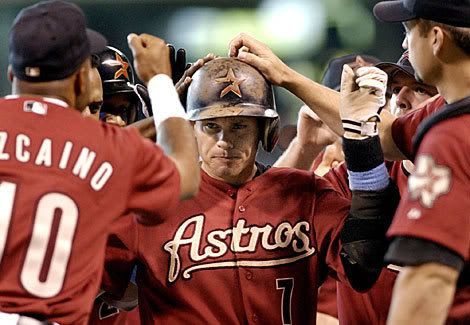
  16. Jose Valverde (pictured) is a dominant closer, but the Astros having him might be a bit like GM execs keeping their private jets. It's going to be a long season in Houston.

  17. Please show some love for Wandy Rodriguez, who's among the best pitchers no one outside of fantasy leaguers has ever heard of.

  18. This Roger Clemens Sports Illustrated cover from five years ago is pretty ironic.

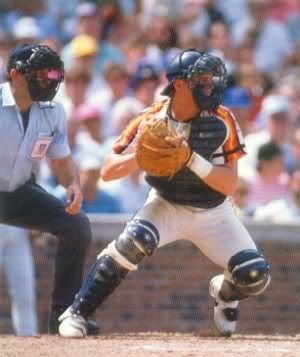
  19. Tuesday is the 30th anniversary of former Astro Bob Forsch throwing what was then the earliest no-hitter in baseball history. His cather that night was The FAN 590's Alan Ashby, who the good Lord willing, will get to commentate the next Blue Jays no-hitter.

  20. You probably knew that veteran outfielder Darin Erstad was the punter for the Nebraska Cornhuskers when they won the NCAA football title in 1994, but did you know he actually caught a pass that season? You do now. It's around the 2:00 mark of the clip. Apparently, the Cornhuskers were using an old Ottawa Rough Riders playbook: Have the holder drop the snap, pick up wildy run around wildly and heave it downfield and hope something good happens.


  21. From the department of "good to know," the franchise record for losses in a season is 97, set the first year the team was known as the Astros.

  22. The best baseball team in Houston right now is probably the Rice Owls. They're 19-7 this season.

  23. Minute Maid Park could stand to lose Tal's Hill in centrefield. How someone hasn't broken their neck running up that incline is absolutely amazing.

  24. Lance Berkman's spouse is named Cara and knowing that is not the least bit pathetic.

  25. Cecil Cooper could be the first manager fired this season, one of the risks of working for the Rich Texan.

Thursday, February 26, 2009

Zen Dayley: Carlos and the Bagman

It's been around the blogosphere and back, but a pre-eminent baseball writer batting out a column calling ex-Jay Carlos Delgado "the lost slugger of the Steroid Era" demands a response, especially when you totally called this spin:
"It's been hard, as a Jays fan, to shake the idea that Carlos Delgado's reputation might improve even though there's no way to presume anyone was clean as a bean."
-- Feb. 10, 2009
Discretion seemed like the better part of beating the Delgado drum two weeks ago.

It is zero-sum to play the guessing game of who was clean and who was juicing in baseball in the 1990s and 2000s. Tom Verducci, though, makes six figures writing about baseball (oh, the envy is just dripping off the computer screen), so maybe he can feel a little safer stepping out on to that ledge. The rest of us, who don't have editors and advertisers to answer to so much, can, as Jason at It Is About The Money, Stupid did, call this a "fool's errand." There is no way of knowing, so you can't turn Delgado into this smiling, ebullient bald-headed beacon.

It is also curious, mildly, whom Verducci doesn't seize upon as the Lost Slugger as he did his tour of spring training camps, carrying a lantern in the daytime. Delgado hit the ninth-most home runs in baseball from 1996 to 2003, which is taken to be the full run of the Steroid Era, to which Jules in Superbad would say, "Wow, that's a bit of an oversimplication there." Another first baseman of that period, Jeff Bagwell, is tied for sixth on the list (with Mark McGwire, who actually didn't play in two of those seasons).

Bagwell was not forgotten. He was simply underrated. He is also retired as a player, plus there was a New York Daily News report last spring that a trainer supplied drugs to him, Roger Clemens and Andy Pettitte when all three played in Houston. It didn't have much of stickiness factor, perhaps since "the rules of American sports journalism prohibit steroid allegations from being directed at average-sized Caucasian ballplayers on teams based in Red States." (OOLF, Dec. 15, 2006.)


Point being, Jeff Bagwell is not as good a literary device as Delgado. He's also not as a big skin to hang on the wall compared to Rodriguez, Barry Bonds, Sammy Sosa or Clemens and Mark McGwire. Being underrated and playing your whole career in a football state has its perks. (As an aside, someone claimed the spike in Bagwell's home-run rates was fishy, failing to point out he hit only four homers in his Double-A season in 1990 because he played in an extremely pitcher-friendly league; no one on his team hit more than five homers, and Bagwell led the league in doubles, which is an indicator of a burgeoning home-run stroke.)

Getting back to Delgado, it's easy to see why he would put on such a pedestal. He plays for the other New York ballclub and he could soon be in rare company when it comes to his counting stats.
"This season, be it anything close to ordinary for him, Delgado will become only the 11th player in baseball history with 500 home runs, 500 doubles and 1,500 RBIs. It is a club with no back door. The others: Babe Ruth, Ted Williams, Hank Aaron, Willie Mays, Frank Robinson, Eddie Murray, (Ken) Griffey, (Manny) Ramirez, (Rafael) Palmeiro and (Barry) Bonds. And yet Delgado never is talked about as a first-ballot Hall of Famer, and is rarely discussed as a Hall of Famer at all."
It's a fun thought, although piling up the big career hit, home run and RBI totals is somewhat a combination of longevity and the era where someone played. The first five names on that list are all-time greats beyond that doubt. The next five involve a guy who played forever and four who had the benefit of playing in the ArenaBall era, including two whom most people would call drug cheats.

Delgado should not be turned into a hero after the fact. He was a terrific hitter in Toronto. The vibe with him was the same as it has been with Roy Halladay since the start of the 2005 through on or around July 31, 2009,. He made it feel like the Blue Jays would always have some hope as long as he was as around. Perhaps Hall of Fame voters, who tend to give a lot of credence to someone having won a MVP award or Cy Young Award, will consider looking at it as if he won in 2003, when he was edged by Alex Rodriguez.

The bottom line, as ShysterBall noted, it's really hard to except people to believe who was clean and who was dirty.
"Look, I appreciate what Verducci is trying to do here. He, like so many of us, wants to bring some kind of certainty to bear on steroids' impact on baseball. He wants to draw a line around certain players and statistics so we can at least have some kind of a foothold for assessing the era in which we find ourselves. The fact of the matter, however, is that no analysis, such as it is, like this one going to achieve that certainty or allow us to separate the wheat from the chaff. Rather, it's going to take a lot of time and a lot of reporting and scholarship. In the meantime, we're just going to have to live with our vague senses about this stuff and have some faith that the enduring nature of the game -- and the work of history -- will sort all of this stuff out for us."
In the meantime, Carlos Delgado is 31 homers from 500. He'll probably achieve the milestone in September. Sure, it would have been great if he could have done it in a Blue Jays uniform.

Bloggers can't be choosers, though. Only Sports Illustrated gets make such choices.

Related:
Appreciating Carlos Delgado, the lost slugger of the Steroid Era (Tom Verducci, SI.com)

Friday, July 27, 2007

THE "SEC RET" TO BIGGIO'S SUCCESS

Anyone who believes Craig Biggio (pictured) wasn't worthy of entering the Baseball Hall of Fame until he achieved his milestone 3,000th career hit late last month needs to have her or his head examined.

Biggio said earlier this week that he would retire after 20 seasons of wearing only the many colours of the Houston Astros. No doubt a lot of sports journalists said or wrote gems on a theme of, "He's never won a World Series or a MVP award," to quote a very blond anchor at one of the Canadian sports networks.

Ya? And? So? What? Neither did Tony Gwynn, who is being inducted into the Hall of Fame in Cooperstown, N.Y., this very weekend. He only got 97.6% of the vote too.

Twenty players who played most of their career after the Second World War have reached 3,000 hits. The point here is that Craig Biggio brought a wider range of abilities to the game than almost any comparable player in the past 60 years who also had the staying power to reach 3,000 hits. What's special about him touches almost all areas of what a batter does to help his team score runs, which is the name of the game.

So, and this is crude, one way to do this is to compare each post-WW2 3,000-hit club member's ratio of secondary bases (extra bases on hits, stolen bases and walks) to career hits. The principle is that not every hit is created equal. A 2-for-3 game with two singles is not the same as 2-for-3 with a home run, a walk and a stolen base. This can basically be called the "Secondary Return" ("SecRet") for short. I'm not even sure if it has any value, but it should show what a player contributed on top of just getting hits.

For relevancy's sake, Henry Aaron, Rickey Henderson and Willie Mays have been omitted (I did crunch numbers for them anyways, and they're so far ahead of the other guys here that it's not even funny). Biggio's not competing against them to get into the Hall of Fame; he's competing more against the likes of Gwynn, Paul Molitor or Ryne Sandberg. Since this is about the Hall of Fame, Rafael Palmeiro has been omitted for obvious reasons.

So here's each player's ratio of secondary bases to career hits for the remaining 16 players:
  1. Carl Yastrzemski: 1.209
  2. Stan Musial: 1.152
  3. Dave Winfield: 1.141
  4. Eddie Murray: 1.101
  5. Al Kaline: 1.084
  6. Craig Biggio: 1.061
  7. George Brett: 1.010
  8. Cal Ripken: 0.989
  9. Lou Brock: 0.964
  10. Paul Molitor: 0.944
  11. Robin Yount: 0.899
  12. Wade Boggs: 0.827
  13. Pete Rose: 0.766
  14. Rod Carew: 0.759
  15. Roberto Clemente: 0.732
  16. Tony Gwynn: 0.709

Remember, the five players ahead of Biggio on that list each played first base, designated hitter or a corner outfield spot. Biggio, in fact, is the only player of the post-WW2 era to reach 3,000 hits while playing most of his games at second base, which is more demanding mentally and physically. (Rose, Carew and Molitor started out there but moved to other positions; Yastrzemski was converted to the outfield in the minors).

What's that as a percentage? Here's the career secondary averages (secondary bases divided by at-bats) for our sweet sixteen (career batting average:

  1. Musial: .381 (.331)
  2. Yastrzemski: .345
  3. Winfield: .323 (.283)
  4. Kaline: .322 (.297)
  5. Murray: .316 (.287)
  6. Brett: .308 (.305)
  7. Biggio: .299 (.282)
  8. Molitor: .289 (.306)
  9. Brock: .283 (.293)
  10. Ripken: .273 (.276)
  11. Boggs: .271 (.328)
  12. Yount: .256 (.285)
  13. Carew: .249 (.328)
  14. Gwynn: .240 (.338)
  15. Clemente: .232 (.317)
  16. Rose: .232 (.303)

It's clear, looking at this list, that batting average has import, if not actual importance. It's an easily understood touchstone between sports fans. Suppose those averages were reversed. How would fans perceive Tony Gwynn if he had a .240 career average and a .338 secondary average? He wouldn't be looked at in the same way and he probably wouldn't have been able to spend 20 years with the San Diego Padres.

Conversely, if Craig Biggio was a career .299 hitter across 20 seasons -- which would have meant he was well above .300 lifetime during his peak seasons -- there would be no doubt about it with his Hall of Fame candidacy.

There's more to it in than that. This exercise probably only has value if you're comparing similar types of players who played about the same number of seasons. It also doesn't take into account era or home-ballpark factors.

Also, we're only looking at career stats. Ballplayers should be judged based on a their peak period across 10 or 12 years. That's why this was limited to 3,000-hit club members, who do take a hit on their "percentages" to get the hallowed milestone. The most infamous was Kaline, who was a .300 hitter all his life until his final season, 1974, when he came back in a bid to reach 3,000 hits and 400 homers (he ended up at 399).

For instance, Sandberg, the great Cubs second baseman who went into the Hall of Fame on the first ballot in 2003, played "only" 16 seasons with 2,386 career hits.
Guess what? His Secondary Return for his career was 1.050, lower than Biggio's 1.061. The gap is only that close due to Sandberg's early retirement(s) and Biggio spending 11 seasons as an everyday player with the Astrodome as his home ballpark. (Biggio had a higher on-base plus slugging, or OPS, on the road in eight of his 11 seasons as an everyday player where the Astros played indoors.

How about Biggio's other 1990s contemporary at second base, Roberto Alomar, who retired on a career .300 batting average after 17 seasons and 2,724 hits? Alomar's "Sec Ret" is 1.028.

Using Secondary Ratio and looking at secondary bases should show how Craig Biggio's essence as a ballplayer spread across so many facets of the game and elevates him to the class with Gwynn, Alomar, Sandberg and Cal Ripken, who's also entering Cooperstown this weekend. It's not that he was better. It's just most of the others had something defining -- Gwynn's .338 average, Ripken's consecutive-game streak -- that has import, but isn't the be-all end-all.

He could get on base (career .365 on-base percentage), he could score runs (12 seasons with 94 or more runs scored), and he hit with exceptional power for a second baseman (he's the all-time leader in doubles among right-handed hitters, and had more than 300 homers). Did I mention he started his career as a catcher?

We haven't even touched on his mastery of the little things. If we added in hit-by-pitches into these comparisions, Biggio, who has been plunked a record 285 times, would come out even better. Remember who people talk about Gwynn's bat control? Well, Biggio has come to bat some 2,000 times more than Gwynn did and he's hit into 111 fewer double plays. What does it say when Biggio has been that much harder to double up than the guy who was reputed to have the best bat control of any player in the past 50 years?

It's all in how people orient their thinking about a ballplayer, and it's obvious if people did it better, Biggio's Hall of Fame worthiness would have been a given long before he got his 3,000 hits. At the very least, it wouldn't have taken until 2007 for the reality to dawn on very blond Canadian sports anchors.

Related:
Jeff Bagwell: Early Adopter And First-Ballot Hall of Famer (Nov. 1, 2006)

That's all for now. Send your thoughts to neatesager@yahoo.ca.

Saturday, April 07, 2007

THE GLORIOUS GUEST POST: PININGS OF AN ASTROS "FAN"

Hello, friends. My name is Ted, and this is my first post on Neate's tremendous Out of Left Field blog. I normally write here, and occasionally other places. I'm not as familiar with his HTML encoding, so if the top portion looks all messed up, don't blame me. Anyway, here we go now:

I lived in Houston from 2003 to 2005, serving as a public elementary school teacher (you can read about those exploits here, provided you care to). My baseball background, at the time, was fairly simple: having grown up in New York, I told anyone that would listen that I was a Yankees fan; mostly I had selected this team because my dad was a huge Mets fan, and I thought it would make my childhood more interesting if I picked all my teams in opposition to my dad (this led to me betting $1 against him in the Scott Norwood Super Bowl and crying when the kick sailed wide -- I think he bought me a Connect 4 set as a result). However, if you've grown up with a father, you know he tends to control the remote; as such, I watched at least a portion of every Mets game televised between 1986 (Game Six!) and 1999, when I left for school. I was pretty much far more knowledgeable about the Mets than the Yankees, and probably a bigger fan, honestly.

I went to college down in DC, and since the Nationals at the time were the Expos, I "rooted" (vaguely) for the Orioles, meaning I got sloshed at Camden Yards a few too many times, including heckling Kenny Lofton (then a White Sox) in the summer of 2002. When I got down to Houston, I had been through three baseball allegiances, had my heart broken a few times (2000 NLCS, 2001 World Series, the Orioles existence in general), and was ready for a fresh start.

I found love, in the form of my (now ex) girlfriend, and the Astros. When I got down there, in the summer of 2003, I made my debut at Minute Maid Park (right beneath the train; I was so honored) by mid-July. I liked the team a lot: Morgan Engsberg, a victim of tragedy, blossoming at the hot corner; Jeff Bagwell, Craig Biggio and Lance Berkman were indeed Killer Bs; Richard Hidalgo was deceptively fast; Wade Miller was destined for stardom, and so was Roy Oswalt. I checked out the team a few times that summer and fall, although quickly, I became more interested in the culture of Texas football.

See, Texas is -- first and foremost -- a football state. I think even if the Rangers and Astros eventually met in the World Series, and Game 1 was on a Saturday night, more people would be listening to the radio broadcast of Texas vs. Oklahoma than Joe Buck's soothing voice. That's just how it is; with the Astros vaguely good in 2003, they were regularly on the 8th page of the sports section, behind coverage of Texas, Texas Tech, Texas A&M, Oklahoma, and sometimes even Baylor football teams. The Rockets pre-season notes occasionally got ahead of 'em too.

2004 was a little bit of a different story. I was basically living with my then girlfriend by the time the season got rolling, so my committments - both as a viewer and an attendee -- were a little bit reduced. I dragged her to about five games that summer, and a magical summer it was. We had Roger Clemens now, and Carlos Beltran, and we replaced manager Jimy Williams with Phil Garner, and lo and behold... we were in the playoffs. Having spent the better portion of my life in New York in the 1990s, I knew what a playoff atmosphere felt like, but Houston hadn't felt it in five or so years. The Rockets weren't great, the Texans were barely passable, and college football was just warming up - so the town took notice. The Astros moved to C1 instead of C8, Clemens added another chapter to his folk hero legacy, and Beltran became a man we all knew would make gazillions in some bigger market.

Everyone forgets about the 2004 NLCS, and that bothers me; I understand the 2004 ALCS was literally unreal and surreal in terms of how it transpired, but the 2004 NLCS was one of the better seven-game series in recent memory, and featured arguably one of the best individual playoff performances of the past decade, in Beltran. Interestingly, that year Beltran shone and Johnny Damon locked up Game 7 for the Sox; both are former Royals. That has to hurt. Even though the demise of the Yankees was interesting to me -- I had begun to resent them because of how much money they spent without getting proper results -- I was glued to my television for the '04 NLCS. I hung on every pitch, every FOX cutaway, every single moment. And then we lost. To the friggin' Cardinals. And then they got swept. By the friggin' Red Sox. Nothing was going my way, at all.

I caught a few games at the beginning of the '05 season live -- 3, I think -- but then I bounced from Houston, to my current gig in Connecticut (which I'm trying to bounce from now, but that's a story for another day). I followed the Astros from afar, which was hard because I didn't get them in my market, and even though they had made the playoffs the year before, they weren't on national TV so much.

Then, the '05 playoffs began, and again, I hung on every moment for those guys. It helped that the ALCS that year was a pretty tame White Sox vs. Angels match-up, whereas the NLCS was another go-round between us and St. Louis. I checked The Houston Chronicle frequently to see where, and how often, the Astros were featured. I literally threw stuff around my depressing 1 BR when Pujols emasculated Lidge in Game 5. But then -- THEN -- WE did it. We made the World Series. The Houston Astros in the mother-tooting World Series.

Er, then we got swept. And it wasn't so interesting in the process.
Last year, again I had a fleeting relationship with the Astros - can't get 'em on national TV enough, and every time you do, it seems like Lidge is completely imploding, which is just depressing -- and right now, I do as well. I look at the standings, and the MLB.Com game recaps, and I'm sad they're 0-4, because it used to be something I was so involved in, even though I bucked the trend of residents down there: football first, everything else second. The fact that they opened the season being swept by the Pirates and the heroics of Xavier Nady was bad enough, but to drop the fourth game of the year to the Cardinals and a guy who's never started before is also less than desirable. I imagine some of my former brethren, who got so caught up in those Clemens-Garner-Beltran moments, turning to notions of spring football, and Colt McCoy, and the Texans draft stock, and whether Matt Schaub really is the answer.

Deep in the heart of the Texas -- a song they sing at Minute Maid 81 times a year -- the Astros are not the top priority. But I hope, for their sake, that this early season rut is just that: an early season rut. I want the young guys to shine, and the pitching to come together, and Oswalt to throw 20 on his back again, and Brad Lidge to suddenly banish all the negatives from his head (so Wheeler can stay a set-up man), and Carlos Lee and Berkman can just start bashing the hell out of the ball. That's what I hope for, because the Astros deserve it, and Houstonians deserve it. It's a beautiful downtown ballpark, as indicative as a city renaissance as any ballpark in America (uh, at least as far as I know). Let's just hope - for my sake, and for Houston's sake - that it doesn't become a house of horrors this year.

Saturday, March 17, 2007

BATTER UP: HOUSTON ASTROS

Counting down the seconds till Opening Day when life begins anew involves providing a "starting nine" for all 29 major-league teams, and if there's time, the Tampa Bay Devil Rays too! Presenting: The Houston Astros.


  1. Can't anybody there build a damn ballpark right? For 35 years, Houston played in the Astrodome. It was bad enough that it ushered in an era of domes and artificial turf, but Ted Williams also once described as place where "Babe Ruth couldn't hit one out."

    The new Houston park, formerly called Enron Field (although you probably shouldn't bring that up) is basically the brainchild of Texas robber barons with too much money and too little sense of baseball history. It's the real-life equivalent of what Jackie Mason turned Bushwood G&CC into in Caddyshack II. (Admit it, you've seen it on TBS.)
  2. In other words, the Astros are a team only a Texan could love: Some hip people come from Texas (Mike Judge, Natalie Maines, Bill Hicks). On the whole, however, no team from that state should be a contender for any kind of major sports championship unless it's the NFL or a team whose best player is a foreigner (see the Dallas Mavericks and San Antonio Spurs with Dirk Nowitzki and Tony Parker, a Frenchman, respectively).

    That goes double for the Astros, who keep letting Roger Clemens taint our collective unconscious.
  3. You Canadians are just jealous of the Astros' pitching: Guilty as charged. Roy Oswalt is the best pitcher who hasn't won a Cy Young yet -- only 29, he's finished in the top five in the NL voting five times already. The Jays' Roy Halladay, who's the same age, has two top-5 Cy finishes.
  4. Two words: Friends marathon! Does anyone find it weird that the American Hockey League's Houston Aeros have more black players than the Astros? More to the point, the Aeros actually have a black player (defenceman Shawn Belle, from Edmonton). Houston's starters consist of left-fielder Carlos Lee, a Panamanian, and seven white guys, including ones with names such as Morgan and Lance. The pitching staff, led by Roy Oswalt and Jason Jennings, stands to have even more white guys.

    Ironically, the Astros did have baseball's first African-American general manager, Bob (Bull) Watson, the man who fobbed a 39-year-old middle reliever off on the Red Sox and got someone named Jeff Bagwell in return.
  5. Well, they were originally called the Colt .45s: In 1988, Astros manager Hal Lanier, who would be fired at the end of the season, snapped during a slump and yelled at one of his players, "I ought to shoot your ass." Outfielder Gerald Young fired back with, "I'd like to read that in the transactions tomorrow."
  6. Retro Cool 'Stro: Time was, you could play for a team called the Colt .45s (after the handgun, not the maltiest of malt liquors) and sport the nickname the Toy Cannon, and have none of it contain ironic meaning -- a far cry from the Age of the Sex Cannon, which even comes with T-shirts.

    Jimmy Wynn (pictured, centre-fielder, 1963-73) earned his regal sobriquet since he was the National League's reigning home-run champions in the light-heavyweight division. The 5-foot-9, 170-lb. Wynn (smallish even by the standards of his era) had three 30-homer seasons even while playing in pitcher-friendly parks in conditions where 35 was often enough to lead the league. He also had six 100-walk seasons, including a sick 148 in 1969.

    Wynn, whom Bill James has ranked as the 10th-best centre-fielder of all time, also once led the league in walks while posting a batting average of .207 -- also a record.
  7. The Astros have a tragical history: The Astros have known hard luck that goes way beyond what happened in 1980, '86 against the Mets and in 2005.

    There's human tragedy: a young César Cedeño drew comparisons to Willie Mays; he wasn't, but being haunted by a fatal shooting incident that occurred in his early 20s didn't help. Pitcher Don Wilson committed suicide in 1975; five years later, intimidating right-hander J.R. Richard had a stroke, costing him his livelihood and probably keeping the Astros out of the World Series that year, although they should have made it anyway -- they were ahead 5-2 in the eighth in The Decider against the Phillies with Nolan Ryan pitching.

    It goes on. In late 1971, the Astros wanted slugger Lee May so badly that they got him from the Reds for Joe Morgan in a 5-for-3 trade -- and believe it or not, the Reds got the five. In 1975-76, when Morgan was winning back-to-back MVPs and World Series titles, Houston finished a combined 65 1/2 games behind Cincinnati.

    Some of the tragicomic history predates the Rainbow Guts uniforms, but if even the thought of wearing that was in team executives' minds, clearly there's been some bad karma. I mean, look at those things. Your family dog could go blind if he or she looked at the TV at the wrong moment.
  8. Clear thinking? Uh... Houston seems to be down with a philosophy popular in today's corporate world -- "What the worse that can happen?" Chris (Corky) Burke is pencilled in as the Opening Day centre-fielder. Houston fans are deeply divided over Burke's position switch: Some think it's stupid, and others think it's myopic by half. Burke, meantime, got off to a 2-for-25 start in spring training and minor-leaguer Hunter Pence is having a huge spring.

    Burke was a below-average hitter in '06 and below-average in the 44 games he played in centre, so what's the payoff of playing him there since second base (Craig Biggio, 70 hits shy of 3,000) and the corner spots are spoken for?
  9. Need-to-know: The best time for a beer run during an Astros game is when their 7-8-9 hitters are due up. Between catcher Brad Ausmus, shortstop Adam Lane and the pitcher's spot, you won't miss much.

    Houston's pitching and D will always keep them afloat in the sea of averageness that is the NL Central, but the problem is they're trying to hard to give manager Phil Garner -- known as Scrap Iron in his playing days -- a team in his own image. That means "gamers," guys who play defence, accumulate dirt and grass stains and look awful in the offensive stats -- see Burke, Chris (Corky).

    The Astros were eighth in the NL in homers, ninth in on-base percentage, and for a team that goes station-to-station on the basepaths, that's bad. Eighty-two wins won't be enough to flirt with the playoffs again, but the Astros have money to burn after the Bagwell buyout (how it gets spent is another question) and Biggio is chasing 3,000, so that's probably enough for 2007.

That's all for now. Send your thoughts to neatesager@yahoo.ca.

Tuesday, February 27, 2007

STATE OF THE BLOG... (RE-POST)

(Originally posted Feb. 26. How about some ripostes to this re-post?)

Time to get a little navel-gazey without crossing into 3M Blog territory,* since it seems like there have been some new readers here.

A while ago someone asked, "What is your blog about?" and that deserves a straight answer. The question should go to the masses out here -- what do you believe this should be about? This periodic state-of-the-blog update (don't worry, I won't threaten to quit) has been brewing for some time.

This space is 10 months old and has passed 70,000 page views, which sounds good for a distinctly Canadian sports blog whose main focus isn't the National Hockey League. It's not an easy road, but the decision was made to focus less on the NHL until the Stanley Cup playoffs. There are plenty of outlets -- cable sports networks and their websites, bloggers such as mc79hockey and Mirtle -- where people can get better-informed hockey commentary.

Going lighter on the NHL and maintaining a readership suggests that taunts of "Blogger Boy" and "Get off the blog and get a girlfriend," notwithstanding, many people do like what they read here. As one new reader put it:

"You speak my language -- plain English with a good dose of wit and a little sarcasm. I also love that you’re a hometowner and follow the local scene as well as chatting up the kids from Kingston who go on to do us proud in various sports."

This is ideally something you'll never get from some drudge in a TV studio who's been imbued with all this authority since he used to skate on the third line for the Toronto Maple Leafs. This is what sports looks like if you come at from the perspective of a knowledgeable fan, one who's as curious about anything and everything, and doesn't just follow the crowd. It should reward people who seek their own path as sportsfans (always one word). It's more about developing your own connections to sports instead of waiting for Sportsnet Connected.

Anyway, here's a quick rundown of topics:

Baseball: Yes, there's a huge childish complex about the Blue Jays and a fascination with statistic memorization, who belongs in the Hall of Fame (cough, Jeff Bagwell, Tim Raines, Mark McGwire). Baseball is the one mainstream major-league sport where this blog can supplant what the papers and the TV talking heads give the public.

Basketball: Love those Raptors like they're kinfolk. Chris Bosh and Official Brother of Out of Left Field Shawn Sager are both 22 years old, so really they're interchangeable aside from a difference in height (one foot, give or take), race and handedness. There's a serious Basketball Jones here that fades in and out depending on the time of year.

Football: Three-down, 12-man, big-field Canadian football is the better-designed game. It is truer to football's origins than what they play down in the States -- check it out, another run up the middle! -- and it's a more free-form game, nowhere near as overcoached. Sometimes it can be sloppy, but more to the point it's unpredictable and a better game for the fans. The CFL has had a down couple of years since the NFL has co-opted a lot of elements of the Canadian game -- spread offences, running quarterbacks (many of whom are African-American), but this is a place where the CFL gets its due alongside the NFL.

With the NFL, there's a serious love-hate relationship with the Minnesota Vikings, but the Vikes were utterly unwatchable for much of the season and no one needs to bored reading about a team no one would watch unless they were a fan.

Golf: Zzzzzzzzzzzzzzzzzzzzzzzzz.

Hockey: Call it a fear of commitment, but the NHL season is just too damn long to hold my interest. When there's something that's a fan issue -- a Ken Dryden sweater retirement; George W. Bush's inability to read some simple platitudes about the Carolina Hurricanes; the bad things that are gonna happen to anyone who buys fraudster's Alan Eagleson's hockey memorabilia -- we're so there. Other than that, it's the Jim Rome policy of "Have a take, and don't suck." Some NHL takes here sucked; apologies for that.

Women's sports: We're sure as hell more enlightened about this than Ottawa Senators president Roy Mlakar, who was on the radio this afternoon and made some crack about "playing in dresses." We're more advanced than the media whose idea of women's sports coverage is to put up photos of Amanda Beard in a slinky dress. (Shame on sportsnet.ca for conflating "hottest female athletes" and "top female athletes," by the way. Sure, it generates traffic, but it's also very trite.)

There's been thought to helping establish a women's hockey blog that would give coverage to the NWHL, WWHL, the CIS women's teams and Canadians playing at U.S. colleges. If you check the federal government website culture.ca (where this blog is listed) it notes that women's hockey are not well spoken for in the blogosphere. The obvious irony is that I'm a guy wanting to address, but if anyone's interested, drop me a line and we'll get to work.

Finally, the CIS Thing: Yes, the blog's been tweaked good-naturedly for "being a little CIS-heavy" but Canadian university athletics has always been in the thick of the sporting consciousness. Starting a CIS football blog (depending on whether cisfootball.org returns in the summer) has been in the hopper at times.

True, university sports in this country is nowhere near as popular as the NCAA and never will be, but here in Ottawa last Saturday, outside of student journalists there were no other print or web writers on site at the Gee-Gees-U of T basketball playoff we liveblogged and covered. James Mirtle did a superior job of covering it over the phone for The Globe & Mail. (Sorry that slipped my mind, James.)

In the mind of friends who implied it was a waste of time to do that, guess it would have been better to be the 1,001st person to opine on the Senators-Sabres game, but so be it.

The aim here is that hopefully everyone (the writers included) learn something and share some laughs. The question is, which topics and sports are the best vehicle for doing so?

(A 3M blog is one where the writer's favourite topics are me, myself and my.)

That's all for now. Send your thoughts to neatesager@yahoo.ca.

Sunday, December 17, 2006

BAGWELL: COOPERSTOWN, ALL THE WAY

Just a quick follow-up to Friday's essay about Jeff Bagwell's Hall of Fame chances: About 55-59% of respondents to polls at ESPN.com and at the Blue Jays fan site Batter's Box say he's a Hall of Famer.

You need 75% support from the baseball writers to get elected to the Baseball Hall of Fame.

Friday, December 15, 2006

JEFF BAGWELL: EARLY ADOPTER AND FIRST BALLOT HALL OF FAMER

(Future Hall of Famer Jeff Bagwell is retiring today. Here's what appeared about him on Nov. 1, the day after it became clear he would retire.)

Jeff Bagwell has been handed a $7 million buyout package by the Houston Astros. Money for nothing -- what else would you expect from a franchise whose ballpark was once called Enron Field?

Very few Bagwell retirement tributes will refer to him and his buddy from the right side of the Astros infield, Craig Biggio, as "early adopters." That's Net lingo for people who can sense a coming change and lead it instead of react to it. Both Bags and Biggio were players who foreshadowed the Moneyball era -- which is why Bagwell's Hall of Fame credentials may be lost some of the Hall of Fame voters of an older generation. (Just look at the people who look like dunderheads for claiming that Mark McGwire's low career hit total is somehow relevant.)

The Hall of Fame voters have all these arbitrary standards -- 3,000 hits, 500 homers, a .300 career batting average, etc. -- that should have been discarded long ago, because they obscure the brilliance of players such as Bags and Biggio. Neither has a .300 career average, but both have excellent on-base percentages -- the all-important stat that teams used to discount before slowly waking up to its most importance over the past few years. Both were great "percentage players."

Both have skills which teams underrate. For Bagwell, that's defence and base-stealing ability from a first baseman. For Biggio, it's his surprising power for a second baseman.

That's lost on some baseball writers who fetishize Triple Crown stats -- batting average, home runs and RBI -- and World Series rings. When Bagwell comes up for the Hall of Fame, they'll look at the .297 career batting average and 449 career home runs -- fewer dingers than Jose Canseco, Fred McGriff and the disgraced Rafael Palmeiro (and Sammy Sosa and Mark McGwire, all of whose hopes for the Hall range from not a chance to iffy at best, for various reasons.)

On a side note, Bags and Biggio's career arc reflects how baseball, in the States, has tried to become (like a lot of U.S. pop culture) this white, Christian right-pandering enterprise — ironically at a time when it's more of a global game than ever before. The '05 Astros were the first pennant winner in 50 years to not have a single African-American on their roster.

A generation ago, baseball had lots of coulda-been-anything guys, black and white, who could easily be pictured playing another sport: Kirk Gibson, Paul Molitor, Eric Davis, Tim Raines, Rickey Henderson or Dave Winfield. Tom Glavine and Orel Hershiser both could have played hockey. Understandably, that could be off-putting to a veteran baseball writer.

Those are just a couple factors in why Bagwell and Biggio have gone so unnoticed. Back in '03, ESPN.com did a poll (unscientific, I know) and respondents didn't think either was a Hall of Famer. People have come around on Biggio, but mainly because he's hung on long enough to approach 3,000 career hits.

(Biggio reached 3,000 secondary bases a couple years ago. Hopefully, voters will perk up to value of secondary bases in a player's Hall of Fame credentials: Tim Raines, the great Montreal Expo, fell short of 3,000 hits due to injuries, but had more than 3,300 secondary bases.)

Bagwell slowed down after 2001 due to an arthritic right shoulder, which along with nine seasons of 81 games a year at the Astrodome cost him a shot at 500 homers. Still, a player should be taken at his peak value, and he managed 449 homers while playing only 14 full seasons. That's a Hall of Famer. He's also had the same strikes against him that Carlos Delgado has had -- played for a team that didn't get a lot of attention, and he was very consistent year-in year-out, so he didn't generate a lot of buzz like Ryan Howard or Justin Morneau did this year.

Plus, in the '90s, there was always a ton of guys putting up these ridiculous home run and RBI totals each year. Brady Anderson once hit 50 home runs in a season. It's tough to sift through the numbers and figure out who was for real during the Steroid Era. The 5-foot-11 Bagwell's body type changed a little but he seems to have escaped scrutiny, since the rules of American sports journalism prohibit steroid allegations from being directed at average-sized Caucasian ballplayers on teams based in Red States.

Nevertheless, Bags was bona fide, all right. His stats list how he fares on a series of litmus tests Bill James devised to measure a player's Cooperstown credentials, and Bagwell passes three of the four, no problem. It's just that his greatness is obscured from some people since:
  1. He didn't play in a major baseball market
  2. Wasn't in the post-season every year, and struggled when his team did make it
  3. Played in a pitcher's park -- it would be a fair guess that he lost 4-5 homers a year while playing in the Astrodome from 1991 to '99
  4. Didn't get to pad his stats during the "wind-down" portion of his career
  5. His offensive skills were spread out over several areas, rather than just one or two (like McGwire and his home runs, or Tony Gwynn and his batting average)

Bagwell, like Albert Pujols, was a more complete player than the aforementioned guys who put up big career home run totals and won't get into Cooperstown. That should be taken into account. He's the only first baseman to ever have a 30-homer, 30-stolen base year, and he did win one Gold Glove for his defence.

Take a look at that .408 career on-base percentage -- OBP goes a lot farther toward helping a baseball team win than batting average. Take a look at his all-around game. Oh, and while I don't have the time to put it in historical context, his on-base plus slugging (OPS) of .948 is among the top 25, all time.

A Hall of Famer? Hell yes. There are plenty of early adopters among baseball nuts who realize Bagwell was a brilliant player. If he's not a first-ballot Hall of Famer, then burn the place down.

OK, please don't burn the place down.

Related:
Jeff Bagwell career stats (Baseball-Reference.com)

Quick note on secondary average (extra bases on hits, walks, hit by pitches and steals divided by total at-bats): Craig Biggio has a career batting average of .283, but his secondary average is .329. Fellow middle infielder and sure-fire first-ballot Hall of Famer Cal Ripken hit .276 lifetime, with a secondary average of .278. (I'm including hit-by-pitches in these figures, although some people don't.)

Tony Gwynn hit .338 for his career, but his secondary average is only .242. Again, none of this has been put in the context of eras or home parks.

Talk you later. Send your thoughts to neatesager@yahoo.ca.