Showing posts with label Neil's Notes. Show all posts

Sunday, January 03, 2010

Blog blast past: Niedermayer as captain? Could 'C' that coming from 2 years away

Good friend Neil Acharya totally called Scott Niedermayer being captain of Team Canada. From June 11, 2007:
There has been talk that Scott Niedermayer could retire after leading the Anaheim Ducks to the Stanley Cup. It says here no such thing will happen. Not only is Niedermeyer coming off a tremendous season, capturing the Conn Smythe Trophy and Stanley Cup, he also enjoyed the highest point total of his career.
"Out of any NHL team that has won the Cup in over the past three seasons, Anaheim is the best suited for a repeat. Farther down the line, in 2010, the Olympics will be in Vancouver. Although he already has an Olympic gold medal, can you imagine Niedermayer playing in front of a rabid audience in his home province? He’ll be 37 years old by then, but Steve Yzerman was playing his 19th season during the 2002 Salt Lake gold medal run with Canada and Chris Chelios captained the U.S. Olympic hockey team well into his 40s.

Niedermayer is currently playing some the best hockey of his life. I'm predicting he will be in Vancouver with a letter on his sweater.

Monday, March 09, 2009

Not yet on the side of the majority, but time to Poz and reflect

This conversation, really, should be over, thanks to Poz.
"Baseball folks just do not seem to get that the people who get into baseball statistics often do it BECAUSE they love the game, because they want to understand it better, because they want to celebrate the greatest players, because they want a more specific answer than 'We had great team chemistry' or 'John just knows how to come through in the clutch.' "
Long story short, some of the I-played-the-game, don't-question-my-authoritah baseball flat-earthers resurrected that rubric on the otherwise awesome MLB
Network over the weekend.

At this point, it's best just to hope as time rolls along, sabermetrics will just continue to slowly seep into the mainstream. Good friend Neil Acharya always makes the point that 20 years ago, you never heard on-base percentage cited on a baseball broadcast. Today, it is displayed every time someone comes up to bat. These things take time.

Related:
Straw Hats and Calculators (Joe Posnanski)

Friday, January 30, 2009

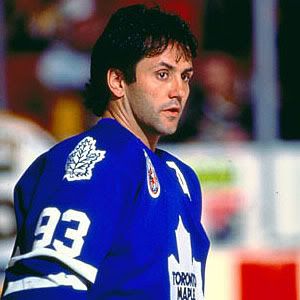
Dougie defined us, fully completely

The analogies with Doug Gilmour fall short, just like the Leafs have so often.

The best stab at fighting through any ambivalence on the eve of Gilmour's big night in Toronto, is that for two years, 1993 and '94, he embodied something that courses through Canadians on a chromosomal level. Plain and simple, he was embodied by what he didn't have, which is like next to godliness in the Great White North, eh.

There's a passage in Roy MacGregor's cult hockey novel (hacky to be quoting, true), The Last Season, which better explains why "great and being loved can be two different things" in sports, hockey in particular (assist to Cox Bloc). A small-town hockey coach, Ted "Sugar" Bowles, closes a pregame pep talk to the protagonist's team, "What makes a shark truly unusual is what he doesn't have. And that's a swim bladder ... A shark has to keep moving constantly. A shark does not float, like other fish. He has no swim bladder, see. He can't let up for a minute and that's what makes him top dog."

Gilmour, in 1993 and '94, was our shark. Either you got him or you never could. It's just like how five of Kingston's other favourite sons, the Tragically Hip, are rock gods in Canada but have seldom charted in the United States. Both were too particular to their time and place to translate very well.

He had to keep moving. In the end, that gets a player more attention than those who have the supple arrogance of grace, which is what doomed Mats Sundin to being Tall Poppy Syndromed. There were better playmakers in the NHL during Gilmour's prime years, such as Adam Oates, or Pat La-La-Lafontaine. There were comparable good undersized players, such as Theo Fleury. For two-way centremen, Steve Yzerman and his three rings come to mind.

None of them stretch across 1993 to 2009 like Gilmour, now the Manchurian Coach of the Kingston Frontenacs.

Please keep in mind it was the Leafs, post-Harold Ballard and pre-Ontario Teachers Pension Plan. Down in Kingston, where ol' Pal Hal had been in the clinker for a couple years in the '70s (he was in Bath Institution, next door to the "Millhaven maximum security" that the Hip mention in the first verse of 38 Years Old), there were boys and girls willing to cheer for the dismal Leafs, instead of the still majestic Montreal Canadiens or the Edmonton Oilers.

There was no pinpointing the low point. My best friend Neil Acharya often talks of the day in 1988 when Mark Potter, the sports anchor at CKWS, led off with, "You'll never believe what the Leafs have done this time," alluding to the infamous Russ Courtnall-for-John Kordic trade. There is an argument it might have been a good deal for the Leafs.

In '89, Floyd (Trader) Smith dealt away the draft choice which the New Jersey Devils used to draft Scott Niedermayer. Ballard died in '90. In '91, Cliff Fletcher came in as GM. In the early hours of '92, Fletcher made The Trade to get Gilmour.


Go ahead and laugh, but the Game 7 overtime win over the Red Wings in the first round in 1993 was, wait for it, legendary. They could have played that series 10 times and the Red Wings, with Yzerman, Paul Coffey and Sergei Fedorov, would have won eight or nine times. Bob Cole's sum-up at the unlikelihood of it all, "I am going to talk to Cliff Fletcher and Pat Burns and I am going to ask them to pick my numbers for the lotto next week," still raises chill bumps.


It is pretty easy to see Gilmour and look back at '93 and get bogged down in bathos. It could never be so linear at age 16. You're such a jumble of hormones, half-thoughts and trying not to get your ass kicked just for living. (Aside: That's different from being 32 how? Well, the ass-kickings only come in the figurative sense.)

It was a pretty good place for an average guy to start self-medicating with sports, music and such. Kingston's Doug Gilmour had the year of his life leading the Leafs sadistically close to the Stanley Cup final. The Hip — there was a young, hockey-haired Gord Downie in a team picture from 1978-79, the goalie on the far left of the front row, hanging at Henderson Arena in Amherstview — had just come out with Fully Completely. The Blue Jays were on their way to back-to-back World Series championships in baseball; Queen's had won the Vanier Cup in football. After Wayne Gretzky's high stick-Kerry Fraser's no call-Dave Ellett's skate happened, the hockey gods came through with a makeup call. Another good Kingston boy, Kirk Muller, scored the Stanley Cup-winner for the Montreal Canadiens a couple weeks later.

Doug Gilmour was defining, no two ways about it. He was a smart player and he had the look, the one that landed him the nickname Killer. He'd worked for everything, from making it to the NHL after being a seventh-round pick to playing his way on to Team Canada in '87. He made hockey seem a little closer just as it drifting away from people in heartland Canadian towns (remember, the year of Gilmour was also Year 1 of Gary Bettman). Maybe it is like seeing your high school yearbook photo, especially when you see the clips from Don Cherry's Rock 'Em Sock 'Em videos, but there's no deniability.


Sixteen years later, it might be just random accessed memories. It is no more important nor more interesting than the Winnipeg Jets of the '70s or the 1982 Vancouver Canucks are to people who grew up in another time or place. There is still the burn every Leafs fan has to live with, knowing his best was not enough to silence the "Sixty-seven!" chants.

For me at least, it is complicated further since, as a rookie coach, Gilmour is now of an embarrassing gong show being perpetrated by Doug Springer, owner of the Kingston Frontenacs. The joke making the rounds is that Gilmour, can no longer be called Killer. That nickname belongs to Brian Kilrea in Ottawa.

There is a symmetry to Gilmour's foray into coaching. Say whatever you want about him as a coach (and people have), but like a lot of ex-jocks, he's just trying to figure out where he fits in, like everyone else. It makes him one of us, OK sure he has a lot more money, but Saturday we will be applauding one of our own.

Related:
Getting a lift; He may not be a distinguished coach just yet, but Doug Gilmour the player is that and more (Michael Traikos, National Post)

Thursday, November 27, 2008

Blog blast past: Keeping Bryan's song alive

The late Bryan Fogarty, forever star-crossed, has popped up in a few news items the past week, mostly in connection with another OHL defenceman, the Windsor Spitfires' Ryan Ellis, who 20 years after Fogarty did so by scoring a mind-bending one hundred fifty-five points in 1988-89 -- but in Niagara Falls, not in Kingston -- is in the early running to win the OHL scoring title. Kukla's Korner is also reporting that Dave Bidini, of Rheostatics fame, has a song about Fogarty on his upcoming album. From Sept. 19, 2007, here's a recollection of a player who still haunts puckheads all these years later.

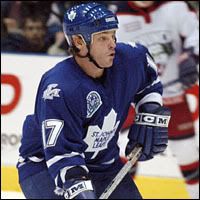
Kingston Frontenacs nostalgia is kind of a misnomer. Few want to be reminded. But our favourite OHL team got it right by choosing to retire the number 17 of former captain David Ling (near right) before Friday night's home opener vs. the Belleville Bulls.

Ling, now 32 and a long shot to make the Leafs after playing in Russia for two years, will be the first Kingston junior to have his number retired. Ling was a big part of two of the best teams to ever grace the Mem Centre when myself and co-blogger Neil Acharya were in our formative years, the 1992-93 and '94-95 clubs. To this day, those are respectively the only Kingston OHL team to ever get by the second round of the playoffs, and the only one to ever finish in first place.

There are dozens of David Lings in junior hockey. He was a scrappy little Dale Hunter-type, wore the C as team captain and he was universally loved. (He was also a Maritimer who came to Ontario in the era before the QMJHL expanded into Atlantic Canada.) His story is one that can be easily understood, so why not start a season-long nostalgia trip by honouring him?

Thing is, as ex-Kingston juniors go, Ling doesn't dog a sports nut late at night. There were so many like him. There was only one Bryan Fogarty (far right), one of hockey's greatest human tragedies, remains the guy, some five years after his heart gave out in a Myrtle Beach hotel room, it's the memory of him that gnaws and nags.

There is no historical parallel, no time-sensitive reason for why anyone should have Bryan Fogarty on the brain, but it's in keeping with something another Kingston type, Gord Downie, once said during a song intro: "For something to be great, it has to have moral complexity."

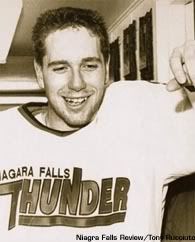
Fogarty's greatest moments, of course, came in 1988-89 when he was breaking Bobby Orr's records with the Niagara Falls Thunder. He had that one year where he was able to keep it together and show why he'd been the No. 1 overall pick in the midget draft by the Canadians in 1985, why the Québec Nordiques drafted him No. 9 overall two years later (and waited to take Joe Sakic with their second first-round pick). To someone who was a kid then, as Neil and I were, all we ever knew was that all of a sudden, this guy who'd played three years in Kingston with the Canadians, some poor teams, including the infamous 1987-88 crew that lost twenty-eight games in a row, was tearing up the OHL. He was kind of like a Mark Fidrych of hockey — this fun-loving kid who had this one splendid season.

Chances are, there won't be many mentions of Fogarty during all the retrospectives done on the Kingston team's 35 seasons in the Mem Centre. Something should be done, but how does a team acknowledge one of hockey's human tragedies? Moral complexity. If Fogarty had been struck down in a car crash or by a rare disease, it would be simpler. Instead, his diseases were much more common and ones (alcoholism, social anxiety) that, in his time, people didn't fully understand as not being self-induced.

The Kingston Canadians don't exist, the Niagara Falls Thunder don't exit, the Nordiques don't exist. Nor do most of the teams Fogarty played with during his curious pro career — Las Vegas Thunder, Minnesota Moose, you name it. Still, how do you mark 35 seasons of OHL teams playing at the Memorial Centre without mentioning the most gifted player who ever put on the sweater of Kingston team in that time?

Related:
Wasted (Eric Adelson, ESPN The Magazine, Sept. 18, 2002)

That's all for now. Send your thoughts to neatesager@yahoo.ca.

Thursday, August 21, 2008

Can't spell 'U.S. in a lather' without U-s-a-i-n

Seeing a quote from Usain Bolt's father in the Jamaican media lays bare how the American media's ability to make much ado -- or Ato -- out of nothing.
"Usain was simply being himself, he likes to celebrate when he does well and there was no time he was trying to put down the other runners in the race." -- Jamaica Observer
Straight talk like that is the best way to hurl truth into the bourgeois -- more like boor-geois -- language of NBC's Bob Costas, et al., who tried to portray Bolt's celebration during the 100 metres at the Beijing Olympics as sacrilege. Sports On My Mind, incidentally, had a great spoof pointing out how Costas and NBC were rather selective about just whose celebration was deemed offensive, overwrought and a terrible example to children.

Usain was simply being himself. Of course, that's the problem, right, because a black man from the Caribbean, from a culture that doesn't "venerate humility one single bit," (to quote a SOMM commenter) flouts Bob Costas' concept of What Should Be.

Perhaps this should be left alone, maybe it seems too far removed from Canada, where you can just watch CBC and TSN, but it isn't entirely. There is a ripple of effect, or ripple of evil (hat tip to Lewis Black), with how Americans decide to present something to the world, since we in Canada are so saturated with U.S. viewpoints. The U.S. sets an example, for good or ill.

That's why it's so nauseating, every four years (it's more a Summer Olympics thing) to see Costas, et al., with their agendas. At a time when it seems like a lot of people have adopted Peter LaFleur moral relativism,* these smug little twits are trying to one-up everyone else, trying to wedge everything into their worldview.

That sends the signal that it's OK to be ignorant, to be insular, to not understand how it is in other countries. Costas can backpedal and butt-cover all he wants, but at the end of the day what matters is that his first reaction was to tear a strip off Usain Bolt for, well, being himself. He didn't act in the Bob Costas-approved manner of an athlete who's a visible minority, so it was bring out Ato Boldon is brought out to give legitimacy to NBC's crock-and-bull story.

Never mind that, on this end, more than a few associates have said Lightning Bolt has made their Olympic watching worthwhile. Records in the 100 and 200 metres; we might never see that again. At 6-foot-5, he might be a prototype for sprinters we'll see in in 2016 or 2020, or maybe he'll be a one-off and the 100 and 200 will remain being the domain of coiled, compact men. In the short run, he's been a one-man antidote to Michael Phelps fatigue and athletes, who quite understandably given the years of sacrificing and training it's taken to get to Beijing, are all-business and no-nonsense to the point of seeming like faceless droids.

He's also a reminder of how the Olympics, for all the excesses, for all the ills, for all the sports which shouldn't be there and for the others no one cares about for three years and 348 days in between quadreenials, for all the purple prose (present company included, so don't bother pointing it out), do act as a reminder that no country has all the answers. No one's way is the right way.

You might have been taken aback by Bolt's showing in the 100 because when you played minor hockey as a kid growing up in small-town Ontario, the worst label to have was that of a "hot dog," someone who rubbed it in after scoring a goal. However, as a late, great American named Bill Hicks said, just because you learned that, it doesn't make it true.

So long live Lightning Bolt and to hell with Bob Costas. He wears nice suits, he's got a voice that's sweeter than restaurant-quality lemonade and he's smarter than the average bear. All of that adds up to a nice, faux-erudite facade for a complete and utter boor, enabling Ugly Americans not to feel so bad.

(It's a wicked burn on the American media that Bolt ran down Michael Johnson, since as we know, the 200-metre record has been the Holy Grail for fast men ever since, well, Bob Costas decided it was in 1996.

Mac Gs World has a whole lot more on Bolt, including some speculation on whether the Nun Linga could knock the Souljah Boy out of circulation if there's a God in heaven, it will. Neil Acharya came through with the Jamaica Observer article.)

Related:
2008 Olympics: Triathlete Snowsill Demans the Games with Her Showboating Finish (Sports On My Mind)
Boldon defiant (Jamaica Observer)
Dad defends Usain Bolt's 100m celebrations (Paul A. Reid, Jamaica Observer)

(* This comes from a line spoken by the villain in Dodgeball, played by Ben Stiller -- "I'm not OK, you're not OK, but that's OK.)

Friday, August 15, 2008

OPJHL hopes to fly high with new pilot division

A massive pilot project has taken the OPJHL by storm.

Eight teams have created a new Central Division, in an effort to create an division within the league that gets away from the appearance of a "watered-down product." Central Division teams will play an independent schedule within the league, with the champion advancing to the OPJHL playoff semifinals where they will face off against the rest of the league.

The eight teams involved are the Cobourg Cougars, Hamilton Red Wings, Markham Waxers, Newmarket Hurricanes, St. Michael's Buzzers, Stouffville Spirit, Toronto Junior Canadiens and the Wellington Dukes. This has come over some objections with the league.

Marc Mercier, governor of the Cobourg Cougars and member of the executive board for the new Central Division, explains the rationale.

“We believe, strongly, that the changes we have made for the upcoming season as part of the pilot will have a very positive impact on the future direction of junior hockey in Ontario.”

The changes Mercier are alluding to include “stronger franchise governance principles, the use of division-wide educational agreements, meaningful reduced roster sizes, mandatory play rules for 16 year-olds, reduced roster positions for 20-year-olds, the use of 2-referee systems, among various other changes.”

Fellow Central Division executive board member and Anthony Pietramala, the co-owner and president of the Newmarket Hurricanes, feels that there was a pressing need to create a test project in the OPJHL.

“The watered-down product and quality of programs offered in a 36 team league has noticeably deteriorated in recent years as evident by the disparity of teams in all current divisions as well as the substantial reduction in OPJHL players advancing to the next level be that the OHL, CIS, NCAA or Professional Hockey,” he says .

While many in the league are in agreement with Pietramala’s assessment, things are not all that rosy. There were numerous clubs that either declined to comment or did not return phone calls in connection with this story.

Frank Robinson, GM of the Whitby Fury -- a non-pilot team -- sees both sides of the coin.

“The Central Division is a good mission, it is setting an example for Junior A hockey. It's the right thing to do. However, if you think everyone was happy, no they weren't.”

Robinson sees how teams were chosen for the new division as a sticking point.

“We’ve known for the last three years that something was going to happen," he says. "The bone of contention is how did those eight teams get chosen, it should have been an invite, (however) it was done by all types of calls in the background."

There is reason to believe that other teams are far more at odds with how these changes will affect their operating costs, especially with the loss of divisional rivals that are in close traveling proximity. The Kingston Voyageurs, for instance, lose Cobourg and Wellington as conference opponents. Instead, they gain Whitby (formerly Durham), the Ajax Attack and Pickering Panthers.

Mercier acknowledges as much.

“We understand that some of the teams in the OPJHL are disappointed with the emergence of the Central Division. However we are very encouraged by the number of those teams who have indicated to us that they support our vision, our core operating principles and objectives and very much look forward to working with us closely.”

Pietramala explains how the pilot is really in its infancy.

“Initially there will not be a major impact as the recruiting of players for this year was not based on this test pilot but rather the current system.”

Major changes this year will include roster sizes being pared down from 23 players to 21 and the number of players dressed from 20 to 19.

The number of 20-year-olds will be reduced from nine to seven and as well, teams must dress their 16-year-old players unless there are special circumstances preventing them. All teams in the OPJHL will play four more games this year for a total of 53.

Pietramala sees the upcoming season as a challenge but thinks that if it is successful, it will benefit the league as a whole. “Change is never easy to manage and I’m sure there will be growing pains and challenges to educate in one year - players, scouts and associations - as to why the concept will be beneficial to junior hockey long term,” he says.

“The intent of this pilot is to improve junior hockey as a whole across Ontario at all levels. This is a test pilot and it may prove to be only that a one year pilot but like anything else sometimes you need to isolate a small group to understand what changes are best for a wider group,” he adds.

Meanwhile, even though he understands and agrees with the motivation for the new
Central Division, Robinson is more sombre about what the future may hold.

“Some teams will survive the changes and some teams won’t.”

Pietramala does not deny that at some point if the pilot lasted long term, beyond this season and expanded, there could be a drop off in the number of teams hitting the ice in the OPJHL.

“Potentially less teams over a larger geographic region would make for a more competitive product on the ice night after night which would benefit players wanting to develop for the next level, be that the OHL, CIS or NCAA.”

Tuesday, June 17, 2008

Taking up the cause of Bol Kong

Bol Kong's situation was the subject of a sympathetic newspaper editorial in the States today:
We can't help but look ahead and wonder how many other losses we're racking up under the post-9/11 immigration rules.
There is an online petition. Signing it would not necessarily change anything, but a little empathy isn't such a bad thing.
(Incidentally, while we're here, if you happen to encounter a man of great wisdom named Neil Acharya, wish him a happy birthday. It's one of those round-number milestone birthdays.)
Related:
Immigration: Rules are a maze (Seattle Post-Intelligencer)

Wednesday, June 04, 2008

Acharya called it

Wikipedia defines an acharya as "an important religious teacher (guru) who teaches by his own example."

Well, hockey is religion. Our man Neil Acharya — who's not merely a hockey play-by-play man from Newfoundland just like Hockey Night in Canada's Bob Cole but was also born in Carbonear in 1978, just like Detroit's Dan Cleary — intuited the Red Wings' dominant Stanley Cup run way back in January:
"... with a vastly improved division this season, the Wings have chalked up all their losses to divisional foes. With the Wings having faced harder divisional tests throughout this regular season, they could be better equipped to tough it out in this season's quest for the Stanley Cup." — The Score Forecaster, Jan. 10, 2008

Now you know the rest of the story ...

(For anyone who's wondering, NBC reported a 3.8 national rating for Game 5 on Monday, the triple-overtime contest -- twice as much as Game 5 of last season's final, but lower than the same game from the little-remember Red Wings-Hurricanes final in 2002.
A post on the playoffs finally being over is up at Epic Carnival. You will probably hate it, but there were things in there that had to be said.)

Wednesday, May 07, 2008

SCRUM DOWN IN K-TOWN...

Good friend Neil Acharya has an article in Kingston Life magazine looking at the upcoming matches in the Barclays Churchill Cup rugby tournament that will be played at Richardson Stadiun next month.

Fingers are crossed that yours truly will somehow be able to attend a Churchill Cup game, be it in Ottawa (the capital) or Kingston (the first capital).

Thursday, April 10, 2008

STARVED FOR SCORING IN MURPH DOG'S KITCHEN

A couple vaguely hometown hockey notes to keep us all going:

  • No doubt there's a great story behind a Kingston guy on the Belleville Bulls, Mike Murphy, going from fourth-round draft choice three years ago to top goaltender in the OHL.

    Both dailies, The Intel and The Whig, should have good takes tomorrow. Presumably it's a great ride for the Inverary native and all his people. The Bulls have dropped just one game in the first two rounds of the OHL playoffs; they should be favoured to reach the league championship series.

    It is a bit of a stretch to say that Murphy will be matched up against the goalie that Frontenacs GM-for-life Larry Mavety took ahead of him in 2005 if Belleville meets Oshawa in the next round. Daryl Borden, taken 44 picks earlier, hasn't played a minute in the playoffs for the Generals.

    (Then again, Mav is the same guy who rode with Andrew Raycroft and buried Mike Smith on the bench once upon a time. It made sense, then.)
  • Let's see how this plays out: An ex-Kingston city councillor, Rick Downes, is trying to have Mayor Harvey Rosen sacked over an alleged undeclared conflict of interest during the debate over Kingston's K-Rock Centre (AKA the Krock Pot).

    For 90 per cent of people, it's academic now that the arena is open for business. The other 10% might be able to enjoy it for a while.
  • Jim Dorey, the former NHL defenceman and one-time Kingston Canadians coach, was the subject of a Hockey News profile penned by good friend Neil Acharya.
  • Some cosmic force prompted checking The Canadian Press wire on Tuesday for an update on the Manitoba Junior Hockey League playoffs, a one-time sports beat during the Portage Daily Graphic days. The Terriers, coached by Blake Spiller, who along with his family were unfailingly accommodating around Centennial Arena and the local ball diamonds back in those days, won the league title by eliminating Winnipeg 5-2 in Game 5 on Tuesday.

    Several of the Terriers main cogs, including forwards Mike Audino, Eric Delong and Rob Roteliuk and d-man A.J. Spiller (the coach's son), were part of a pretty good Triple-A midget team back in the day. Here's hoping they can get reach the Royal Bank Cup next month in Cornwall.

(Thanks to the Kingston readers who sent along word of Murphy's honour.)

Thursday, March 13, 2008

A LITTLE BLAST FROM THE PAST

A little blast for the past for all you Kingston hockey fans: The Whig-Standard had a profile on former Canadians coach Rick Cornacchia -- still going strong in the Provincial Junior A playoffs with the Markham Waxers -- penned by none other than good friend Neil Acharya.

Cornacchia, of course, also coached Eric Lindros with the Oshawa Generals in the early '90s.

Related:
A career coach; Rick Cornacchia got his start in Kingston (Neil Acharya, Kingston Whig-Standard)

Tuesday, March 04, 2008

LIFE ON THE ROAD...

Play-by-play man Jim Gilchrist has always been the best part of the Kingston Frontenacs' whole operation, but he's always been heard and never seen.

Good friend Neil Acharya took the time to give a profile of the man and some of the sacrifices a broadcaster has to make.

Related:
Hockey Night in Kingston (Neil Acharya, Kingston Life)

Thursday, December 06, 2007

UP AT 6... "SCOLARIED" ... IN OTHER WORDS, RON BURGUNDY IS NO LONGER THE BALLS


Someone's been watching too many Entourage reruns...
  • Seeing the teasers for Will Ferrell's upcoming comedy Semi-Pro and reading comments at Yahoo! Sports -- fairly typical sample is, "Oh, now he's the 1970s basketball player in Flint, and not the 1970s newscaster in San Diego? -- kind of begs the question if he's been Scolaried.

    Scolaried, as defined by the L.A. Times' J.A. Adande, is the state of being "left behind by someone considered an equal at one time."

    Judd Apatow will have three Ferrell-free hits on his hands by the end of this calendar year, since Walk Hard, starring Mike Honcho himself, John C. Reilly, looks like a sure bet. Amy Adams, who played Ferrell's love interest in Talladega Nights, just got catapulted into stardom thanks to Enchanted (should have been for Junebug, but oh well). Steve Carell and Seth Rogen are both bankables, although you'd only notice that Rogen was in Anchorman if you've seen it 35 or more times (uh, according to what a friend says).
  • There's no point describing what goes on when Pierre McGuire and Gord Miller broadcast a game that Sidney Crosby is playing in: The Coming Crosby Backlash was already covered off almost a year ago.
  • Housekeeping item: Good friend and regular contributor Neil Acharya is contributing to The Score Forecaster; his first post is up today.
  • There's a primer on Tim Lincecum up at Hardball Times. It's nice, as a Jays fan, to picture him getting ground-ball outs off that changeup he developed last year.

    It's still damn hard to part with Alex Rios, though. He's a much better player than Delino DeShields was when the Expos swapped him for a young Pedro Martinez back in 1994.

Thursday, November 29, 2007

ACHARYA: SENS ARMY... THE LIONS IN MID-ADOLESCENCE

Associate Blogger Neil Acharya was in Ottawa last Saturday to take in the Flyers-Senators game, and came away with a few concerns about the state of the Sens Army.

Ottawa has got a great hockey team, which goes without saying. Regardless, there are some aspects to the Senators gameday presentation and the fans' reaction to it that left me scratching my head on Saturday night.

I am a Leafs fan, and like most, hold the Senators in high regard for the quality team they put out year after year, how they draft well and play an exciting brand of hockey. I also respect how into the game everyone at Scotiabank Place seems to be.

So on Saturday, as a Leafs fan, I was interested in the out of town scoreboard as the team was on the road in Phoenix, where as you know, they got hammered 5-1, prompting more calls for mass firings. When it showed that Phoenix was ahead 2-0, there was a smattering of "Leafs suck" from the upper bowl, which is fine. Many Toronto fans were thinking the exact same thing.

However, after Phoenix got its third goal, the board actually read 13-0 (not 3-0) for several minutes. Everyone makes mistakes, and as people around me began to notice, I laughed. More than five minutes later, it still read 13-0 and it got me wondering if the operator was seeing how long it took people to notice.

Later, the people in charge of the video scoreboard decided to display the Leafs score. After about 10 seconds I realized that they were not going to show another score. Twenty seconds later the score was still up on the board as 4-1, as the crowd roared as loud as it had all night for anything that had happened in the game they were actually watching between their Senators and the Flyers. A moment later, the score read 5-1, and Radim Vrbata's name as the goal scorer was slowly typed in letter by letter as the crowd went crazy.

It was mildly amusing, and the goal is to get the fans going, right? Regardless, the shot at the Leafs was somewhat understandable, but the Senators were playing the Flyers. I had seen nothing directed at that team.

During one of the intermissions, the video scoreboard showed a clip from the Molson Senators Overtime with Ian Mendes. The segment was a focus on the Sens’ rivalry with the Leafs. To sum it up, it was the Daniel Alfredsson hit on Darcy Tucker and subsequent goal in the 2002 playoffs; a shot of Tucker diving in a separate play; Brian McGrattan bloodying the now-retired Tie Domi early in ’05-06; and Zdeno Chara (who’s not even with Ottawa now) throwing around Bryan McCabe, who’s not a fighter, around like a rag doll. Meantime, there were a couple interviews with Senators players mixed in.

That stuff with the Leafs is all ancient history. After the game, I thought about what I had seen that evening: A battle between two high-flying hockey clubs contending for Eastern Conference supremacy, the difference being one goal and a last-second flurry of activity that had people on the edge of their seats.

Meantime, the impression left with me was that Ottawa fans were supposed to be more concerned about the Leafs going down in flames 3,000 miles away. That shouldn't be expected of them after 15 years in the NHL.

As a Toronto Raptors fan who was scorched by Vince Carter, I know about having a hate-on for another player and another team. The Air Canada Centre people does not go out of its way to whip people up into a Vince rage during Raptors games, and nor do they call attention to it when his New Jersey Nets team is playing elsewhere and losing. The fans are allowed to take care it themselves.

The bottom line is that on Saturday, I saw a gameday production that was out of touch with what was taking place on the ice. It reaffirmed that despite claims to the contrary, this is one of the NHL's newer franchises. The Sens Army is showing how strong it is and how much stronger it will get, but it still needs to mature.

Neil Acharya can be reached at neil__acharya@hotmail.com.

Friday, November 02, 2007

DREAMING BIGGER IN TEXAS

Good friend Neil Acharya, who does play-by-play for Rogers Community Television in the GTA, has a feature story in the Allen (Tex.) American about a couple Texans playing in the Provincial Junior A Hockey League.

Neil's also at the mike for tonight's broadcast of a St. Michael's Buzzers-Dixie Beehives game.

Related:
Allen grads key for Vipers (Allen American)

Thursday, September 13, 2007

UP AT 6: WORLDS ARE COLLIDING

As you were enjoying a Banana Kaboom.
  • Is Bill Simmons becoming Rick Reilly, or vice-versa? Simmons couldn't get through the first two paragraphs of a column Monday without name-dropping, a classic Reillyism. Then within 48 hours, Reilly mailed in published a worshipful column about Tom Brady.

    Regardless, quoting either iconic sportswriter hasn't been cool for about three years. No word of a lie, right as that was typed, a Canadian sports anchor quoted Simmons.
  • Great quote from Canada's Tomasz Radzinski after the 1-1 tie with Costa Rica on Black Wednesday: "If I am in the stands next time I am going to wear a black shirt as well."
  • Whites hanging nooses from trees, district attorneys threatening African-Americans with retribution if they didn't toe the line, and trumped-up jail terms handed out to blacks who got only a token legal defence. Sounds like 1957? Try Louisiana, in 2007.
  • Cory Murphy, the veteran Finn-league defenceman from Kanata who played in the world championship last season, could be a top-4 blueliner for the Florida Panthers, writes SI.com's Allan Muir.
  • Heads-up: Co-blogger Neil Acharya makes his season debut as hockey play-by-play man for Rogers 10 in Toronto tomorrow night, Vaughan Vipers vs. the St. Mike's Buzzers, live at 7:30 p.m.

Thursday, July 26, 2007

INTERVIEWING A LEGEND

Co-blogger Neil Acharya has interviewed Ice-T for TheCyberkrib.com in advance of the hip-hop legend's show tonight at The Phoenix in Toronto.

Monday, July 23, 2007

ACHARYA: ACROSS THE POND, THERE'S POSITIVE DEVELOPMENTS ON BRITISH ICE

(Originally posted July 20. Scroll down, there are other new posts.)

The NHL is starting its regular season in London this fall. With Canada having a summer of soccer, it only seemed sporting to check into how hockey is doing in Great Britain. U.K.-based sports journalist Mike Appleton, author of
Tony Hand: A Life in British Ice Hockey, a memoir of the most celebrated player in British ice hockey, took the time to answer a few of Neil Acharya's questions via e-mail about the state of shinny across the pond.

OOLF: It says in the book sleeve that you caught the ice hockey buzz in 1996; take us through how that happened?

Mike Appleton: This makes it sound like I'd never heard of hockey before my 19th birthday. Not true! I actually remember watching the Panthers in the British Championship Final on BBC 1 and being amazed at the speed of the players. This has to be in the early nineties. I also remember the Championship Final at Wembley going into penalty shots (Cardiff v. Murrayfield) and delaying the Soccer scores on the BEEB (late eighties).

I really got into Hockey in 1996 when my partner and now wife Hannah, dragged me along to see Manchester Storm at the then Nynex Arena. I was hooked straightaway. I couldn’t believe there could be anywhere near 10,000 in an arena watching a North American sport. It moved the 'fan experience' up a level for me and from then I was checking the web daily for news on my adopted team. I was well and truly hooked.

OOLF:Is the current situation in Great Britain, where you have two leagues (EIHL focused on bringing in the best players possible from around the world, ENL which has a focus on development of GB talent) the best of both worlds? Is this the perfect recipe to pack seats and grow talent or would one league be more ideal.

Mike Appleton: Difficult really. I can see it from both sides. EIHL clubs want to nurture GB talent because they realise how much the fans like it when a local lad comes through and develops well in the team and league. But success and failure is such a fine line that stepping onto one side of the line could mean the difference between a club being around or not at the end of the year. It costs a vast amount of money to train and develop a British player -- and even then you are hoping they will make the grade in the way a Tony Hand, MBE, or David Longstaff have done -- that is, have the impact that an import would have.

So, economically it makes more sense to get that 'quick fix' by bringing in a tried and tested import from North America or Europe that can do the job already. It also ensures a degree of success.

The ENL can focus on British talent because of the semi-amateur nature of the league. More British players can play in that league, train and maintain a day-to-day job.

It really isn’t as simple as unifying the leagues into one. It is better hockey, better promotion, more goals and more fights -- they bring the fans in. Creating an event like they used to do in Manchester and now do in Nottingham and Sheffield also helps as well.

To nurture GB talent you need more British kids in the top flight coming through, more representative games that aren't just exhibition matches and more training camps. Above all you need more coaches that can make the grade and also show kids the 'line to the top flight.' That means creating a programme that will pick up a youngster at an early age and show that if they work hard, and have the talent, they can make the Elite League.

OOLF: With the Summer Olympics being awarded to London 2012, there is an obvious attempt by the government to put more money into sport (this is similar to Canada with Vancouver 2010). How has this affected the winter Olympic program and moreover, is there any attention being paid to improve the national ice hockey program?

Appleton: I'm not sure you can class the extra money the government (Sport England) has put into the sport as 'more money.' It is simply what the national team needs to be able to get together every year and have a crack at the World Championships. Ice Hockey UK have had to fight for this money as the opinion seems to be that if GB win a medal, it is one medal and not 'X-medals' depending on the side of the squad. They don't see Hockey as a good return on their investment as say an athlete.

With Paul Thompson coming in as GB coach there does seem to be a refocusing of efforts to make Vancouver in 2010. And that started at the (2006) World Championships in Slovenia where Britain cemented their place in the World's top 30 to have a crack at qualifying for the event. Unfortunately, club hockey is king in this country and that is unlikely to change. Until the clubs can agree to how develop the national team then GB will always struggle to reach Pool A again like they did in 1994. Then you have the problem of 10 imports per team in the Elite League, which means less ice time for British kids.

OOLF: Professional soccer has gone through growing pains in North America and seems to finally have caught hold with the MLS. What is the state of the game in GB, is it in any way parallel to the MLS. Do you foresee more shakeups in league structure?

Appleton: You only have to read Tony Hand's book to see how far hockey has come since the semi-pro days of the early eighties. Money has increased; more players are now fully pro and the EIHL has a more professional structure. We still have a long way to go though because there are two leagues pulling in opposite directions. As for a shake-up? Unlikely. There are far too many personalities in the game for significant unification of all clubs to occur. There also isn’t the fans or venues to have 11 or 12 teams competing on an even keel.

OOLF: North America's progress in creating a strong soccer league was gaining a lot of momentum. David Beckham joining the L.A. Galaxy provided a huge surge forward. Does hockey in GB need top-flight players to go over in the latter part of the careers? Theo Fleury is obviously not a fair comparison to Beckham, but in the same vein.

Appleton: Theo was a revelation in this country. He caused a lot of publicity -- both negative and positive -- and really ripped up the league in terms of point scoring. His antics in the penalty box at Coventry left a lot to be desired (he took a lot of stick from Coventry fans and tried to get out of the box to confront a fan) but he was a real success. Yes, of course, we need more players like this. Hockey fans are really knowledgeable and appreciate quality on the ice. But we aren’t top payers anymore and only seem to attract the 'goon' type players who fit in, in our game.

OOLF: Is there a television deal for the two leagues? If not, would a TV deal help draw fans in the long run, or are owners more reluctant to TV because of a loss at the gate?

Appleton: We simply aren’t a big enough sport to have TV coverage. The days of Sekonda (Watch manufacturer) and SKY TV are long gone. There is an Internet TV station which records matches and that is proving very popular, but that is as far as it will be going at the moment. There simply isn’t demand from the non-hockey public for a TV deal and would it improve the sport? Possibly it would expose more people to the game but would it drive up attendances?

OOLF: Since hockey is not the prime sport in mainstream media in the UK, how important is the Internet and blogs to the coverage of the sport?

Appleton: Vital. The Internet has revolutionised all sport. Club websites in this country are excellent at the moment and will only get better. Radio is still proving to be a big draw. BBC Coventry covered GB through the Internet when they were in Slovenia. Internet forums are pretty popular too but can propagate rumour and argument. And you always have the problem that the person that is slagging a player off is 13 years old and has only seen one game.

OOLF: Would a ENL, EIHL fan follow other European leagues with any interest and moreover is there any kind of a following for the NHL, is it sought out and viewed on television?

Appleton:
The NHL is major over here amongst hockey fans. Every hockey fan owns at least one NHL shirt (I have a Rangers one that I bought in person from Madison Square Garden). People talk about Sidney Crosby, et al., during period breaks in the games. It is also shown on Channel 5 early in the morning and on NASN – a subscription channel. The Hockey News sells pretty well too.

Europe isn't so big. Some fans will follow it on Satellite, but the closest people come is when a player is signed from the Continent, then we are all onto the Hockey Database to find out where he has come from!

OOLF: Despite hockey being followed with great intensity in Canada, the crowds tend to be pretty tame (in Toronto it is argued that it is so quiet because the average fan is priced out of the Air Canada Centre). There is a lot of tradition in the way fans in the UK support their clubs most notably in soccer. Does that carry over into the way hockey is supported? What are the traditions that exist in the stands at the homes of British ice hockey? What can fans in North America learn from UK fans and vice versa?

Appleton: There is a respect for other clubs in this country that perhaps you don’t get in football. As an Everton fan I hate Liverpool and everything they do. In Hockey there is rivalry between Sheffield and Nottingham and some other clubs but apart from a few isolated cases it never descends into hatred. Hockey is a real family sport and when the team I cover -- Manchester Phoenix -- were mothballed waiting for a new rink, our fans would travel two hours to Hull to watch the Hull Stingrays instead. They were welcomed with open arms and given discounted tickets. It just seems like something we do over here. Fans bring drums to the game and there are sections of singers in the arena – perhaps that is something you guys could think of? The chants are all pretty clean compared to football too!

There is probably not a lot fans could learn from each other apart from merchandising. You guys over there have a lot more than us. We also eat far less during period intervals!

OOLF: There is mention in the book of players that play a rough and tumble brand of hockey signing with British teams as opposed to teams in other European leagues. Has the adoption of the zero tolerance policy on obstruction changed this pattern? How has the zero tolerance policy been received by fans?

Appleton:
At first zero tolerance was a disaster. Referees either were totally intolerant and penalised everything, or let a few things go that should have been called. There were letters in Powerplay Magazine about the death of the game. After a while referees seemed to adopt a 10% tolerance policy and the games got better. But attendances were still down on a whole from the year before, but that probably had more to do with over familiarity of teams. Clubs faced each other four times -- more in the Cup competitions and perhaps fans got bored.

As for the players, it was a difficult transition at first. Tough guys struggled and had to learn how to play hockey again. They couldn’t just goon it up and if you looked across the league, more of these types of guys managed to get more and more points last season. Teams like Newcastle that built their success on tough tactics also struggled.

Next season should see quicker games, more goals and fewer penalties.

OOLF: It appears that Nottingham is the hockey hotbed in Great Britain. Have other teams studied their success in hopes of creating a long-standing hockey market of their own? Do many of the national players come from in and around Nottingham?

Appleton:
Nottingham is an incredible hockey story. They market the club to fans in the area and are always in the press pushing themselves. They also spend a lot of money to do this too both on and off the ice -- but perhaps this isn't the place to comment on the rights and wrongs of this. Manchester and Sheffield are traditionally hotbeds, as is Cardiff, Coventry, Dundee and Fife. There is best practice shared around the clubs, but teams tend to market themselves individually instead of a 'league wide' policy.

National players are spread all over the country, but Nottingham, Coventry, Guildford and Cardiff provide the bulk. It’s simply down to better facilities.

OOLF: What are the misconceptions you find that North Americans do have, and can have regarding British ice hockey?

Appleton: That it's crap! Simple as really. They think it isn't as quick or as skilful. They’re probably are right in a way, but many North American players have cut out a long career in the sport over here. We may not play on the same scale you guys do, but the atmosphere and passion can be just as good. The one game, winner takes all playoff final is simply breathtaking.

Mike Appleton is a member of the Ice Hockey Journalists, Sports Journalists Association and Member of the National Union of Journalists. He currently serves as media manager with St. Helens Rugby Club (www.saintsrlfc.com). He does support Everton, rival of Neil's beloved Liverpool, but we won't hold that against him.

That's all for now. Send your thoughts to neil__acharya@hotmail.com.

Wednesday, June 27, 2007

INSIDE THE MOBB CANCELLATION

Co-Blogger Neil Acharya has an article at theCyberkrib.com which examines the ramifications of Mobb Deep having a recent scheduled show in Toronto cancelled due to poor ticket sales.

Related:
Mobb Done? (theCybercrib.com)

Thursday, June 14, 2007

RAPTORS: FAREWELL, JT, AND WELCOME, NEILADAMUS

Raptors fans are going to miss assistant coach Jim Todd sharing his often salty observations at halftime with the game announcers now that's he joined the Milwaukee Bucks as an assistant coach.

It'll take some time to get used to the reality that Sam Mitchell's coaching staff no longer has a straight-talking, no-nonsense type. Mike Evans, a Raptors scout, is moving up to coaching. Who knows, maybe the Canadian, Jay Triano, will be more publicly visible next season, although his role is apparently going to remain the same.

JUST CALL HIM NEILADAMUS

This is almost kind of eerie:

"This simple gesture was in fact a grand statement by the astute and soon to be best dressed in Toronto nominee, Bryan Colangelo."
Neil Acharya, Oct. 31, 2006

"Raptors general manager Bryan Colangelo says his style hovers between North American and Italian style. Colangelo has all his shirts custom made at Manifatture all’ Orologio in Bologna, Italy, and tailors in Phoenix and Toronto and visits to Via Cavour and Harry Rosen keep him in slim-cut suits."
Toronto Star living section, June 7

That's all for now. Send your thoughts to neatesager@yahoo.ca.