Showing posts with label Jack Todd. Show all posts

Tuesday, June 30, 2009

Mornings with Mr. Canoehead

It's all raisins off an Oldsmobile. None of this should have kept you up at night ...

... Any gut feeling that the Senators will end up stuck with Dany Heatley and have to pay him his $4-million bonus.

... People treating the story about Wimbledon putting better-looking female players on centre court as ribald. Sorry, but when the two Grand Slam events held in old Europe often schedule Serena Williams to play on a side court, it's not amusing. It's something else which rhymes with acism.

... wondering how long until it is OK to riff on Vernon Wells changing his at-bat music to Michael Jackson songs. It's a classy move, but it's as if Wells is trying to point out someone else has actually gone even longer without producing a big hit.

... feeling like you have taken the Hamilton Tiger-Cats' futility for granted for the past 10 years. (That's a great column by Stephen Brunt.)

... Whether to take the inaugural football Junior World Championship seriously. The joy of football is the journey, yet New Zealand, Sweden and France travelled all the way to Canton, Ohio to lose by a combined 184-7 to Canada, Mexico and the U.S. Did the French run the original Statue of Liberty play against the Americans, or did their quarterback's play wristband read, "Prenez un genou."*

(BT to the dub, proof the Creator does not throw dice. The Hockey Hall of Fame is in the heart of Canada's largest city. The Baseball Hall of Fame is nestled in the postcard-worthy Finger Lakes. The Pro Football Hall of Fame in Canton, Ohio is right next to interstate highway.)

Columnists bellyaching about how bored they were by watching the NHL draft. There seriously has to be a better topic and whining about you doing journalism, isn't that what a blog is for? (Besides, Jack Todd wrote the definitive takedown of the NHL draft on Monday.)

(*That's French for, "Take a knee.")

Monday, January 05, 2009

The dude doesn't abide. He might be pulling on a Sweden sweater

The jury has always been split on Jack Todd at the Montreal Gazette.

People don't go so much any more for that columnist-you-love-to-hate shtick. Eventually, don't they hit just a point when the emotion is all gone, like in that episode of Cheers when Norm is hired as the corporate killer? However, there are times when, right or wrong, he really gets into one.

Todd did not pull a Claude Lemieux (I'll explain later), but he did refer to the world junior hockey championship as "the time when our TV networks bring us coverage that is so sycophantic, chauvinistic, shrill, strident and one-sided that it almost makes you embarrassed to cheer for Team Canada. Almost." And it just goes on from there.
"... the coverage this year (with TSN leading the way) reminds me of the way the United States welcomed the world to the Atlanta Olympics in 1996. The low point of that fiasco was when USA Today ran a list of the 100 greatest Olympic athletes of all time: 99 Americans and Nadia Comaneci, who was married to an American.

"The U.S. media treated the rest of the world like an opponent, which is exactly how TSN is treating the visitors to this tournament.

"Such treatment is both ungracious and un-Canadian. We are better than that. (TSN commentators Gord) Miller and (Pierre) McGuire are better than that."
Some would say, "Took him long enough."

This site's Trevor Stewart disclosed there was cheering in the press box on Saturday (personal opinion: As well there should have been!) when Canada tied the game with five seconds left vs. Russia on Saturday. Duane Rollins had at it about 10 days before the tournament started. Our resident liberal sissy snarked off that, "It would be ironic if Canada lost the World Junior hockey gold medal to Sweden. In Sweden, there's a chance a promising hockey player might actually serve his country. In Canada, we just have them do a photo op at a military base."

Todd hit that, referring to, "Pat Quinn squeezing his corpulent form into a paratrooper uniform for an embarrassing military photo op." Senators owner Eugene Melnyk in Canadian Forces garb has a much higher wince factor.

Really, Todd is echoing what a lot of us have been saying. The rest of us just abide by it, since no one wants to be like Lemieux, after he was cut from Team Canada many years ago, bitterly chanting, "USA! USA!" Love seeing Canada win, love the media coverage.

That said, it is good writin', Dickie (so is Todd's memoir, The Taste of Metal: A Deserter's Story).

(P.S. Incidentally, a broadcaster friend says four OHL teams have a shot at getting John Tavares., including one in the OHL's Eastern Conference, but not the Belleville Bulls. Would Melnyk get him for his Mississauga St. Michael's Majors, in hope he might get him again in the NHL draft?)

Related:
Canada goes ga-ga over baby faces (Jack Todd, Montreal Gazette)

Monday, December 01, 2008

Snark break...

As you were ... getting a charge out of making people run to the dictionary, even though the rest of us got it out of our system by the age of 22.

From Daily Norseman: "...the Chicago Bears are no longer owned by the McCaskey family. It turns out that the Chicago Bears are now owned by Adrian Peterson." (Well, actually, they're owned by Jared Allen; six of one, half-dozen of another.)

The Blue Jays are probably going to offer A.J. Burnett arbitration. It's their best chance to get back two first-round draft choices, along with J.P. Ricciardi's Punisher War Journal 6, his copy of Fletch and the remote to the clubhouse TV.

It's nice of the Buffalo Bills to start playing like the Argos the week before their game in Toronto. An officially sponsored tailgate party? Only in Toronto. Feel free to complain there are no vegan alternatives.

(And 49ers-Bills should have been the game to get moved to Rogers Centre.)

Jack Todd on the hiring of Brian Burke: "I don't think Sam Pollock and Scotty Bowman together could win in Toronto." Of course they wouldn't -- they wouldn't be able to trade with the California Golden Seals.

(By the way, the media-coined Pope Brian label is irony, on a number of levels. The Vatican hasn't had a lot to hold its head high over lately, either.)

The Patriots' white wide receiver Wes Welker can take a hit like a champ:


The preceding was worth nothing, but this is worth noting:
  • Talk about being the presence of greatness ... talking about Ottawa native Erik Gudbranson getting to be interviewed by Kinger during yesterday's Frontenacs-Ottawa 67's game, not the other way around.


    Your goal today is to tack on "at least for now" into every sentence without anyone noticing.
  • A tip of the cap to a few Ottawa-area women's hockey players ... Cumberland's Jennifer Chaisson got the go-ahead goal for the UConn Huskies in their win over Yale at the Nutmeg Classic tourney. She had two points in a win over Wayne State where Melissa Boal of Pakenham scored her 99th career goal. putting her one way from being the fifth player in NCAA history to score 100.
  • The ol' alma mater, Ernestown Secondary School in Odessa, Ont., is having a fundraising drive for its football program You will donate, not just for the young men and women (well, one young woman, cornerback Sydney Compeau) who play for the Screaming Eagles, but for all the graduates of mid-'90s vintage who never got to pad up and lay out some Frontenac Falcon.
That's all for now. Send your thoughts to neatesager@yahoo.ca.

Friday, February 22, 2008

IT'S NOT A JPOD FROM JACK TODD

Far be it to suggest that a guy who dishes it out like Jack Todd of the Montreal Gazette better be able to take it in kind.

Todd, who apparently believes a professional writer composing a blog entry is on the same level as a teenager sending a text mesage -- is something less than Swift when it comes to a more traditional form of communication. His forthcoming first novel, Sun Going Down, was described by Quill & Quire as "a long, rambling tale set against the settlement of the American midwest" -- and that was about the most complimentary part of the review in their March edition.

The novel is heavily plot-driven, but it is difficult for the reader to care for the characters, as they are allowed little in the way of internal dialogue. They do things to advance the plot, rather than because of who they are.

... Some descriptions jar -- the sun rises "like a rotten tangerine over a molten river" -- and others are simply strange -- a catfish breaches the river's surface for a "toothful of dragonfly."

Occasionally, even the action is overdone -- is is hard, for example, to see how a man with a gouge in his biceps the size of "a turkey egg," a broken forearm with "a jagged edge of bone" poking through, as well as cracked ribs, manages to keep fighting and even get his opponent in a "death grip."
Hey, you can't say "historically, epically bad" without "historic epic." Now, some blogger types would fight back by saying there's not much difference in literary quality between Jack Todd's foray into fiction and a teenager's text messages.

But that's simply not true. At 450 pages, Sun Going Down will make a much better paperweight than your daughter's cellphone.

Tuesday, November 27, 2007

FEELING DEFLATED AFTER THE GREY CUP

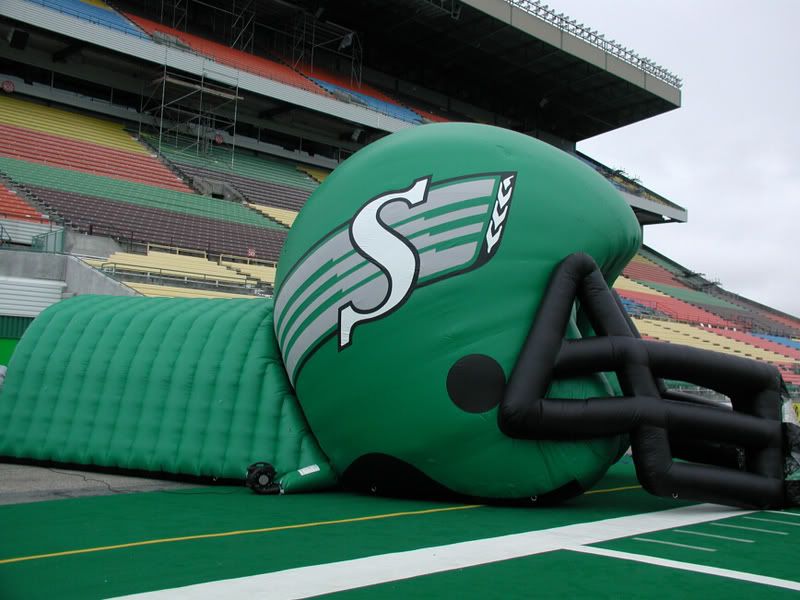
Everyone seems to be saying today that the Grey Cup was thrilling if you're from Saskatchewan, unwatchable if you love Canadian football.

All week there was whole vive-la-difference going on comparing how healthy the league is financially -- attendance up, TV ratings up -- compared to the last time the Grey Cup was in Toronto in 1992.

It's almost a complete opposite a complete mirror image in terms of the quality of the game. Around the time of that '92 Grey Cup, when Doug Flutie passed for more than 500 yards -- more than the combined output of Ryan Dinwiddie and Kerry Joseph on Sunday -- the CFL was hurting financially.

It was the choice of the football coinnoisseur, though. Sports Illustrated sent its nuts-and-bolts football guy, Paul Zimmerman, up to cover that Grey Cup, and he raved about CFL ball being a "chessboard gone mad." Compared to the NFL, where Bill Parcells-Joe Gibbs ball-control offences ruled, it was a revelation.

Fifteen years later, contrast that with the overnight reviews:

"This was one time the network should have switched to Heidi." -- Montreal Gazette

"...the 95th Grey Cup game was a few moments of glory wrapped in 31/2 hours of poor throws, dropped passes and one team, the Saskatchewan Roughriders, actually outscoring itself at one point, a true CFL oddity." -- Globe & Mail

"The first offence-free Grey Cup in recent memory..." -- Toronto Star
The CFL used to let us indulge our need to feel superior to the Americans. Our game, with our wider field and one less down, enabled Doug Flutie to explore the full range of his talents. It was a place for smaller players such as Gizmo Williams and Pinball Clemons. In the '70s, the CFL gave African-Americans -- Chuck Ealey, Condredge Holloway, Warren Moon -- a genuine chance to start at quarterback -- long before the NFL was so enlightened.

CRYING OUT FOR A CREATIVE BREAKTHROUGH

Now it has a healthy bottom line, a better TV contract and the game sucks. C'est la vie. The way to sell a lot of cultural prodcuts to Canadians seems to be to make it look like a watered-down imitation of something American.

People who are the top of the CFL hierarchy read so many reports for so many years about teams losing money and failing to draw in a wide audience, that it started to believe that was all that mattered. Like the NFL, it's become more about the people who have no real interest in the game, getting casual fans to watch and bring up the TV ratings. The rush to cater to those folks, to quote Chuck Klosterman, "creates a nonspecific product that isn't appealing to anyone."

Meantime, the game has steadily evolved into one of field position and managing the ball (yawn). The CFL has lost the plot.

Defence dominates, which is fine, but the league is crying out for a creative breakthrough on the offensive side of the ball. It's almost like since Flutie went back to the NFL 10 years ago, the league collectively forgot how to put together an exciting offence that balanced running with passing. That's led to two Grey Cups in a row that were almost devoid of any big-yardage plays on offence; on Sunday, aside from a 50-yard Winnipeg touchdown, the next two longest gains on the day both came on pass interference penalties.

If you wanted to see someone fake out an entire kicking team à la The Giz on Sunday, you would have had to flip over to the Chicago-Denver NFL game to see Devin Hester torch the Broncos for two touchdowns. If you wanted to see an offence spread receivers sideline-to-sideline and light up the scoreboard, you could have seen that in almost any NCAA and NFL game during the U.S. Thanksgiving weekend. You could have seen that on Friday during a game between Colorado and Nebraska, two programs which won national titles in the 1990s while running a variation of the power option -- all running, almost no passing.

Canadians should be proud the Americans have co-opted the CFL's style and embraced the more open style of offence. We should understand that a lot of players who are the seventh or eighth wide receiver on a NFL depth chart might have come to Canada and been stars in another era. Twenty years ago, a starting wideout such as Antwaan Randle El probably would have come north to play for a chance to play quarterback. The same goes for another converted QB, the New York Jets' Brad Smith, who's now a special teamer.

It could be, that being Canadians, we always have to invent a crisis for ourselves, but it's clear that the league, like the running backs in Sunday's game, has hit a wall tactically. The game has become predictable, and thus boring.

Here's a couple ideas that worth throwing against the wall to see if it might spark some creativity:
  1. No "I" in team. American coaches' overuse of the I formation with its "stretch" and "search" plays has led to predictable running games. The CFL could effectively outlaw the I (and the single back set where the QB is in the shotgun and the running back often starts the play eight or nine yards deep) by making a rule that prohibits any back from lining up more than five yards deep between the tackles.

    In the long run, it would make teams use more motion and misdirection in the running game. They would have to find lighter, more agile offensive linemen who can pull and trap-block. The two-back offence -- remember Neil Lumsden and Jim Germany? -- might return, and quarterbacks would have to develop better ball-handling and faking skills. An exciting running game is just as much fun as an exciting passing game.
  2. Wider hashmarks. This is touched upon in the Todd column linked below. To be honest, I wasn't aware the hashes in the CFL were once only 15 yards from the sideline (it's now 24). It's clear it was changed since coaches probably hated it. The league could slowly phase it in, moving the hashmarks out by three yards every two years.

    The coaches would have no argument about having less room on the short side to run the ball. As it stands, they would have nothing to be worried about since nearly every play is up the middle or off tackle. They need to rediscover the wide field.
  3. Get fan opinion. Seriously, when the league sits down to discuss rule changes in the off-season, each team should have one hardcore CFL nut at the meeting to discuss what they liked and didn't like about the style of play.
  4. More Canadian players. The homegrown talent in the league has probably caught up to the import ratio. Some teams now start Canadians and have American backups playing special teams. Over time -- phase it in so no one's career is ruined in one fell swoop -- the league should go from about 18 Americans per team to 12 or 14. Sure, maybe the game would be a bit more ragged and imprecise for a few years, but that's the CFL.

Who knows if any of that would bring back the CFL we once knew and loved. It would be a hell of a lot better for what passed for the league's showcase on Sunday, though.

Recommended reading:
A once wild, woolly CFL goes to hash (Jack Todd, Montreal Gazette)
Four Ways to Save Sports Media (Chuck Klosterman, Esquire)

That's all for now. Send your thoughts to neatesager@yahoo.ca.

Friday, July 06, 2007

CIS CORNER: STRACHAN HARTLEY, McGILL FOOTBALL CAPTAIN, LOSES CANCER FIGHT

The overused word "tragedy" fits upon learning former McGill football captain Strachan Hartley lost his battle with non-Hodgkin's lymphoma earlier today, just 30 years old. I didn't know him personally, but Hartley by all accounts was everything one would want to see from a CIS athlete, an academic all-Canadian who graduated in the top 15% of his McGill med school class even while underdoing cancer treatment.

It's a brutal story for any family, let alone one as accomplished athletically as the Hartley clan, which includes the Olympic medallist diver Blythe Hartley and Wyatt Hartley, who played tailback for the Queen's Golden Gaels around the turn of the decade.

One memory stands out from the Hartley brothers' only meeting during their CIS football careers, in the last Queen's-McGill game in September 2000 at Molson Stadium in Montréal. After the game (Strachan's Redmen won 30-15, but Wyatt got both Gaels touchdowns), the players were doing the usual post-game catching up with families and friends on the field before heading into the locker rooms.

The duelling Hartleys had by far the largest contingent around them. A couple of little girls, maybe cousins, had slipped on their helmets, which were comically oversized on their tiny heads, and were ramming into each other. Knowing about the family's athletic reputation — Blythe Hartley competed in her first Olympics that same month — it was comical to see all that vigour had spread across their friends and family.

I didn't know the family beyond having interviewed Wyatt a couple times after games, obviously. It's hard to imagine that same family that was there seeing the brothers face each other in football that day seven years ago going through such heartache now.

Condolences to the Hartleys, Strachan's friends, his spouse Dr. Chloe Roumain and his football families at McGill and the University of British Columbia, where he was a captain on the Thunderbirds team who beat the Ottawa Gee-Gees in the Vanier Cup 10 years ago this fall. Before his death, he expressed hope to the Montreal Gazette that his fight would move people to give blood or register for a stem cell donor registry, and hopefully some work will be done in his name that once the mourning period has passed.

Related:
A simple story of heart and grit (Jack Todd, Montreal Gazette, Dec. 16, 2006)

Thursday, February 01, 2007

PROFILES IN JELLO-HEADEDNESS, PART 2: THE NHL'S BREAKUP SONG

(Part 2 in a rant. Here's Part 1.)

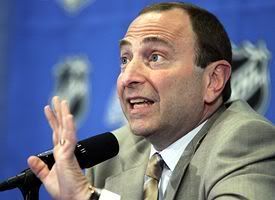
Gary Bettman hasn't turned hockey into the NBA, like so many feared he would when he became NHL commissioner 14 years ago today, Feb. 1, 1993.

No, Little Lyin' Gary, the real-life Nathan Thurm, has overseen something far worse. He has turned the NHL into Major League Baseball with higher ticket prices.

On Feb. 1, 1993, baseball was the sport that was getting battered pillar to post by the media -- it had labour unrest, sagging TV ratings, fans fed up with greedhead players (remember the shitstorm over Bobby Bonilla getting $29 million for 5 years?) a bad national TV deal and, with Fay Vincent having been forced out as commissioner the previous year -- this is the big one -- a complete lack of a credible central authority who could facilitate solutions to the game and league's problems. It had become a lumbering dinosaur. Gee, sound familiar?

Today, the emperor has no clothes, Iraq doesn't have the WMDs and Bettman has, in the immortal words of my man Chris Thomas, "noooooooo credibility." The great leap forward that was envisioned 14 years ago has been the biggest flop this side of Basic Instinct 2. It's not as bad as people make it out to be, but let's be honest: Who thinks hockey can survive Gary Bettman and the teams who have the long end of the stick, like that one run by Lou Lamoriello in New Jersey?

It can, on one condition: Break up the NHL as we know it (there's a strong decentralization movement afoot already), and get away from a structure set up first and foremost to maintain wealthy interests -- and that includes the players and the NHL Players' Association. Only in a sport as hidebound as hockey would anyone ever think you could have a revolution without a change in the hierarchy.

There are teams in cities where no one cares about them and Canadian cities who would kill to have real hockey or more real pro hockey (instead of what some deride as the Almost Hockey League) but have no hope of getting it under the NHL's current structure. There are hockey-mad fans who have to sell a vital organ to afford tickets (i.e., Toronto) while even once great U.S. hockey cities like Boston, Chicago and St. Louis can't give 'em away. For pity's sake, Hal Gill gets paid more than $2 million per year. Most importantly, there is an eroding connection between players and fans, and it's all but gone.

(Just a note, and thanks to Pete Toms for pointing this out: There is no cause-and-effect between high salaries and high ticket prices -- the Leafs or Senators charge what they think people will pay. But with free competition, we can bring both ticket prices and salaries down, and grow the game.)

Maybe it's just a case of the curtain being pulled back on the business side of the game, but the NHL has reached the point where they don't care about entertaining people anymore, notwithstanding whatever minor changes were made in 2005-06. No one, not even Bettman, meant for this to happen, but that's what we have.

Maybe it's the effect of globalization, but a league whose structure has no relationship to where passion for the game runs deepest -- there's a team in Sunrise, Florida, but not one in Winnipeg -- is not a sport. It's a fraud. It's no longer enough to say you "like the game the way it is," and think that passes as a valid argument. Hockey needs to adapt and stick with tradition.

Tradition, by nature, is always changing. Ken Dryden probably had it right when he said the golden age of hockey is "whoever was playing when you were 12 years old." (Or 10, or 16.) That would put us in the late '80s, early '90s. The Original Six was long gone, but no one who could think seemed too put out by Los Angeles having a team. Players were earning high six-figure salaries, but weren't held up as greedy like their counterparts in baseball and basketball (for a time, hockey's whiteness served as a halo effect there), and more players than ever before were able to make a decent living. On the ice, clutch-and-grab tactics were becoming a problem, but not to the extent that radical change -- bigger nets, 4-on-4 hockey -- was being proposed to maintain the parry and thrust between skill guys and checkers, or shooters and goaltenders.

Hockey in that 1985-93 period wasn't perfect, but it was a hell of a lot better than the setup we've got entering Year 15 of the Wonderful World of Gary Bettman, where tradition is all but spit on -- which is why no one with a heart should mind if a sweater retirement gets overly grandiose, almost as a form of compensation. The topper, for a lot of people in Canada, came during the all-star break last week when the league, with its head up its ass and its finger as far away from the public pulse as possible, voted any against adopting a schedule that would have ensured all Canadian teams of playing each other in 2007-08.

One question which failed to come up: If Vancouver and Montreal, or Calgary and Toronto have representative hockey clubs, why do they need Gary Bettman and Lou Lamoriello's say-so to play each other in a meaningful game?*

Not allowing those teams to play each other every season amounts to restraint of trade and it's not fair to the fans. If the Canucks, Flames and Oilers had any balls, they would protest this by refusing to sell tickets for the home games they'll be forced to play in 2007-08 against a poor-drawing Atlantic Division team like the New York Islanders and letting everyone in for free. Of course, they won't, since there's increasing pressure to milk the game and the fans for every last dollar and pay those salaries.

Which kind of gets to the real problem, the one that explains why we need to break up the NHL the monopoly for the good of the sport. As things stand, the lack of competition at the business level and for players traps the owners into paying the high salaries. That's not sustainable, since it ultimately puts more and more distance between the fans and the players they want to identify with.

The real irony of the '04-05 lockout was that it was a missed opportunity for the owners. They could have broken up the NHL, made everyone free agents and signed them back for pennies on the dollar. But they were so bent on breaking the players' association, they insisted on a strict adherence to their bloated 30-team corpse of a league. You can only imagine the lawsuits that would have been filed if it had gone down this way, but the owners could have had the players over a barrel if they had announced they were dividing into three or four different leagues, giving 10 or so AHL operators major-league status to create more jobs as a sop to the players' unions, and making everyone a free agent.

The league is decentralizing anyway, so why not go all the way?

With, say, 200 or 300 defencemen flooding the free-agent market, there would have been no equivalent to the Boston Bruins wouldn't have paying $7.5 million per year for Zdeno Chara last summer, since they would have had access to Chris Pronger, Scott Niedermayer and dozens and dozens of second- and third-line D-men. It's called a buyer's market. But no, they had to rob us of a season to make the hockey world safe for the Florida Panthers. It was totally worth it.

If the NHL had Balkanized itself and given some AHL owners -- such as Hamilton, Winnipeg, or the Chicago Wolves -- a chance to move up to the big leagues, the player pool would have been there. Far from squawking over the talent being too diluted to support expansion to 32 teams, there's probably enough talent for 50 to 60 quality teams in North America. There isn't that wide a gap in talent between the NHL and AHL anymore. It's just that the best teams don't have access to all the available talent, since it's tied up due to draft rights and farm systems.

So what's the proposal here for hockey's Brave New Post-Bettman World? It's not concrete, but it starts with a few basic principles that should be nailed to the door of every pro hockey arena.

  1. Free competition, starting with the breakup of the existing 30 teams into at least two leagues, and possibly as many as four, with many existing markets opened up to competitor leagues.
  2. League alignment that recognizes the game's geography and its history: How about carving a league out of the existing Canadian teams, Winnipeg and Hamilton, a second team in Toronto, and strong northern U.S. markets such as Chicago, Detroit, Minneapolis-St. Paul, Philly, Buffalo and Boston? If Raleigh-Durham, Tampa-St. Petersburg, Atlanta and Sunrise, Fla., really want to have hockey, let them have their own version of NFL Europe -- out of sight and out of mind for all but the most hardcore fans.
  3. Free the minor leagues. No formal affiliation agreements. No more of Winnipeg feeling like it got stuck with a cheap facsimile of hockey so Vancouver can have everything. Teams would be on their own for coming up with players (hey, Tier II Junior A and college teams do it), and there could be a transfer system (similar to soccer's) for moving players from a lower-division team to the top leagues. Corporations who own two teams in the same market -- like in Toronto, where MLSE owns the Leafs and the Marlies -- would have to divest themselves of one of their teams, and could not stop a competitor from entering.
  4. The leagues shall do nothing in concert -- no licensing deals, no TV contracts, no player drafts (each can have its own), no rule changes -- except agree to hold a Stanley Cup final.
With the breakup of the NHL, salaries would drop, but more players would get to play the game at an elite level. Ticket and concession prices would drop since the public's expectation of what it should cost to attend a pro hockey game would change, and free competition -- in the Leafs' case, a team on the other side of town -- would force them to justify their ticket prices.

Access to real hockey would be more equitably distributed. More people would probably attend games, especially in Canada. Instead of 5,000 fans for an AHL game at the MTS Centre in the 'Peg or Copps Coliseum in Hamilton, those teams would get two to three times that for a team in what would truly be the New NHL.

The game would be more diverse, since each league in each pocket of North America would take on its own style of play, and would be free to tweak the rules as it saw fit. There would be a more interesting regular season -- teams could probably play a shorter schedule and spice it up with challenge tournaments or exhibition games. For instance, the Canucks could just invite Sidney Crosby's team in for a game, similar to a big intersectional game in college hockey.

Would teams get gimmicky? Sure. That's showbiz. There would also be instability -- teams failing, folding in mid-season -- but that's business, and if it's between a little instability and more Bettman-induced malaise and monotony, instability looks pretty good.

Change -- real change, the first that hockey's had since the WHA challenge of the '70s, would be more possible, since smaller leagues would all have to work to win the public's attention and disposable income, and they would all be learning from each other's trials and errors instead of just offering spin-doctoring.

The point here is to spur people to not to be resigned what we've had in 14 years under of Gary Bettman. It's not the only way, much less the best way.

(Much obliged to Bill James, whose essay "Revolution" formed some of the basis of the arguments presented here.)

* As much as one game out of 82 can be meaningful.

Related:
Unhappy Anniversary (Dan Wetzel, Yahoo! Sports)
Few cheers for Bettman anniversary (Jack Todd, Montreal Gazette)

That's all for now. Send your thoughts to neatesager@yahoo.ca.

Tuesday, January 16, 2007

HOCKEY LAST NIGHT: YOBS GIVE NEW MEANING TO TERM "CANNONADING SHOT"

A high school hockey game in Massachusetts was forfeited last weekend after spectators starting hurling golf balls at the players: the "golf-and-tennis-ball cannonade rained down so suddenly that players and coaches were unable to avoid it."

"Saturday’s ruthless pelting at Newburyport’s Graf Rink caught a trainer smack in the forehead, sending him first to the hospital and then home with a nasty welt. "

Sick puppies that we are, we couldn't help but smile a little at the appearance of the word "cannonade" -- a nice Danny Gallivan reference.

Red Wings 2 Canadiens 0: Ho, hum, Dominik Hasek pitches the shutout and wheels really seem to be coming off the Habs.

Predators 5 Flames 3: David Legwand has a three-point day (it was a 5 p.m. local time start, so you can't really call it a three-point night) in what might end up being the 2 vs. 7 playoff matchup in the West.

Bruins 3 Sabres 2 (shootout): Ryan Miller made the save of the year, which will probably be all over YouTube by 10 a.m., but Marco Sturm slipped home the shootout winner for the B's (that would be Boston).

Headlines: The Gazette's Jack Todd calls TSN's Pierre McGuire two-faced; Yutaka Fukafuji's debut fairly deserves to be set off with haikus; Syracuse continues talking college hockey (which would be fitting, since one of the higher-ups in the athletic department there is named Wildhack); Kitchener eyes the 2008 Memorial Cup which Kingston is going after (deadline to apply is Feb. 2).

NHL Scoreboard

Today's better games: Leafs-Lightning, 7:30; Capitals-Team Mud, 7:30; Canucks-Canadiens, 7:30; Oilers-Wild, 8.

Back with more later... send your thoughts to neatesager@yahoo.ca.