Showing posts with label Mark Cohon. Show all posts

Monday, June 29, 2009

CIS Corner: Losses hit Gaels hard; mulling the Ravens revival

Being on vacation last week precluded weighing in on a couple pertinent university football stories, the emerging details about a Carleton Ravens revival and Queen's losses to the CFL.

Ravens/Gee-Gees: Ottawa's WCE — whose turn is it to wear the mayor's chain of office this week? — could still screw this up. After last week, it is easier to picture a double launch in 2012, with the Ravens joining the Reconstituted.

CFL commissioner Mark Cohon said recently that Ottawa will come back into the pro league in 2012. Three years is enough lead time for Carleton to prepare the proper exploitation for a football revival.

Carleton would basically run on the Laval model, with the football team almost separate from the university save for academics and admissions. Quoth John Ruddy, one of the Lansdowne Live leaders (and a former Ravens defensive back):
"The Ravens would utilize our professional training facilities, they’d play in a new, fan-friendly stadium and they’d leverage our marking and operations staff ... At the end of the day, I think those elements would benefit recruiting and player development and fast-track success on the field."
David Naylor, the excellent Globe & Mail football reporter, noted this gives Jeff Hunt, Roger Greenberg, John Shenkman and Ruddy an important card to play in their negotiations with the city:
"... The revitalization of Lansdowne starts to look less like the building of a home for a CFL team and more like the construction of a community asset that will be used for two sports at both the amateur and professional levels.

That is surely the message the (Jeff) Hunt group wants to get out in advance of city council vote scheduled for Aug. 26."
Two questions pop immediately to mind:
  1. How does this affect the Ottawa Gee-Gees, who play at Lansdowne? As an ottawasun.com user noted, the Gee-Gees would not want to play at a stadium run by a group which is putting its fundraising and marketing expertise toward their cross-town rivals. It would be similar to the situation where Waterloo used Laurier's stadium for many years, the irony here being the Gee-Gees have been a powerhouse while Carleton was an also-ran more often than not.

  2. Carleton coming back likely means another OUA school is exploring starting a football team to bring the conference to even 12. Not to play coy, but feel free to speculate away about who might be that school. The one these ears heard would be a stunner.
Golden Gaels: Losing Dee Sterling to the Edmonton Eskimos probably leaves more of a hole in Pat Sheahan's two-deep than Mike Giffin making the Montréal Alouettes.

That is not a knock on Giffin, who made the Als as a fullback and special-teamer. Sterling going up to the CFL probably was less anticipated.

Meantime, Thaine Carter, the middle linebacker, ripped up his shoulder at Winnipeg Blue Bombers camp and Osie Ukwuoma might remain on the Calgary Stampeders practice roster, so that is three players lost off the front seven if Sterling stays in Edmonton and Carter does not comeback from his surgery. In order, that means Queen's is without a linebacker who could play sideline to sideline, its best rusher coming off the edge and a disruptor in the middle of the defensive line.

The Whig's article from last Friday noted cornerback-kick returner Jimmy Allin is a maybe to return for a fifth season. Centre Dan Bederman is "expected to return."

Meantime, good on Giffin for making the Alouettes. He was in tough after converting from tailback, since one of the other fullback spots was being used for Martin Bédard, a tight end from UConn who can also long snap. Giffin is not the first Queen's rushing star to earn his keep in the CFL as a fill-in back and special teamer. Bryan Crawford is going into his fifth season with the Toronto Argonauts, while Brad Elberg did it for the better part of a decade.

It just took Giff a little time to commit to the switch:
"I didn't go in with a good attitude last year (with Hamilton) ... My head just wasn't in it with my wife (Heidi) being eight months pregnant. I didn't think I had to perform. I was naive."
— Kingston Whig-Standard


Related:
Carleton aims for return of football (Terri Saunders, Sun Media, June 25)

(Cross-posted to cisblog.ca.)

Wednesday, June 17, 2009

CFL in Ottawa: Cohon says import ratio could be tweaked

Talk about a Canadian conundrum: The CFL's chances in the nation's capital could rest on American players.

League commissioner Mark Cohon told SUN TV's Casino Rama Grill Room last night that the league of loosening the import rule for the Ottawa Rough Riders begin play. The gist of what he told host Gareth Wheeler was that, "we need to ensure that team can become competitive quickly, and one thing we would look at doing is letting them have a few more Americans when Ottawa comes back into the league in 2012."

It is not the big CFL story of the past couple days, but it sounds promising. The rank-and-file fans whose support will make or break the Reconstituteds (as they shall henceforth be known until it's official they'll be the Rough Riders) likely won't care too much. They're more about Ws than whether the Will linebacker grew up in Waterloo or Walla Walla.

What Cohon said is worth passing on for posterity's sake. The current import ratio is 21-18-3 (Canadians, imports and quarterbacks, who are stateless in the CFL's eyes). There's a risk in crediting it for the emergence of ratio-busters (Canadians who play positions traditionally earmarked for Americans) such as the B.C. Lions receiver Paris Jackson, Edmonton running backs Jesse Lumsden and Calvin McCarty and Kingston native Brent Johnson, who plays defensive end for B.C.

Those players can be few and far between and the eight established clubs will not be eager to part with them via an expansion draft. Tweaking the import ratio to 25-14, maybe for Ottawa's first 2-3 seasons, might help with their efforts. It has been noted previously (April 24, 2009) that putting a team that plays good football on the field will be Job One in Ottawa. The league has had two re-launches within the past 15 years, first in Montréal in 1996 and then Ottawa in 2002. One succeeded beyond everyone's wildest dreams, the other did not.
"Montréal got an established team ... which was competitive right off the hop. The terms of the expansion draft should reflect that the overall growth of an underdog league trumps Edmonton or Winnipeg's depth chart. There is no obvious, less direct way to break that to Westerners. The league also said in 2006 it would "place an emphasis on assisting Ottawa to field a competitive team upon its return."
Again, we'll see how this holds up once Ottawa rejoins the league. CFL owners' generosity only extends to far (propping up a struggling Southern Ontario franchise, good, letting the new kids on the block raid your roster, bad).

It is at least something worth pursuing. The point will remain the same, though, the terms of the expansion draft are going to have to be more generous than they were the last time around. It is one thing to let the Reconstituteds dress a few more Americans, but if they're all rookies or newcomers to the Canadian game, it would be self-defeating.

Friday, April 24, 2009

The overdue Ottawa Reconstituted Rough Riders post; a quick six ideas

There can be no return engagement for The Dan Crowley Experience, unless that's the name of a band.

Crowley was the erstwhile Edmonton Eskimos third-stringer who ended up becoming the Ottawa Renegades starter in 2002 after CFL teams wrongheadedly allowed each team to withhold two quarterbacks from the expansion draft. The terms of the expansion draft were about as favourable as the terms of some of the loans Lenny Dykstra has taken out. It hurt the second team's efforts to establish credibility, although it was just one reason among many.

Anyway, it's a decent jumping-off point now that Ottawa's W.C.E. has voted to allow negotiations for redeveloping Lansdowne Park to begin. One feeling is that the energy spent on Ottawa's stadium debate will look more ineffectual than the current city council did on Wednesday if it doesn't yield a competitive team. A couple general points about what it will take, among other things, for this to work:
  1. The expansion draft. Commissioner Mark Cohon cited the rebirth of the Montréal Alouettes in a press release earlier this week, but the thing is, Montréal got an established team (the former Baltimore Stallions) that was competitive right off the hop. The terms of the expansion draft should reflect that the overall growth of an underdog league trumps Edmonton or Winnipeg's depth chart. There is no obvious, less direct way to break that to Westerners. The league also said in 2006 it would "place an emphasis on assisting Ottawa to field a competitive team upon its return."

    The Renegades were only able to select 16 established CFLers in 2002. It left Ottawa deficient at the most important position. It was wrongheaded.

    The league won't, but it should consider letting Ottawa go in the Canadian college draft a year early. Many CIS athletes return to school for another season after being drafted. Something could be arranged to loan players drafted from U.S. schools to other teams.

  2. A fresh face in the GM's chair. The face of the team's front office is going to have to some cred in the capital. One name that comes to mind is TSN analyst Jock Climie has the smarts, the gift of gab and roots in the city, having grown up the city and practised law. It's tempting to think of the ex-Rider (and Queen's Golden Gael) having some involvement with the new team. It wouldn't have to be Climie per se, but someone personable and with ties to the city could help keep the media onside.

  3. Two sides to the river. The last team acted like the 300,000 francophone residents in Ottawa-Gatineau, without whom this would not be the fourth-largest city in Canada, didn't exist. That's pretty glaring, given the rise of amateur and pro football in Québec since the mid-1990s.

  4. Hit the hustings — hard. Football has grown by leaps and bounds in Eastern Ontario since 1996 — more amateur leagues, high schools fielding teams after decades without football or having never had a team before. Ottawa and Kingston, two hours away, both have solid amateur football communities.

    Ottawa teams who are not the Senators seem to struggle to market outside the city proper and that myopia needs to be avoided. Riders 3.0 needs to have employees out and visible at high school and junior games in order to help with their branding. It could be something as simple as hosting the spring high school all-star showcase at the new stadium — trick one team out in home black and the other in road whites, or passing out team tuques and scarves when the National Capital Amateur Football Association (NCAFA) has its championship day in November.

    Jeff Hunt's Ottawa 67's have a good relationship with minor hockey in the region. That gives hope something similar can exist with the football team.

  5. Avoid the same ol', same ol'. Trading on Ronnie Stewart and Russ Jackson's legend, et al., as awesome as those cats were back in the day, isn't going to bring out the under-35 crowd. Only three-down football devotees have heard of those Canadian football gods, which is partly the CFL's fault for neglecting its own history for so many years.

    Relying on history isn't the way to sell tickets; it's going to rise or fall based on the on-field product. Never underestimate grey power, especially in Eastern Ontario, whose population is on average older than the rest of country. It will take more than appealing to nostalgia, especially for people who weren't born when Tony Gabriel got open on "Rob I, 34 Flag" to make that catch in '76.

    (There does not appear to be a YouTube clip of that play. But check out this local car commercial featuring the great tight end and say that doesn't put you in a mood for football!)


Those are just a few thoughts, hopefully readers have more.

(Don't worry, soccer should have its day in Ottawa eventually. It takes time.)

Monday, December 08, 2008

How the CFL might cash in on the recession...

One positive development for the CFL on the weekend the Bills come into downtown Toronto.

The Arena Football League is in some deep doo-doo financially, according to a PFT report from Mike Florio. Speculative posts about the global credit crunch's impact on the sports industry are already causing reader fatigue, I know. Oddly enough, in one of those Canadian conundrums, the CFL probably featured the most exciting, wide-open play it's ever had in the late '80s and early '90s, during the last big global economic slowdown.

Whatever the cause and effect, in those days days, the CFL didn't have a big competitor for talent, in the wake of the USFL folding. When the New England Patriots cut Doug Flutie in 1990, the CFL was his best, if only option.

The Arena league's growth has siphoned off a lot of the quarterbacks and wide receivers who are needed to sell the game. It is something to consider. The PFT report notes that the Arena league was depending on a big cash infusion that might not be coming, that "(s)ome team employees have been advised to find other work," and that the league gets no money from its U.S. television deal (hey, just like the NHL).

Greater minds such as Stephen Brunt have noted that the CFL under Tom Wright and his successer Mark Cohon has done well making itself financially stable. Teams have relatively low overhead. The salary cap is a joke but there aren't any Larry Ryckman types among the owners.

Scoring was up in the regular season this past year, but it had seemed like that until John Hufnagel took over as coach in Calgary, there hadn't a new play in the CFL since the late '90s. No one can predict what having a wider range of coaches and players would bring to the league, but it's something to keep in mind.

Related:
AFL in a death spiral? (Mike Florio, ProFootballTalk.com)

Saturday, November 22, 2008

There was a time when everybody was working for Grey Cup weekend

The Grey Cup has gone uptown.

The biggest change to Grey Cup week has been lost on the thinned-out media horde in Montreal. TSN having the game has meant the loss of those last-night Grey Cup classics that the CBC used to air for three-down devotees.

Those broadcasts were a rip, more as a museum piece than for the actual games. Look! The Alouettes coach is smoking a cigarette on the sideline. There's federal sports minister Iona Campagnolo in the stands, bundled up in a fur coat. You would never see that today -- a national TV audience actually being expected to know who was Canada's federal sports minister, never mind the fur coat or the coach ... (takes drag on cigarette) "watch the tight end!" (exhales).

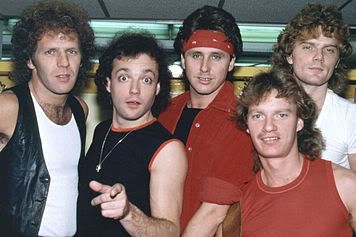
It was pure Canadiana, almost compelling in its lameness, but back then, we owned it. It was also unique to us and anything but America-lite that the Grey Cup reflects nowadays. CFL commissioner Mark Cohon or TSN president Phil King have no time for such nostalgia. It's too bad, really. They could cover it off with one simple act -- hire Loverboy as the halftime entertainment.

Alas, Theory of a Deadman will be playing at halftime of Sunday's Alouettes-Stampeders clash. Going in reverse chronological order, the halftime entertainment the past three years has been Lenny Kravitz, Nelly Furtado and The Black-Eyed Peas. No disrespect, but my Canadian Football League does not include the wherewithal to land A-list entertainment. You're supposed to end up watching Colin James or the pre-Styx Lawrence Gowan, alternating between thumbs in ears and fingers down throat, saying to yourself "Why do I support this league again?"

It indulged the most Canadian of traits, the right to eternal self-flagellation. (Thank god Canadian Interuniversity Sport, by its inaction, gets this.)

The first preference for the halftime show should go to a band that is well past it. These eyes will never forget the sight of a middle-aged Burton Cummings banging on the piano in a pair of fingerless gloves while The Guess Who performed in minus-25C temperatures during the 2000 championship game in Calgary. Failing that, it should be a group which has simply hung on long enough to have become imbued with something that miguided souls confer respectability. That must be why Loverboy is being honoured at next year's Junos.

It's not like this would be lacking in synergy. Loverboy has an album to promote in its own right and goodness knows, since the CFL's audience does skew more toward the middle-aged, there might be a certain sadistic appeal in seeing that time and fevers have robbed Mike Reno of the ability to squeeze into a pair of red leather pants (but at least he could once).


At the very least, this simple act of charity (toward fans, not Mike Reno) would remind us that the CFL hasn't lost its -- well, not soul, it's highly dubious to claim Canada has ever had that -- but has not totally shed its old skin. It is neither here nor there that rock and roll "has been sliding towards extinction since 1980, when Loverboy released its first album," as some wiseacre wrote a few years ago while doubling as his paper's music reviewer.

Point being, Loverboy rocks, in their way. Commissioner Cohon can tout the CFL's financial stability, its improved TV ratings, the increased scoring this season and its firm grasp of its market share as it deals with the NFL's inexorable advance on Southern Ontario all he wants. The CFL is in, as much as it goes against the grain to actually praise a Canadian institution, is in a pretty good place, enough to start talking about going back to Ottawa.

Strangely enough, that is almost odd and off-putting to someone who came in an age when the league was rough around the edges, not slick and corporate. The CFL was sometimes almost entertaining when the entire lot of it seemed to have one foot on a banana peel and the other kicking the latest commissioner in the arse on his way out the door.

Those days are thankfully gone, but don't deserve to be dropped entirely as the league moves onward and upward (OK, maybe they do). Commissioner Cohon, do the right thing and give Mike Reno a call, first thing today.

Related:
No panic for CFL during economic uncertainty; There's a quiet confidence here that certainly hasn't been a hallmark of all Grey Cups (Stephen Brunt, globesports.com)
Expect the unexpected when Grey Cup game is in Montreal (John MacKinnon, Canwest News Service)

Grey Cup: You lost us at turban-spotting

That old line about the ability to hold two opposing ideas in mind at the same time and still retain the ability to function always comes in handy.

There is a Toronto media personality who has truth and fun on his side like no one but no one in this country, but sometimes, well, he doesn't polish the message. His heart was in the right place when he wrote about the Grey Cup losing some of its cultural cachet, but it he blew it kind of with a line about how you won't "spot a lot of turbans" or "many young immigrants with tickets" in the crowd at Olympic Stadium Sunday.

Eep. Did anyone else read that and look over their shoulder for the Queen's University conversation cops? It is not necessarily prejudiced, merely careless on the website editors' part to post that unexpurgated.
"...take the behind-the-scenes crew at Sportsnet who put the nightly highlights together. Most of them are young, some of them multicultural, but all of them are passionate NFL fans. I see it every year and I'll see it again on Sunday; The kids will go crazy if the Jets upset the Titans but when the Grey Cup kicks off, our studio will sound more like a library.

"So, while CFL officials, the media and fans come together to toast the league with a few wobbly pops during Grey Cup, they should also take a good look around.

"With Calgary in the big game they're bound to see a bunch of cowboy hats in the crowd, and French-Canadians might even break out a few colorful Berets.

"However, they won't spot a lot of turbans and they'll be hard-pressed to find many young immigrants with tickets to the 'Big O,' which is too bad since it should be a heckuva game." (emphasis mine)
Far be it to wonder about what makes an individual "multicultural," whether colleagues in their 20s count as "kids" or where this guy gets off thinking he is entitled to use a semicolon. (Granted in Ontario, the definition of "kid" keeps getting pushed farther and farther back.)

They won't spot of a lot of turbans ... A Heinz-57 Canadian from cracker-ass crackerville cannot assume to know what it's like read that for those who are young, black or brown, or a first- or second-generation Canadians (not "immigrants"). The best one can is be thankful to have once had a teacher who stood before a classroom full of whiter-than-white Eastern Ontario teenagers and said, "You're not Canada."

The CFL has some issues with demographics, but it's borne of age, not just ethnicity. The CFL, in central Canada, is reaping what it sowed in the '80s and '90s, which is why the makeup of its crowds have not kept pace with the face of modern Canada.

Shortsighted blackout policies, franchises in turmoil in all four Eastern cities and the nuclear proliferation of televised sports caused the CFL to lose a lot of fans. They are now, 25-39 years old, which represents a person's prime years for following sports and buying tickets (the optimal point between having disposable income and not having to chase after children). There are still plenty of men and women who will seek out the CFL on their own, the same way some people love indie rock or art-house movies. That cuts across all lines.

If the CFL is becoming nichey, it's because of what happened in the '80s and '90s, and CFL commissioner Mark Cohon, et al., have to find that lost generation. They're smart enough to figure that out, without looking for fans in turbans.

Related:
It's just a football game (sportsnet.ca
; funny someone at the cable sports network that doesn't have either the Vanier or Grey Cup games would make that argument, but whatever)

Friday, October 17, 2008

Lansdowne Live: Developers Shenk one; or, this dog-and-pony show won't Hunt

The pro sports scene in Ottawa could turn Norman Vincent Peale into a cynic.

Dated references are called for after watching the Lansdowne Live, so-called, press conference. It was like walking into a time warp, right down to the knob from Heritage Ottawa asking about the stupid cattle castle that should have been torn down long ago. It was very hard to watch without coming away feeling like nothing will get done with the site any time soon. Roger Greenberg (gotta be careful here, I rent from Minto!) more or less had to backtrack and say, "This is more of a concept plan."

It sucks to be anyone who thought they were getting decisive action or anything new. This was a first draft.

The upshot is that if you go by historical significance, the site has been for pro sports. It's one way to honour history (and a few business portfolios). Given today's gong show, it would not be surprising if this ends with the city throwing up its hands and saying that is how it has to be. (That's how Kingston got the K-Rock Centre, people!)

It just probably won't happen in time for the 2010 CFL season, as good friend Pete Toms predicted during a chat some time ago.

It would feel wrong to cross over the bridge and see condominiums and stores selling crap that no one needs. It would be a selling-off of a shared heritage, and that is important, although not as important as the knob from Heritage Ottawa would have you believe. Greenspace is good, but it's also prime real estate in the centre of the city. Money talks and leftie lingo walks, so that's not happening. It would amount to cutting a hole in the city's pocket at a time when it's having trouble paying for snow removal.

The main point is that today probably did not do much to sway anyone in either direction, and that's sad. That's too bad, because it sucks to feel like a jerk for just seeing this as more business-as-usual.

This is coming from someone who would love to watch a CFL game -- and to borrow one add-on from today, "perhaps pro soccer, too!" -- here at some point before he moves on to his next city. Suffice to say, to Roger Greenberg, Jeff Hunt, John Ruddy and Bill Shenkman, you are each more brilliant and successful than I will ever be, and it's fair bet none of you ended up spending Thanksgiving alone. Gentleman, though, you're going to have to do a lot better than you did today if there will ever be another CFL team -- "and perhaps, pro soccer too!" playing in this city.

Anyway, the rest is all bullet-pointed:

  • As you can guess, the MLS was an afterthought, save for Hunt telling Rogers 22 that you couldn't put a stadium on the "outskirts" of town. There were two Roughriders football helmets on the table and one artist's conception of the stadium not-so-subtly included a soccer ball in the middle of the field. They didn't come off as credible when talking about soccer, though. No one spoke from the Ottawa Fury, which a lot more in touch with soccer at the grass roots. That's simply a gut feeling.

    There was a mention that the Gatineau entry in a new Quebec semi-pro league (eye-roll) would be interested in playing there. Where was the Fury, though?

  • Ottawa city councillor Clive Doucet, whatever you think of his politics, killed it. He told Rogers 22, "It's the tail wagging the dog. Good for them, but they're sharks and I don't want to be eaten." ... "It's not an urban oasis, it's a big-business vision."

    The man gives good sound-bite.

  • Hunt claimed that there is a "correlation between world-class stadiums and the success of the teams who play in them." Two words: "PNC Park." Or "Safeco Field."

    Between the Boston Red Sox (96-year-old stadium), Tampa Bay Rays (whose stadium is a dump), Super Bowl champion New York Giants (stadium opened 1975), last season's Stanley Cup finalists, the Detroit Red Wings (arena opened 1979) and Pittsburgh Penguins (1961), teams in aging stadia seem to do OK. There doesn't seem to be a strong cause-and-effect.

  • One of the Glebeites asked why the developers just don't buy the stadium. Two minutes of Wiki'ing answered that question -- there are no privately owned stadiums in the CFL. The Winnipeg Blue Bombers, a community-owned team, own their stadium. The Toronto Argonauts rent Rogers Centre. The other six are all government- or university-owned. Ottawa cannot come back into the league under such a financial burden, even though the CFL supposedly has a salary cap.
Sorry, but it's just been a frustrating couple of hours. To CFL commish Mark Cohon, here's hoping you're calling Halifax, Moncton and Quebec City right now, to tell them to get a move on.

Monday, March 24, 2008

THIRD DOWN AND 2010....

The Globe has it posted that CFL commissioner Mark Cohon is supposed to be in Ottawa tomorrow to announce a conditional expansion franchise.

Who knows how long the turnaround will take, especially with Mayor Lare in office.


Related:
CFL set to confirm return to Ottawa (Globe and Mail)