Tyler King has the call, 7:30 ET:
Free Webcam Chat at Ustream
Showing posts with label Junior Hockey. Show all posts
Showing posts with label Junior Hockey. Show all posts
Wednesday, March 31, 2010


Saturday, March 13, 2010
The King of Kingston hockey: Trenton vs. Vees, Sunday, 2:30!
Tyler King will have the call of Game 5 of the Kingston Kimco Voyageurs' OJAHL second-round playoff series against the Trenton Golden Hawks. Kingston is up 3-1 in the best-of-seven series.
Live video chat by Ustream
Live video chat by Ustream
Sunday, November 01, 2009
Six degrees of gruesome Fanelli injury
There's a Kingston connection with the awful story about Ben Fanelli, the Kitchener Rangers rookie defenceman who is in intensive care with skull and facial fractures.
The firsts-thing-first hoping Fanelli has a full recovery (not the same as whether he'll return to competitive hockey). It was not a head shot although it did look like Michael Lianbas, the 20-year-old Erie Otters player, took a good three full strides before hitting Fanelli, who had turned his back to play the puck up the boards behind his own goal.
The odd part is Fanelli went in the fourth round of the OHL draft in May, one round after the Rangers selected forward Keli Grant, a Kingston boy who attends Ernestown Secondary School, where my mother teaches. Mike Koreen, the Kingston Whig-Standard's excellent sports editor, wrote a while back about how Grant's experience this fall "will hit home for those who feel it's tough to force 15-or 16-year-olds to make such an important decision about their athletic future at an early age."
Perhaps that's where the debate is, whether it's necessarily good to force 16-year-olds to skate alongside 20-year-olds. For every player who's ready for it emotionally and physically, there are a few who are not, speaking generally.
The Rangers kept Fanelli instead of Grant to fill out their maximum allotment of three 16-year-old players. Grant ended up being caught up in a numbers game in Kitchener and with his hometown Kingston Kimco Voyageurs Junior A, who are only allowed two 16-year-olds (one of whom is his twin, Kris Grant.) He also lost his NCAA eligibility in the process by playing in an exhibition game with the Rangers.
Needless to say, all of that is a trifle compared to what is ahead for Fanelli and his family. Strange how that works. (Bob McKenzie might have Twitter updates on Fanelli later.)
The firsts-thing-first hoping Fanelli has a full recovery (not the same as whether he'll return to competitive hockey). It was not a head shot although it did look like Michael Lianbas, the 20-year-old Erie Otters player, took a good three full strides before hitting Fanelli, who had turned his back to play the puck up the boards behind his own goal.
The odd part is Fanelli went in the fourth round of the OHL draft in May, one round after the Rangers selected forward Keli Grant, a Kingston boy who attends Ernestown Secondary School, where my mother teaches. Mike Koreen, the Kingston Whig-Standard's excellent sports editor, wrote a while back about how Grant's experience this fall "will hit home for those who feel it's tough to force 15-or 16-year-olds to make such an important decision about their athletic future at an early age."
Perhaps that's where the debate is, whether it's necessarily good to force 16-year-olds to skate alongside 20-year-olds. For every player who's ready for it emotionally and physically, there are a few who are not, speaking generally.
The Rangers kept Fanelli instead of Grant to fill out their maximum allotment of three 16-year-old players. Grant ended up being caught up in a numbers game in Kitchener and with his hometown Kingston Kimco Voyageurs Junior A, who are only allowed two 16-year-olds (one of whom is his twin, Kris Grant.) He also lost his NCAA eligibility in the process by playing in an exhibition game with the Rangers.
Needless to say, all of that is a trifle compared to what is ahead for Fanelli and his family. Strange how that works. (Bob McKenzie might have Twitter updates on Fanelli later.)
Monday, July 06, 2009
Sentenced to the Island ...
No doubt a lot of in-the-know people were aware what Ontario Hockey League player was convicted of manslaughter in the death of 15-year-old Manny Castillo in a high school rugby game two years ago.
Long story short, the player received a year's probation and 100 hours' community service. Canada's Youth Criminal Justice Act is what is, so one cannot say explicitly who it was. Apparently it was decided that being drafted by a certain NHL team was punishment enough. Suffice to say, if you do not want to know who the player was, do not visit Chris Botta's blog.
(Update: Does it need to be explained that it was a joke to say being drafted by a certain NHL team is punishment enough?)
Related:
The Castillo verdict: Don't press the panic button (May 28, 2009)
Long story short, the player received a year's probation and 100 hours' community service. Canada's Youth Criminal Justice Act is what is, so one cannot say explicitly who it was. Apparently it was decided that being drafted by a certain NHL team was punishment enough. Suffice to say, if you do not want to know who the player was, do not visit Chris Botta's blog.
(Update: Does it need to be explained that it was a joke to say being drafted by a certain NHL team is punishment enough?)
Related:
The Castillo verdict: Don't press the panic button (May 28, 2009)
Tuesday, June 30, 2009
Fronts: Tired and true — Mavety between a K-Rock and a Harnden place
If one did not know better, you'd swear everyone was in cahoots to make sure the Kingston Frontenacs do not three-peat as playoff watchers.
The trade today for 20-year-old forward Zach Harnden along with Monday's move for fellow overage forward Kaine Geldart makes it pretty obvious how the season will set up for the Frontenacs. Getting Geldart and Harnden, two forwards with only a year left in the league, is right off page 125 of Larry Mavety's Big Book of Bad Hockey.
The subtext is that OHL would really like to see a turnaround in Kingston. It will be embarrassing for owner Doug "Whatever It Takes" Springer if the Frontenacs do not improve in Year 13 of Mav's five-year plan. The novelty of Doug Gilmour coaching in the OHL will soon wear off. The issue of a sweetheart arena deal for a subpar team could become hot-button during the municipal election in 2010, so it would help if they get in the playoffs.
The hope is they will. I am nothing if not a diehard fan. However, please try to see what goes along with Mavety falling back on what he knows, a reflex often peculiar to none-too-bright people. Mavety trades for "players we know," as The Royal Mavesty his ownself put it to the Kingston Whig-Standard. That means you get anyone whom another team believed had promise at age 16, since it's well-known how Mavety ranks as a talent evaluator (not very good) and how much he can impart to Gilmour (not very much). True to form, Mavety, who leads the world in trading for former first-rounders (and trading his own) is adding a player who as Loose Pucks noted, "was was Peterborough's first-round pick in the 2005 OHL Priority Selection. But his OHL numbers have topped out at 40 points during the 2007-08 season."
This is not aimed at Harnden and Geldart. They just work there, presumably (the Loose Pucks post, by the way, noted only that Harnden "could be back in the OHL for an overage year." Each could help the Frontenacs get back to the playoffs, probably more so the gritty Geldart. That is always, repeat always the hope.
However, you can see where this is headed, since it was predicted here 30 days ago:
One can reconcile the Frontenacs being unwilling to utilize the CHL Import Draft. It is understandable that Springer does not want to spend and Mavety will not go outside of his "players we know" comfort zone. (One would point out that no OHL team has turned up its nose at drafting high-end Europeans since Don Cherry's Mississauga IceDogs when it won like 16 games across three seasons about a decade ago, but it's not a requirement for OHL success.) The organization also has other fish to fry, like trying to shut up any local media who dare to cast a critical eye toward the team instead of towing the party line.
Anyway, there is a feeling people want to get behind the Frontenacs in Gilmour's first full season behind the bench. The point in writing this is in hope people do not get the wool pulled over their eyes during the season ahead. Setting a goal of simply making the playoffs is the absolute nadir of low-bar setting. Knowing that hockey tends to be a chummy old boys club, it would not come as a shock if a few teams were open to helping Mavety patch together a playoff team, quote-unquote. They owe him after him taking advantage of him so many teams over the years by fleecing him (get it?) in trades. (By the way, who gets the other overage spot now that two of the three are presumably accounted for by the new guys? Defencemen Corbin Crawford and/or Zack Fenwick must not be coming back.
It is certainly in OHL commissioner's David Branch's interest to have Gilmour be a success in Kingston instead of being part of a long-running gong show. Meantime, Kingston's city council and Mayor Harvey Rosen, probably needs the team to start showing real progress to keep the sweetheart arena deal with Springer from becoming an election issue.
In other words, there is a lot more to this than the Frontenacs picking up a little veteran experience. Welcome aboard, Zack Harnden. It has been 616 days since Doug Springer promised to do "whatever it takes" to bring a winner to Kingston.
(Here are Harnden's stats juxtaposed against Luke Pither, the first-rounder from that same 2005 draft whom Mavety gave up on way too soon. It is apples to pears, but Pither had twice as many points last season as the great player Mavety just acquired, 72-34. A Petes fan on the New OHL Open Forum described him as a, "Slow, under-achieving guy with average hands. Thanks for the 3rd!)
The trade today for 20-year-old forward Zach Harnden along with Monday's move for fellow overage forward Kaine Geldart makes it pretty obvious how the season will set up for the Frontenacs. Getting Geldart and Harnden, two forwards with only a year left in the league, is right off page 125 of Larry Mavety's Big Book of Bad Hockey.
The subtext is that OHL would really like to see a turnaround in Kingston. It will be embarrassing for owner Doug "Whatever It Takes" Springer if the Frontenacs do not improve in Year 13 of Mav's five-year plan. The novelty of Doug Gilmour coaching in the OHL will soon wear off. The issue of a sweetheart arena deal for a subpar team could become hot-button during the municipal election in 2010, so it would help if they get in the playoffs.
The hope is they will. I am nothing if not a diehard fan. However, please try to see what goes along with Mavety falling back on what he knows, a reflex often peculiar to none-too-bright people. Mavety trades for "players we know," as The Royal Mavesty his ownself put it to the Kingston Whig-Standard. That means you get anyone whom another team believed had promise at age 16, since it's well-known how Mavety ranks as a talent evaluator (not very good) and how much he can impart to Gilmour (not very much). True to form, Mavety, who leads the world in trading for former first-rounders (and trading his own) is adding a player who as Loose Pucks noted, "was was Peterborough's first-round pick in the 2005 OHL Priority Selection. But his OHL numbers have topped out at 40 points during the 2007-08 season."
This is not aimed at Harnden and Geldart. They just work there, presumably (the Loose Pucks post, by the way, noted only that Harnden "could be back in the OHL for an overage year." Each could help the Frontenacs get back to the playoffs, probably more so the gritty Geldart. That is always, repeat always the hope.
However, you can see where this is headed, since it was predicted here 30 days ago:
"One can hear the spin-doctoring from nine months away. It will be framed as a great triumph if Kingston merely makes the playoffs next season. This means ignoring that 80% of the teams in the OHL get in and owner Doug Springer said at the start of last season their goal was "top four" in the Eastern Conference." — May 30, 2009And as stated even earlier, this goes back to ...
"... a previous point that the Frontenacs are, in Andrew Bucholtz's phrasing, 'Unimaginative talent evaluators (who) tend to go with guys who are generally thought to be good by the scouting community.' They're slave to orthodoxy when it comes who to take and don't do enough to help them get better once they're there."Nothing against the two players the Frontenacs have added, but people have seen this movie before from Mavety and it's about as fresh as a Michael Bay summer blockbuster. There is no rebuilding, just the same ol' same ol': Trade for veterans, trade for forwards, ignore that you win by drafting smart and building out from the back end, goalies and defence (it did not take that much smarts to draft Erik Gudbranson).
One can reconcile the Frontenacs being unwilling to utilize the CHL Import Draft. It is understandable that Springer does not want to spend and Mavety will not go outside of his "players we know" comfort zone. (One would point out that no OHL team has turned up its nose at drafting high-end Europeans since Don Cherry's Mississauga IceDogs when it won like 16 games across three seasons about a decade ago, but it's not a requirement for OHL success.) The organization also has other fish to fry, like trying to shut up any local media who dare to cast a critical eye toward the team instead of towing the party line.
Anyway, there is a feeling people want to get behind the Frontenacs in Gilmour's first full season behind the bench. The point in writing this is in hope people do not get the wool pulled over their eyes during the season ahead. Setting a goal of simply making the playoffs is the absolute nadir of low-bar setting. Knowing that hockey tends to be a chummy old boys club, it would not come as a shock if a few teams were open to helping Mavety patch together a playoff team, quote-unquote. They owe him after him taking advantage of him so many teams over the years by fleecing him (get it?) in trades. (By the way, who gets the other overage spot now that two of the three are presumably accounted for by the new guys? Defencemen Corbin Crawford and/or Zack Fenwick must not be coming back.
It is certainly in OHL commissioner's David Branch's interest to have Gilmour be a success in Kingston instead of being part of a long-running gong show. Meantime, Kingston's city council and Mayor Harvey Rosen, probably needs the team to start showing real progress to keep the sweetheart arena deal with Springer from becoming an election issue.
In other words, there is a lot more to this than the Frontenacs picking up a little veteran experience. Welcome aboard, Zack Harnden. It has been 616 days since Doug Springer promised to do "whatever it takes" to bring a winner to Kingston.
(Here are Harnden's stats juxtaposed against Luke Pither, the first-rounder from that same 2005 draft whom Mavety gave up on way too soon. It is apples to pears, but Pither had twice as many points last season as the great player Mavety just acquired, 72-34. A Petes fan on the New OHL Open Forum described him as a, "Slow, under-achieving guy with average hands. Thanks for the 3rd!)
Wednesday, June 24, 2009
Hoserdome 2009: Oh, that court thingy...
The stickiness of a sports business story is usually in inverse proportion to how sticky it is outside. People might have missed the story about a court finding the NHL has been underfunding pensions, especially in Ontario, where it's probably bigger news the LCBO strike has been averted.
Meantime (and there is a damned-if-you-do element to this space blogging on hockey on the 24th of June), there are a couple fish to toss out there.
"The decision by Ontario Superior Court means the league will have to top up its pension fund by as much as $30 million and may have to make retroactive payments to the widows of deceased players.This does not necessarily go all the way to Gary Bettman and Bill Daly, but it whets the thirst for reading about what depths of malevolence to which a league will sink. Point being, it will be really interesting to see what kind of reception Bettman and/or Daly get on Friday at the NHL draft in Montreal, since it would be his first appearance in Canada since a bankruptcy court dealt a setback to Jim Balsillie's plan to buy the Phoenix Coyotes (which is still very much a going concern).
"The suit, brought forward last year by the NHL Players' Association, charged that errors in the calculation of pensions for players who died before 1986 meant their widows received as little as 10 per cent of the funds entitled to them."
Meantime (and there is a damned-if-you-do element to this space blogging on hockey on the 24th of June), there are a couple fish to toss out there.
- Have you heard the one about Dany Heatley being traded to Vancouver for the Daniel and Henrik Sedin? It would not come as a shock, after reading Bruce Garrioch's story, that the Senators might end up getting stuck with Heatley.
- Ex-Senator Martin Havlat Twittered that he is "only thinking about singing with Chicago."
- Actual words from an actual FAN 590 caller:
"Any real Leafs fan knows the only way to get better is to suck."
Believe it or not, people are already entertaining the idea of finishing dead last and earning the right to draft Taylor Hall No. 1 overall. That would certainly explain why the Leafs would have interest in bringing in ex-Senators Wade Redden and Peter Schaefer: They're planning to tank the season. - Further to the point about the fault-finding mission with John Tavares, check out an interview that OHL coach Dave Cameron did with Islanders Point Blank:
"As a head coach in the OHL, I’ll be the first to admit that sometimes we over-play our best players. These young men play too much. It is impossible for them or for anyone to go full-out over a 100-game season as a teenager. We ask too much of them. So if anyone - the scouts, the experts, the fans - want to focus on gaps in a young player’s game, there will always be areas to pick apart."
Meantime, someone actually said Tavares and Victor Hedman might be the same dyad as Alexandre Daigle and Chris Pronger in 1993. That's rough, man. The only common thread there is Daigle and Tavares were both left-handed shots.
Friday, June 19, 2009
David Branch out to show the 'O' does not stand for 'Omertà'
Sunaya Sapurji, of Loose Pucks fame, touched on a topic that is near and dear to junior hockey fans, noting the Ontario Hockey is "in the market for an enforcer to lay down the law for teams when it comes to the existing rules regarding hazing, draft manipulation and excess player benefits."
This is kind of amusing, with Sapurji's gum-shoeing coming out on the very day that Kingston's Scott Harrington signed with the London Knights, which he just happened to fall to at the 19th overall pick after saying he was going to college:
It is a noble goal, though, and it is possible that there are younger, more open-minded people coming into the league who realize it's bad for business if there's a perception of a lack of oversight. The reality of the digital age means it would be harder for the league to keep something under the rug (imagine if the Windsor Spitfires hazing scandal had occurred in 2008 instead of 2005).
Sapurji's story note this enforcer's duties would cover everything, including draft manipulation, hazing and good old-fashioned payola (far be it to say that if someone wants to buy a 16-year-old's parents a new house in order to try to win a Memorial Cup, that's their problem).
Like Ferris said, this could go one step farther. Teams should be subject to audits of their entire hockey operation, especially those who give contract extensions to general managers who are 0 for the last 11 seasons when it comes to building a team which can win a playoff series.
The teams are franchisees and if the way they're running things are not up to snuff, the league should be able to take action. It is the same principle Harlan Sanders used to work on when he was building Kentucky Fried Chicken.
Meantime, feel free to interpret this as if the situation with Harrington was a last straw. Draft manipulation is nothing new in junior hockey and it's not even clear if it's completely negative.
The players and their parents deserve some say in where their little Dylans and Conors end up playing. Some might say the teams who pay the price are those who won't pay the price to get top-end players. The onus is a two-way street.
However, this is business and the league is right to worry about fallout from another Windsor or a feeling that the games are not on the level. After Harrington just happened to fall to the London Knights, there was an enough's-enough feeling.
Related:
OHL plans crackdown on teams breaking rules (Sunaya Sapurji, Toronto Star)
This is kind of amusing, with Sapurji's gum-shoeing coming out on the very day that Kingston's Scott Harrington signed with the London Knights, which he just happened to fall to at the 19th overall pick after saying he was going to college:
"A survey of 17 of the OHL's 20 general managers conducted by the Star shows 13 believe there are teams manipulating their annual priority selection. However, when asked — off the record — if their own team has participated in draft manipulation, all 17 answered 'no.' "However, Darren Ferris, who is adviser for, wait for it, Scott Harrington, might have hit the nail on the head:
"They don't need an enforcement officer, they need a development officer to go after the teams that don't develop players."The kneejerk reaction is to wonder how much success Branch can have making a league with such an omertà culture more transparent.
It is a noble goal, though, and it is possible that there are younger, more open-minded people coming into the league who realize it's bad for business if there's a perception of a lack of oversight. The reality of the digital age means it would be harder for the league to keep something under the rug (imagine if the Windsor Spitfires hazing scandal had occurred in 2008 instead of 2005).
Sapurji's story note this enforcer's duties would cover everything, including draft manipulation, hazing and good old-fashioned payola (far be it to say that if someone wants to buy a 16-year-old's parents a new house in order to try to win a Memorial Cup, that's their problem).
Like Ferris said, this could go one step farther. Teams should be subject to audits of their entire hockey operation, especially those who give contract extensions to general managers who are 0 for the last 11 seasons when it comes to building a team which can win a playoff series.
The teams are franchisees and if the way they're running things are not up to snuff, the league should be able to take action. It is the same principle Harlan Sanders used to work on when he was building Kentucky Fried Chicken.
Meantime, feel free to interpret this as if the situation with Harrington was a last straw. Draft manipulation is nothing new in junior hockey and it's not even clear if it's completely negative.
The players and their parents deserve some say in where their little Dylans and Conors end up playing. Some might say the teams who pay the price are those who won't pay the price to get top-end players. The onus is a two-way street.
However, this is business and the league is right to worry about fallout from another Windsor or a feeling that the games are not on the level. After Harrington just happened to fall to the London Knights, there was an enough's-enough feeling.
Related:
OHL plans crackdown on teams breaking rules (Sunaya Sapurji, Toronto Star)
Thursday, June 18, 2009
The end of an era in arena anachronisms!
Brian Kilrea's coaching career ended when the Ottawa 67's were eliminated in Game 7 overtime by the Niagara IceDogs in the playoffs, but really, this would make it official:

That post from a Facebook 67's fan group seems to have raised questions; either way, change is in the air.
During the World Junior championships in Ottawa last winter, the benches were on the north side, where the Soixys normally sit. The penalty boxes and sundry IIHF off-ice officials were on the south side, which is normally the visitors' bench. It is noteworthy that such talk is afoot now that Killer is no longer the coach. There's an off chance Kilrea might have resisted the move to have the benches on the same side. That has become a requirement throughout hockey, but it's understandable that Kilrea might have resisted, since he was used to having it a certain way (here one thinks of his contemporary Don Cherry's opinion, oft-expressed over the last 20 years, about putting the benches on the same side).
The setup kept the 67's from having to make a long change during the second period, which was arguably an unfair advantage for the home team, but no more so than those 3-in-3 weekends OHL fans must abide. Granted, the impact of the Civic Centre's unique architecture, where all of the seating on one side of the ice, has worked both ways in how it impacts the game. A poster on the New OHL Open Forum (which totally gets credit for this post idea) argued it has hurt the 67's:
The crux of this, though, really goes to what's lost when teams move into new arenas. This should not be taken as a young fogey's lament for an era that he is barely old enough to remember. The pathological nostalgia is best left to baby boomers. It's the loss of the little quirks of each arena which became part of the game's lore. The Civic Centre has its square corners, which as my contractor father points out, are peculiar to arenas built in Eastern Canada. The Peterborough Memorial Centre has similar square corners.
The Kingston Memorial Centre has benches on opposite sides of the ice. There was some intentional comedy during the third-last Frontenacs game there in February 2008 when Larry Mavety started to walk on to the ice during a shouting match with the Plymouth Whalers coach. The Memorial Centre also has its 200-by-92 ice surface, which was the Olympic dimensions when that arena was built (in the 1940s, not the 1890s, as some snarkers might have cracked). It was always a kick, as an adult, to overhear a group of four 11-year-olds looking at the ice surface, "Is that NHL size?" ... "No," the knowitall of the group might reply, "It's bigger," and of course his friends would doubt that an old barn in Kingston would have a rink seven feet wider than those in the NHL.
It is something which could only be absorbed by cultivating the habit at an early age, being a fan. You don't live in the world you were born into, though. Plus ça change!
(Thanks to Jason Cormier for the tip.)

That post from a Facebook 67's fan group seems to have raised questions; either way, change is in the air.
During the World Junior championships in Ottawa last winter, the benches were on the north side, where the Soixys normally sit. The penalty boxes and sundry IIHF off-ice officials were on the south side, which is normally the visitors' bench. It is noteworthy that such talk is afoot now that Killer is no longer the coach. There's an off chance Kilrea might have resisted the move to have the benches on the same side. That has become a requirement throughout hockey, but it's understandable that Kilrea might have resisted, since he was used to having it a certain way (here one thinks of his contemporary Don Cherry's opinion, oft-expressed over the last 20 years, about putting the benches on the same side).
The setup kept the 67's from having to make a long change during the second period, which was arguably an unfair advantage for the home team, but no more so than those 3-in-3 weekends OHL fans must abide. Granted, the impact of the Civic Centre's unique architecture, where all of the seating on one side of the ice, has worked both ways in how it impacts the game. A poster on the New OHL Open Forum (which totally gets credit for this post idea) argued it has hurt the 67's:
"The biggest problem for the 67's was the opposing team had the opportunity of looking into the stands on the high side and seeing the capacity rink. All the 67's saw from the bench was the WALL. So, when you have 10,000 people cheering you on, you don't see them; therefore, you don't get as pumped up."If they are going to be on the south side, then that has been rectified. Visiting teams will certainly lose the benefit of having an easier time making a change on the fly when a penalty expired, since the penalty boxes have been on that side of the ice.
The crux of this, though, really goes to what's lost when teams move into new arenas. This should not be taken as a young fogey's lament for an era that he is barely old enough to remember. The pathological nostalgia is best left to baby boomers. It's the loss of the little quirks of each arena which became part of the game's lore. The Civic Centre has its square corners, which as my contractor father points out, are peculiar to arenas built in Eastern Canada. The Peterborough Memorial Centre has similar square corners.
The Kingston Memorial Centre has benches on opposite sides of the ice. There was some intentional comedy during the third-last Frontenacs game there in February 2008 when Larry Mavety started to walk on to the ice during a shouting match with the Plymouth Whalers coach. The Memorial Centre also has its 200-by-92 ice surface, which was the Olympic dimensions when that arena was built (in the 1940s, not the 1890s, as some snarkers might have cracked). It was always a kick, as an adult, to overhear a group of four 11-year-olds looking at the ice surface, "Is that NHL size?" ... "No," the knowitall of the group might reply, "It's bigger," and of course his friends would doubt that an old barn in Kingston would have a rink seven feet wider than those in the NHL.
It is something which could only be absorbed by cultivating the habit at an early age, being a fan. You don't live in the world you were born into, though. Plus ça change!
(Thanks to Jason Cormier for the tip.)
Monday, June 15, 2009
Fronts: Doherty could slip, but where did you read that
Please do not hold your breath waiting for someone to make the connection between the Kingston Frontenacs management structure and OHL Prospects' view Fronts d-man Taylor Doherty is the league's biggest "faller" for the NHL draft:
Perish any thought that Doherty's development might have been impacted negatively by the last stint Larry Mavety had behind the Frontenacs bench, from the 12-game mark on in 2007-08 through the first third of last season. That probably did little very to aid Doherty's progress.
As a general point, it would be nicer to see more analytical coverage like the above one from Brock Otten making it into the traditional media when it comes to junior coverage, hell, any sports coverage in Canada, please excuse the gross generalization.
The NHL draft is approaching (June 26-27 in Montreal) It is good a time as any to make such a point. Chances are, in almost any city with a major junior hockey team, you will read the same rundown of which players with a tie to the area has a chance to be drafted, with the potential draftees saying the same extemporaneous comments about how it is a honour just to be drafted. It is in keeping with what a journo friend once suggested would be the ultimate headline, "Athlete hopes to win upcoming game." Sometimes it's as if the writer is looks at the player more the way a publicist looks at a client. (It can be stressed enough this is a general concern. The spur to say it didn't even come from a hockey story.)
Newspapers are limited by finite space, other priorities and cut-beyond-the-bone staffing levels (especially anywhere in Ontario, and you know who to thank). However, they should not turtle when it comes to trying to provide critical analysis, trying to increase understanding or provides a more cohesive picture of what's going on. People already know Big Bobby Clobber Jr. would like to be drafted, the higher the better, since that is why he has been playing hockey since age three. Having that in there, of course, is based on the false premise reality can only be shown through someone else's quotes.
There are piles of empirical evidence which show people want more detailed info. Instead, you can look forward to hearing the same-ol'-same-ol' draft hopeful clichés over the next 11, 12 days. I'm excited ... it's pretty surreal ... I haven't really thought about what team I'd like to be drafted by.
With Taylor Doherty, there is more to the story than just him being drafted. There's the story of how he went sideways a bit as a player in the eyes of informed observers, which jibes with what TVCogeco's Tim Cunningham said on Kinger's radio show during the Frontenacs season.
(Incidentally, the Belleville Bulls traded former Front Luke Pither to Barrie for three draft choices. So Luke Pither and Josh Brittain, Kingston's first-rounders in 2005 and '06, have been reunited. Brilliant!)
(What brought this on? Blame it on one OMD's column about the Blue Jays' Vernon Wells which ran in a Toronto newspaper over the weekend. The writer, who shall remain generic, had plenty of quotes from Wells, saying how he needs to put in extra work in the batting cage to snap out of his horrid hitting funk (now 0-for-17 and 138 at-bats without a home run). Of course, there was no mention of something most sentient Jays fans have already contemplated, that maybe this is as close to as good it gets for Wells. Five minutes of reading The Hardball Times or FanGraphs combined with a willingness to reason will show anyone that 40% of the way into a major league baseball season, a player's production has usually close to finding its own level, just like water. Of course, that cannot be allowed to creep into the picture. Vernon Wells is confident he's going to come around and be a 30-homer, 100-RBI guy like he was in 2006, so by God, write what he said.)
"(Doherty) went into this season as a guy with the potential to go in the NHL lottery. But Doherty never took that step forward, as was expected. Offensively, he had a disappointing season, failing to match his stats from his rookie year. Defensively, he was exposed as a poor lateral mover and an undisciplined aggressor. In many cases, Doherty took a step backwards this season, rather than forwards. This caused his drop from potential lottery selection to possible third round selection."(Click through, because somehow this Kingston Frontenacs post turned into a rant about Vernon Wells. That's the kind of weekend it was for the Blue Jays.)
Perish any thought that Doherty's development might have been impacted negatively by the last stint Larry Mavety had behind the Frontenacs bench, from the 12-game mark on in 2007-08 through the first third of last season. That probably did little very to aid Doherty's progress.
As a general point, it would be nicer to see more analytical coverage like the above one from Brock Otten making it into the traditional media when it comes to junior coverage, hell, any sports coverage in Canada, please excuse the gross generalization.
The NHL draft is approaching (June 26-27 in Montreal) It is good a time as any to make such a point. Chances are, in almost any city with a major junior hockey team, you will read the same rundown of which players with a tie to the area has a chance to be drafted, with the potential draftees saying the same extemporaneous comments about how it is a honour just to be drafted. It is in keeping with what a journo friend once suggested would be the ultimate headline, "Athlete hopes to win upcoming game." Sometimes it's as if the writer is looks at the player more the way a publicist looks at a client. (It can be stressed enough this is a general concern. The spur to say it didn't even come from a hockey story.)
Newspapers are limited by finite space, other priorities and cut-beyond-the-bone staffing levels (especially anywhere in Ontario, and you know who to thank). However, they should not turtle when it comes to trying to provide critical analysis, trying to increase understanding or provides a more cohesive picture of what's going on. People already know Big Bobby Clobber Jr. would like to be drafted, the higher the better, since that is why he has been playing hockey since age three. Having that in there, of course, is based on the false premise reality can only be shown through someone else's quotes.
There are piles of empirical evidence which show people want more detailed info. Instead, you can look forward to hearing the same-ol'-same-ol' draft hopeful clichés over the next 11, 12 days. I'm excited ... it's pretty surreal ... I haven't really thought about what team I'd like to be drafted by.
With Taylor Doherty, there is more to the story than just him being drafted. There's the story of how he went sideways a bit as a player in the eyes of informed observers, which jibes with what TVCogeco's Tim Cunningham said on Kinger's radio show during the Frontenacs season.
(Incidentally, the Belleville Bulls traded former Front Luke Pither to Barrie for three draft choices. So Luke Pither and Josh Brittain, Kingston's first-rounders in 2005 and '06, have been reunited. Brilliant!)
(What brought this on? Blame it on one OMD's column about the Blue Jays' Vernon Wells which ran in a Toronto newspaper over the weekend. The writer, who shall remain generic, had plenty of quotes from Wells, saying how he needs to put in extra work in the batting cage to snap out of his horrid hitting funk (now 0-for-17 and 138 at-bats without a home run). Of course, there was no mention of something most sentient Jays fans have already contemplated, that maybe this is as close to as good it gets for Wells. Five minutes of reading The Hardball Times or FanGraphs combined with a willingness to reason will show anyone that 40% of the way into a major league baseball season, a player's production has usually close to finding its own level, just like water. Of course, that cannot be allowed to creep into the picture. Vernon Wells is confident he's going to come around and be a 30-homer, 100-RBI guy like he was in 2006, so by God, write what he said.)
Sunday, May 31, 2009
Scott Harrington did go south — southwest Ontario
Apologies for having two junior hockey posts in one day, but it didn't escape noticeKingston native Scott Harrington attended a London Knights mini-camp. Presumably, he spent most of his time in the city checking out the girls the library at Western.
There is no begrudging Harrington and his people being disingenuous ahead of the OHL draft. He's a 16-year-old with a shot at the NHL The real beef is everyone — players, parents, agents, GMs, owners — is lying without consequences. That's a great lesson being imparted.
If you no rules, you have no game, it's that simple. A top prospect and his family should have some say in where he plays hockey at age 16. A commenter on one OHL forum nailed it — "Either you think that players should be slaves and report to whatever lame team drafts them, or you think that teams should be held accountable and stop running programs that people don't want to report to."
In the middle, there is a difference, though, between concerns about schooling and playing close to home and just doing it because of good old-fashioned under-the-table payola. There's also a difference between having a few teams you won't report to and gaming the system to go to one team.
It is noteworthy that one paper in an OHL market did say it's time to reform the draft. That was nice to see. (It would have been nicer if there hadn't been seven paragraphs spent on what Eric Lindros did 20 years ago; get over it.) That's neither here nor there. Take is away, Ady Vos:
Point being, though, fans are supporting the league on the presumption it's a fair fight and it clearly isn't. What goes on in the OHL shows clear disregard for the fans' trust. That's why what Harrington, et al., did sticks in people's craw, even if they understand why a player has to protect his self-interest. Meantime, it would be nice if the more major media stopped acting like nothing is amiss, when this clearly doesn't sit well with people.
The empathy is with fans, not the franchises. What's to stop Kingston Frontenacs owner Doug Springer from doing what London's Dale and Mark Hunter are clearly doing?
Related:
Time for OHL to clean up draft (Ady Vos, Belleville Intelligencer, May 27)
There is no begrudging Harrington and his people being disingenuous ahead of the OHL draft. He's a 16-year-old with a shot at the NHL The real beef is everyone — players, parents, agents, GMs, owners — is lying without consequences. That's a great lesson being imparted.
If you no rules, you have no game, it's that simple. A top prospect and his family should have some say in where he plays hockey at age 16. A commenter on one OHL forum nailed it — "Either you think that players should be slaves and report to whatever lame team drafts them, or you think that teams should be held accountable and stop running programs that people don't want to report to."
In the middle, there is a difference, though, between concerns about schooling and playing close to home and just doing it because of good old-fashioned under-the-table payola. There's also a difference between having a few teams you won't report to and gaming the system to go to one team.
It is noteworthy that one paper in an OHL market did say it's time to reform the draft. That was nice to see. (It would have been nicer if there hadn't been seven paragraphs spent on what Eric Lindros did 20 years ago; get over it.) That's neither here nor there. Take is away, Ady Vos:
The practice of players dictating where they will play still goes on. And it's wrong.Hey, it doesn't make a farce out of draft day any more than The Royal Mavesty (Rhymes With...) typically does.
The latest example came just last month when the London Knights selected Kingston's Scott Harrington at the OHL Priority Draft.
Ranked by everyone as one of the top two players available, 18 teams bypassed the 16-year-old defenceman before the perennial powerhouse Knights called his name at the 19th position.
Eighteen teams decided to pass on a player scouts considered to be a sure thing.
Boy what a surprise. Or was it?
Harrington had been telling anyone who would listen that he planned to play college hockey in the United States. The OHL wasn't an option.
'Don't waste a pick on me, I'm going south of the border' was Harrington's repeated message to OHL teams.
That's great. U. S. scholarships are an avenue chosen by many players. But once a player declares he's going south, he should go south. Eliminate his name from the draft eligible list.
Mere minutes after the Knights made the announcement Harrington and his camp said they would at least listen to what London had to say.
Of course they did.
This sure smells like the two parties had an agreement before the draft.
While most teams didn't want to risk a first round pick on a player who said he wouldn't report, the Knights did just that and now it appears to be paying off.
Of course both sides will deny there was a deal in place before the draft.
... If Harrington does in fact play in London this year, the other OHL teams should file a protest. Players deceiving teams about their intentions shouldn't be allowed the privilege of playing in it. It makes a farce out of the draft.
Point being, though, fans are supporting the league on the presumption it's a fair fight and it clearly isn't. What goes on in the OHL shows clear disregard for the fans' trust. That's why what Harrington, et al., did sticks in people's craw, even if they understand why a player has to protect his self-interest. Meantime, it would be nice if the more major media stopped acting like nothing is amiss, when this clearly doesn't sit well with people.
The empathy is with fans, not the franchises. What's to stop Kingston Frontenacs owner Doug Springer from doing what London's Dale and Mark Hunter are clearly doing?
Related:
Time for OHL to clean up draft (Ady Vos, Belleville Intelligencer, May 27)
Thursday, May 28, 2009
The Castillo verdict: Don't press the panic button
There a couple ways to go with the story about "a major junior hockey player with an Ontario Hockey League team" (Toronto Star) being convicted of manslaughter in the death of 15-year-old Manny Castillo in a high school rugby game two years ago.
The first is to tell people not to panic about ramifications for collision sports. The fallout could be positive, if this leads to a more no-nonsense approach with regard to aggressive behaviour, without veering into nanny-state tactics or zero tolerance. Like Jason Whitlock says, "Social agenda does not trump truth." The second, since everyone has a little of the dirty gossip in her or him, is to wonder who is the hockey player; and wonder if hockey should get off scot-free in this since the killer presumably would have had to spend more time on the ice than on a rugby pitch to become a top-level player. (Wondering who it is not that important.)
Please keep in mind will have an impact in future cases, since Canadian jurisprudence is founded on the rule of precedent (which is why it's somewhat immaterial if the victim's parents did not wish to see the killer prosecuted; what if it happens again?). One practical application might be in terms of how much liability insurance cash-strapped schools have to carry in order to have a football, hockey or rugby team. As well, if this ruling had come 10 years ago, Todd Bertuzzi's fate could have been different:
It is notable what the rugby coach at the victim's school, Lorne Park Secondary, said to The Star about how this should be handled:
A honest, heartfelt belief is that people in football and rugby have been doing a good job with taking preventative measures. Football has cracked down on blows to the head, on dangerous tackling techniques that have caused paralysis or death (leading with the head).
As for rugby, Canada's men's national team coach, Kieran Crowley, was also quoted saying he couldn't recall an on-field fatality in his sport. It bears noting rugby, which sort of has that old-boys spirit about it yet has been much more welcoming to girls and women playing, is less imbued with the Domination Culture (hat tip: Chuck Klosterman) that imbues hockey and the Big 3 American team sports. There's more of an all-for-one spirit, a principle that you don't take advantage of a physically weaker or less experienced player. (One of the fascinating parts of rugby is that when the referee stops play, he or she will often explain to the players what they were doing incorrectly.)
The point is there will have to be some measures taken, but honestly, this was isolated. People are smart enough to realize Manny Castillo's death was somewhat isolated, and it's not cause for high schools to stop offering collision sports.
(As a sidebar, yes, one can wonder who is the player. The Globe & Mail story notes, "He has short blond hair." He is 18 years old, from Mississauga and would have started playing in the OHL after the assault occurred in 2007, since major junior teams typically bar players from taking part in other sports where they could incur an injury. That's as far as I'm willing to narrow it down.)
Related:
Teen guilty in rugby death (Bob Mitchell, Toronto Star)
Teen rugby player guilty in game death; Judge rules ‘playing field is not a criminal law-free zone' (Globe & Mail)
The first is to tell people not to panic about ramifications for collision sports. The fallout could be positive, if this leads to a more no-nonsense approach with regard to aggressive behaviour, without veering into nanny-state tactics or zero tolerance. Like Jason Whitlock says, "Social agenda does not trump truth." The second, since everyone has a little of the dirty gossip in her or him, is to wonder who is the hockey player; and wonder if hockey should get off scot-free in this since the killer presumably would have had to spend more time on the ice than on a rugby pitch to become a top-level player. (Wondering who it is not that important.)
Please keep in mind will have an impact in future cases, since Canadian jurisprudence is founded on the rule of precedent (which is why it's somewhat immaterial if the victim's parents did not wish to see the killer prosecuted; what if it happens again?). One practical application might be in terms of how much liability insurance cash-strapped schools have to carry in order to have a football, hockey or rugby team. As well, if this ruling had come 10 years ago, Todd Bertuzzi's fate could have been different:
" 'The force applied by the defendant was not within the rules of the game ...' the judge said. '... dangerous play inside or outside of the rules is not acceptable ... The defendant intentionally applied force that was outside the rules of the game or any standard by which the game is played. Manny did not explicitly consent to that force, and I am satisfied beyond any doubt that no such consent can be implied.' "However, for our understanding here needs to be balance between realizing unchecked aggression which cost Castillo his life has no place in sports, but aggression will always have some place. Athletes need to go into a game realizing there are limits. It's not clear if Castillo's killer had listened to that lesson.
It is notable what the rugby coach at the victim's school, Lorne Park Secondary, said to The Star about how this should be handled:
"Coach Peter Mashinter said he could not support a review of contact sports in high school.That would be scoff-worthy if it was said by a hockey guy, complete with the usual word-vomit about "listen(ing) too much to outside influences when they don't know the spirit of the game, the culture of the game."
" 'It's all about preparation. You need the right people and experienced people,' he said. 'What happened (with Castillo) was an isolated incident. I don't think we need to drastically change things now.
" 'It's the coach's, players' and referee's responsibility to keep things in control. If you have a proper, disciplined team that plays the game the way it should be played, sure there will be injuries, but it will be played right.' "
A honest, heartfelt belief is that people in football and rugby have been doing a good job with taking preventative measures. Football has cracked down on blows to the head, on dangerous tackling techniques that have caused paralysis or death (leading with the head).
As for rugby, Canada's men's national team coach, Kieran Crowley, was also quoted saying he couldn't recall an on-field fatality in his sport. It bears noting rugby, which sort of has that old-boys spirit about it yet has been much more welcoming to girls and women playing, is less imbued with the Domination Culture (hat tip: Chuck Klosterman) that imbues hockey and the Big 3 American team sports. There's more of an all-for-one spirit, a principle that you don't take advantage of a physically weaker or less experienced player. (One of the fascinating parts of rugby is that when the referee stops play, he or she will often explain to the players what they were doing incorrectly.)
The point is there will have to be some measures taken, but honestly, this was isolated. People are smart enough to realize Manny Castillo's death was somewhat isolated, and it's not cause for high schools to stop offering collision sports.
(As a sidebar, yes, one can wonder who is the player. The Globe & Mail story notes, "He has short blond hair." He is 18 years old, from Mississauga and would have started playing in the OHL after the assault occurred in 2007, since major junior teams typically bar players from taking part in other sports where they could incur an injury. That's as far as I'm willing to narrow it down.)
Related:
Teen guilty in rugby death (Bob Mitchell, Toronto Star)
Teen rugby player guilty in game death; Judge rules ‘playing field is not a criminal law-free zone' (Globe & Mail)
Monday, May 25, 2009
Memorial Cup: The format still stinks
Sportsnet renewing its television deal with the Canadian Hockey League meaning there's no chance of overhauling the outdated format for the Memorial Cup.
As awesome as the Windsor Spitfires' win for a town and a team, the fact remains it's a tournament where, as super-commenter Dennis Prouse put it, "all you need is a 1-2 record to make the playoffs."
You know what this means, though? In the big picture, there was a point behind the booing at the Rimouski Colisée yesterday. You just have to believe it wasn't being vented at the teenagers on the Kelowna Rockets, but at the highers-up such as CHL president David Branch, who refuse to ditch the overly drawn out, outdated format since it's a cash cow (and TV ratings were up from last season, but here one could point out that's not saying much since a U.S. team represented the WHL in 2008).
Regan Bartel, Kelowna's play-by-play man, stuck up for his guys, and there's not a word there that's wrong. Teenaged players should not be booed, but the adults who left them hanging in the wind should:
In this case, Windsor was the No. 1-ranked team. Kelowna probably had trouble getting motivated to play their final round-robin game since there was nothing at stake for them, since they were assured a spot in the final. Each Québec team had a chance to oust Windsor in win-or-go-home match and didn't get it done.
The point is the Canadian Hockey League has a problem if customers perceive that it could be to a team's advantage to dump a game. Meantime, the fact a team does not need to win the majority of its round-robin games and can still win the championship is kind of chintzy.
The rub is that in 1980, as Gregg Drinnan related in a great retrospective on the '80 debacle, Branch's predecessor, the late Ed Chynoweth and the other powers-that-were had the humility to realize bad policy could lead to bad results.
As awesome as the Windsor Spitfires' win for a town and a team, the fact remains it's a tournament where, as super-commenter Dennis Prouse put it, "all you need is a 1-2 record to make the playoffs."
You know what this means, though? In the big picture, there was a point behind the booing at the Rimouski Colisée yesterday. You just have to believe it wasn't being vented at the teenagers on the Kelowna Rockets, but at the highers-up such as CHL president David Branch, who refuse to ditch the overly drawn out, outdated format since it's a cash cow (and TV ratings were up from last season, but here one could point out that's not saying much since a U.S. team represented the WHL in 2008).
Regan Bartel, Kelowna's play-by-play man, stuck up for his guys, and there's not a word there that's wrong. Teenaged players should not be booed, but the adults who left them hanging in the wind should:
"... I was a little turned off by the reaction of the crowd at the Colisée over the booing every time the Rockets touched the puck. The booing was the result of the fans belief that the Rockets threw Tuesday's game against the Spitfires when they had a chance to eliminate them from the tournament. Essentially it looked like the fans are blaming the Rockets for the demise of both Rimouski and Drummondville. Windsor would beat Rimouski in the tie breaker before eliminating Drummondville in the semi-finals. To say the Rockets threw the game is laughable."Obviously, that game was on the level. This was no repeat of the stunt Mike Keenan pulled at the 1980 tournament, when his Peterborough Petes lost the last game of the round-robin so they could face Cornwall instead of host Regina in the final. (That debacle prompted a change in format.)
In this case, Windsor was the No. 1-ranked team. Kelowna probably had trouble getting motivated to play their final round-robin game since there was nothing at stake for them, since they were assured a spot in the final. Each Québec team had a chance to oust Windsor in win-or-go-home match and didn't get it done.
The point is the Canadian Hockey League has a problem if customers perceive that it could be to a team's advantage to dump a game. Meantime, the fact a team does not need to win the majority of its round-robin games and can still win the championship is kind of chintzy.
The rub is that in 1980, as Gregg Drinnan related in a great retrospective on the '80 debacle, Branch's predecessor, the late Ed Chynoweth and the other powers-that-were had the humility to realize bad policy could lead to bad results.
"We were lucky for eight years under this system ... There's no sense moaning over what's happened now. Everybody coming into this knew the rules, knew the pitfalls and whatever. It's just unfortunate that this had to happen in our league's turn as host and in the host team's own city.More Drinnan:
"Still, we (in junior hockey) do recognize that we do get ourselves into some great holes with the way we conduct ourselves at times."
"Brian Shaw, the WHL's chairman of the board, added: 'We, as adults, have put the youngsters in a precarious position because there is a loophole or two in the formula as we know it.You wouldn't hear that kind of candour today, even with the increased lip service major junior hockey pays to education. Everything is tamer than it was 30 years ago. Tamer players, tamer fans, and certainly a tamer media. Thank goodness for those Spitfires:
" 'The format, as it stands, is all right as long we put in a modification to prevent a recurrence of what happened Friday night. This formula is the best to bring together competitors from across Canada.
" 'There was a suggestion to go back to an East-West final, but we're involved with the education of our players. We don't want them out of class for the length of time it would take. With the present round-robin taking exactly one week, they don't miss too much school.' "
Sunday, May 24, 2009
Windsor wins Memorial Cup, scores one for Malcolm Gladwell
 The Windsor Spitfires, junior hockey champions, were a great third-period team.
And a great second-quarter team.
The wordsmiths covering the Memorial Cup can capture the spirit of Windsor's triumph for the papers and the sportscasts. The Spitfires, representing a city devastated by the bottoming-out of the U.S. auto industry, are the first team to win the Memorial Cup after losing its first two games of the tournament. They are just a year removed from captain Mickey Renaud's death from a rare heart ailment age 19, which GM Warren Rychel said at the time was "the biggest tragedy in Spitfire history."
(Puck Daddy has did it justice, brilliantly.)
A broader if not necessarily larger truth could be Rychel and coach Bob Boughner, who as our own Trevor Stewart explained last November, have a special eye for talent. This is kind of a complicated post and you're excused for not reading.
The book Outliers shone a light on the disproportionate number of elite hockey players born in the first three months of the year. The Spitfires actually had the fewest (7) of the four teams at the tournament. The tourney MVP, good Kingston boy Taylor Hall, is a November baby, who is not eligible for the NHL draft until 2010. Windsor's captain and No. 1 goaltender were also born late in the year. The runners-up, the Kelowna Rockets, whose Western Hockey League drafts players at age 15 (a year earlier than the other two leagues), had the most, 10, which is fairly typical. The point is the obvious: Maybe one way to get a read on a major junior team's front office is to see how many regulars it has who were born outside the Jan. 1-March 31 window.
This does not explain the outcome of today's game. That debate could be steered around to the ridiculously long layoff Kelowna had between meaningful games. The Spitfires scored on their first three shots before the Rockets could even skate off the rust from four days between games, for pity's sake. As defenceman Ben Shutron told Gare Joyce of sportsnet.ca, they were "the best-conditioned team in the tournament."
However, what made that possible? They had to get there first. Looking at the rosters for the two finalists hints at Malcolm Gladwell's point in Outliers about how we are not "always particularly smart about how to make the best use of our talent." (ESPN.com, Dec. 8, 2008.) It might also illustrate how Rychel/Boughner are smarter than most of their competition.
As Gladwell explains, there is a huge blind spot with identifying good hockey players. The major junior teams which can negotiate around this might be the ones who put themselves in position to pull off something like Windsor did:
"It's a beautiful example of a self-fulfilling prophecy. In Canada, the eligibility cutoff for age-class hockey programs is Jan. 1 ... Coaches start streaming the best hockey players into elite programs, where they practice more and play more games and get better coaching, as early as 8 or 9. But who tends to be the 'best' player at age 8 or 9? The oldest, of course — the kids born nearest the cut-off date, who can be as much as almost a year older than kids born at the other end of the cut-off date. When you are 8 years old, 10 or 11 extra months of maturity means a lot."The Windsor brain trust's wisdom might be borne out when you group the Spitfires' and Rockets' Memorial Cup rosters by which quarter of the year the players were born in (January-February-March; April-May-June; and so on.)
Kelowna: 10-4-6-3Kelowna's 10 players born between Jan. 1-March 31 include star defenceman Tyler Myers (Feb. 1, 1990) and starting goalie Mark Guggenberger (Jan. 10, 1989). The Rockets were considered an improbable WHL champion, but the team they upset in the championship series, the Calgary Hitmen, had a somewhat similar birthday distribution: 10-6-4-2. The main reason to cite Kelowna and Calgary is to show what the age distribution often tends to be with major junior teams: Lots of players born early in the year, very few born in the summer and fall. It doesn't explain why Windsor won, it's just background for how they rebuilt in two years.
Windsor: 7-10-4-5
At age 16, when players are drafted in the OHL, the advantage early-birthday kids have can wreak havoc with teams' evaluations. It evens out somewhat by the time those players are 18, 19 and 20. The Windsor team which Warren Rychel assembled has several contributors born in the second quarter of the year, between April 1 and June 30 (hence second-quarter team):
- Greg Nemisz (June 5, 1990) — Nemisz, who had seven points in six games at the Memorial Cup, was thought of as a bit of reach when he was taken with the No. 7 overall pick in the 2006 OHL draft. Two years later, the 6-foot-4, 200-lb. winger became a first-round pick in the NHL (25th overall to Calgary).
- Dale Mitchell (April 9, 1989) — Like Nemisz, Mitchell went in the same round of the NHL draft that he did in the OHL draft (third round to the Leafs in 2007 and third round by Oshawa in '05). Mitchell, a trade deadline pickup, scored a natural hat trick in the tie-breaker game vs. Rimouski and some thought he, not Hall, could have been the MVP.
- Andrei Loktionov (May 30, 1990) — Also notched seven points during the tournament. Kind of a wild card since he's Russian.
- Mark Cundari (April 23, 1990)— One of Windsor's top defencemen; was able to take a regular shift in the OHL as a 16-year-old rookie in 2006-07, when Boughner and Rychel went with a youth movement.
- Ben Shutron (June 14, 1988) — A feel-good story, since he played for Kitchener in the '08 Memorial Cup and was a whipping boy while he was with the human comedy which is the Kingston Frontenacs. Gare Joyce wrote a nice piece about Shutron for sportsnet.ca ahead of Sunday's final.
Meantime, three of Windsor's veteran role players were all "wrong birthdays" who were acquired in trades:
- Rob Kwiet (Aug. 2, 1988) — An overage defenceman who started out with the Mississauga St. Michael's Majors. Scored the third Windsor goal.
- Lane MacDermid — A tough guy who was a valuable penalty killer during the playoff run. Originally taken 159th overall in the 2005 draft by the Owen Sound Attack.
- Scott Timmins (Sept. 11, 1989) — Centre who was with Kitchener last season. Originally a fifth-round pick.
- Andrew Engelage (Oct. 28, 1988) — A kind of OHL version of the Red Wings' Chris Osgood (often criticized, but his teams win) who was originally a 13th-round draft choice. Ended up being in net for 64 wins this season after Windsor was criticized in some corners for not trading for a more ballyhood goalie, such as Red Wings prospect Thomas McCollum.
- Taylor Hall (Nov. 14, 1991) — One wonders what Hall's progress would have been if his family had not moved from Western Canada to Kingston before he was exposed to the draft. Hall's father was a pro athlete (CFL), which means he has the genes to counter his wrong birthday.
- Harry Young (Nov. 12, 1989) — The team captain and a Windsor native, Young was a fourth-round pick in 2005 by Guelph. Windsor got him via trade.
Ellis, who just became the 20th player to win a world junior gold medal and a Memorial Cup in the same season, is an outlier. Concerns about his size (5-foot-10, 173 lbs.) led to the offensive defenceman slipping through the entire first round in the 2007 OHL draft before Windsor snapped him up in the second. If you read the feature story Sun Media's Ryan Pyette wrote about Ellis ahead of today's game, you see traces of that "ten thousand hours" theory:
" 'I was constantly shooting pucks,' Windsor Spitfires star defenceman Ryan Ellis said of growing up in Freelton, Ont., near Hamilton. 'We had a (white) garage door my dad tried to repair a million times. But it didn't work. There was really nothing left of it. It had brick in the middle but it just covered the net.You know the rest of the story. Ellis scored the sealer today, the fourth goal in a 4-1 win, on a slapshot from the point after some nice work along the end boards by the November baby, Taylor Hall.
" 'I basically destroyed the door.'
"... Boughner remembers, a couple of years ago, pulling into the Ellis driveway to interview the Spitfires' potential draft pick. He saw the garage door with the terrible dents.
" 'Warren (GM Warren Rychel) said I have to see this kid play and after I did, I went to meet him,' Boughner said. 'You watch him knock down bouncing pucks at the blue line and he has the most unbelievable hand-eye co-ordination I've ever seen. It's innate talent, but he works harder than anyone at it. He shoots a ton of pucks. In the games, he doesn't shoot enough for my liking. I'm always on him to shoot more.' "
Obviously, junior teams should not draft or trade based on birthdates. Maybe they should use it a check when they try gauge the upside of a 15- or 16-year-old player. (Oddly enough, the Belleville Bulls are losing P.K. Subban, who went from sixth-round pick in the OHL to a top prospect for the Montreal Canadiens and a two-time world junior defenceman. Subban's birthday? May 13, making him another second-quarter player.)
All this might go to show is how well each team stickhandles around a built-in bias in hockey toward players born in January, February and March. It might show how well teams do with evaluating a player who is not a finished OHL-ready product at age 16, which is almost every player.
It is interesting if you look at the birthdates of players on an also-ran team. Selecting one at random ... the Kingston Frontenacs.
It turns out the Frontenacs are absolutely top-heavy with January, February and March birthdates, 12 in total. In the 2007 OHL priority selection, they didn't take a single player born between July 1-Dec. 31. Coincidentally or not, the only selections from that '07 draft who have panned out were the first two picks, forward Ethan Werek (June 7) and d-man Taylor Doherty (March 2). Doherty is coming off a disappointing second season, but will get drafted into the NHL because teams can't teach size (6-foot-8, 220 lbs. give or take).
Only two players on this past season's team, defenceman Brian Lashoff (July 16, 1990) and winger George Lovatsis (Nov. 30, 1989), were born in the second half of the year. Lashoff ended up being signed by the Detroit Red Wings after being passed over in the 2008 NHL draft, which makes him a late bloomer. Lovatsis proved to be a fan favourite last season. They were, on balance, decent additions.
As you might expect with a 19th-place hockey club, the Frontenacs make a lot of in-season trades. One of general mangler Larry Mavety's trademarks is to deal for a former high draft choice, telling anyone who will listen that he's bound to realize his potential with the Fronts.
This season the Frontenacs traded for three forwards who had each gone relatively high in the draft, Kelly Geoffrey, Colt Kennedy and Mitch Lebar. You know where this is going: Their birthdays fall within a five-day span in late January, the 25th, 28th and 29th. Perhaps it is true they haven't found the right fit. Based on the evidence, it might be that starting from an early age, they had a leg up on their peers. That made them seem better than they really were, and now their peer group has closed the gap.
Windsor has an abundance of players who didn't have the benefit of an early birthday and/or were not drafted early at age 16. They're the champs. Kingston, the Siberia of major junior hockey, has all these players with early birthdays who were taken high and are now perceived as not playing to potential. In the words of an old Twilight Zone episode, how many coincidences add up to a fact?
There are other factors in building a winner in the OHL. How players are treated, fan and community support, being able to bend the draft rules, each play a role. The best this analysis can do is be a gauge for who can find the hidden gem, and who doesn't know their ass from a hole in the ground.
(In the recent draft, the Frontenacs used the 37th and 42nd overall picks on players not born in January, February and March. Winger Brett Morgan, a late second-rounder, was born Aug. 12. Clark Seymour, the defenceman taken early in the third, was born May 18. There might be hope yet for this franchise!)
Thursday, May 21, 2009
Fronts: The wisdom of Larry Mavety still hasn't revealed itself
It's always nice to do a mash-up of two unrelated items to point out the unflattering truth about the whole durned human comedy which is the Kingston Frontenacs.
The first item is that Pat Curcio, a good, young coach (and former Ottawa 67) left the London Knights, where he had been assistant coach the past couple years, to coach an ECHL team. The second is that a one-time Fronts draft choice, Stefan Thompson, was traded within in the Ontario Junior Hockey League.
This isn't a testimonial to either Curcio as a coach or Thompson as a player. The point is, though, this all goes to show how Frontenacs owner Doug Springer and general mangler (not a typo) Larry Mavety have little to no idea how to identify value, or realize what has value.
No one is saying Curcio is the next Mike Babcock. London fans on the NOOF seemed generally happy to have Jacques Beaulieu back as assistant coach. However, he has put in the time honing his craft as a coach and as a personnel man. Curcio turned out solid teams with the Pickering Panthers. The Panthers, since Curcio left in 2007, have won just 26 games in two seasons. They had seasons of 26, 30 and 29 wins the previous three years, so evidently, he knew how to win with a less than perfect organization, which is a good prereq for a candidate to coach the Frontenacs.
He's someone who has put in the time to warrant a shot at running a major junior team, but the Frontenacs would rather put a local celebrity who's a coaching novice behind the bench. One can easily imagine that Doug Springer wouldn't even be able to answer if you asked him, "Who is Pat Curcio?"
It's a similar story with Thompson, who was taken in the third round (49th overall) in 2007 and appeared in one game over two seasons. Who knows what he could have done with more of a chance, although the Fronts keep saying they need goal scorers and he is a 6-foot-1, 190-lb. forward who was close to a point-per-game player in Junior A last season.
The point is Mavety and Springer undervalued a third-round selection. The Frontenacs got only two regulars out of the draft, Ethan Werek and Taylor Doherty, whom they got in the first two rounds. Those were gimmes (and two years later, each of them has the label of "project" heading into the NHL draft. The Hockey News draft preview calls Werek a "project forward," but is generally positive about him.)
The Belleville Bulls' third- through sixth-round picks from 2007 all played regularly last season (Andy Bathgate, Brett Mackie, Luke Judson and Robert Stellick). The Bulls bided their time while some of them played in Junior A or midget during the season after being drafted. It is a similar story with the Ottawa 67's. The Soixys also drafted four regulars after the Frontenacs took Thompson: Brian Birkhoff, Jon Carnevale, Riley Sonnenburg and Marc Zanetti. They also took a NCAA-track player, Ben Sexton, who might get taken in the NHL draft next month.
That's what can happens when a team takes the priority selection seriously and follows up with later-blooming players who aren't ready for the OHL at age 16, which very few are. TVCogeco's Mark Potter has pointed out that the notion of "draft and follow" is pretty much a foreign concept to Larry Mavety. It's a stretch to say any draft choice who isn't OHL-ready gets tossed away like something stuck under your windshield wiper.
Again, there is every hope (not the same as confidence) the magic of a Doug Gilmour makeover will reveal itself once he's had a full season. It's nice, thanks to rhetorical devices such as Pat Curcio and Stefan Thompson, to be reminded how the Frontenacs got in such a mess and why it's doubtful the people who created it are the ones to clean it up, even with Gilmour's reflected glory.
Couple of Werek notes:
The first item is that Pat Curcio, a good, young coach (and former Ottawa 67) left the London Knights, where he had been assistant coach the past couple years, to coach an ECHL team. The second is that a one-time Fronts draft choice, Stefan Thompson, was traded within in the Ontario Junior Hockey League.
This isn't a testimonial to either Curcio as a coach or Thompson as a player. The point is, though, this all goes to show how Frontenacs owner Doug Springer and general mangler (not a typo) Larry Mavety have little to no idea how to identify value, or realize what has value.
No one is saying Curcio is the next Mike Babcock. London fans on the NOOF seemed generally happy to have Jacques Beaulieu back as assistant coach. However, he has put in the time honing his craft as a coach and as a personnel man. Curcio turned out solid teams with the Pickering Panthers. The Panthers, since Curcio left in 2007, have won just 26 games in two seasons. They had seasons of 26, 30 and 29 wins the previous three years, so evidently, he knew how to win with a less than perfect organization, which is a good prereq for a candidate to coach the Frontenacs.
He's someone who has put in the time to warrant a shot at running a major junior team, but the Frontenacs would rather put a local celebrity who's a coaching novice behind the bench. One can easily imagine that Doug Springer wouldn't even be able to answer if you asked him, "Who is Pat Curcio?"
It's a similar story with Thompson, who was taken in the third round (49th overall) in 2007 and appeared in one game over two seasons. Who knows what he could have done with more of a chance, although the Fronts keep saying they need goal scorers and he is a 6-foot-1, 190-lb. forward who was close to a point-per-game player in Junior A last season.
The point is Mavety and Springer undervalued a third-round selection. The Frontenacs got only two regulars out of the draft, Ethan Werek and Taylor Doherty, whom they got in the first two rounds. Those were gimmes (and two years later, each of them has the label of "project" heading into the NHL draft. The Hockey News draft preview calls Werek a "project forward," but is generally positive about him.)
The Belleville Bulls' third- through sixth-round picks from 2007 all played regularly last season (Andy Bathgate, Brett Mackie, Luke Judson and Robert Stellick). The Bulls bided their time while some of them played in Junior A or midget during the season after being drafted. It is a similar story with the Ottawa 67's. The Soixys also drafted four regulars after the Frontenacs took Thompson: Brian Birkhoff, Jon Carnevale, Riley Sonnenburg and Marc Zanetti. They also took a NCAA-track player, Ben Sexton, who might get taken in the NHL draft next month.
That's what can happens when a team takes the priority selection seriously and follows up with later-blooming players who aren't ready for the OHL at age 16, which very few are. TVCogeco's Mark Potter has pointed out that the notion of "draft and follow" is pretty much a foreign concept to Larry Mavety. It's a stretch to say any draft choice who isn't OHL-ready gets tossed away like something stuck under your windshield wiper.
Again, there is every hope (not the same as confidence) the magic of a Doug Gilmour makeover will reveal itself once he's had a full season. It's nice, thanks to rhetorical devices such as Pat Curcio and Stefan Thompson, to be reminded how the Frontenacs got in such a mess and why it's doubtful the people who created it are the ones to clean it up, even with Gilmour's reflected glory.
Couple of Werek notes:
- Faceoff Factor believes the Pittsburgh Penguins, might take Werek with the 28th overall pick (which seems to be a consensus opinion):
"Werek is a funny combination of board work, goal line work, and a pretty even keel of offensive abilities. He keeps getting bigger, and as he does so, he’s continuing to get better in traffic. He can play wing and should has a high potential to become a top-six guy someday. The 6-foot-2, 195-lb. center will be playing under the tutelage of Doug Gilmour next year and, along with Moon, will have a great opportunity to hone his offensive and defensive abilities. In his rookie year, Werek had 64 points (32 goals, 32 assists) in 66 games."
- Werek is rehabbing after having a blood clot in his ankle which required a MRI
Tuesday, May 19, 2009
Memorial Cup: There can't be that much sightseeing to do in Rimouski
Fish and the Memorial Cup begin to smell after four days.
The Memorial Cup's nightmare scenario kicked in last night. The Kelowna Rockets beat Drummondville 6-4 and secured a spot in Sunday's final. Kelowna's last round-robin contest tonight vs. the Taylor Hall-led Windsor Spitfires will essentially be an exhibition game, coast-to-coast on Rogers Sportsnet (while their baseball-playing corporate brethren are on TSN2). Meantime, the other three teams will play up to three more games to decide whom the Rockets meet in the final. Don't worry, CHL president Dave Branch, your national championship's format makes sense.
It is reasonable to wonder if any of the journalists who are out there for a long, pretty much pointless in Rimouski, Que., are going to sack up and ask Branch when he plans to adopt a more compact format. The only reason for the current model is greed.
This is not an original thought. David Naylor and Bob McCown, in their 100 Greatest Hockey Arguments book, made a very strong case for switching to a Frozen Four format for the Mem Cup. The gist of it was, find a way to have four teams qualify (no "host teams") and do it over a single weekend.
It is understood that there are financial considerations for a 10-day tournament. It is a cash cow for the host team. This being Canada, there's a feeling that it's a waste to have teams travel cross-country to play only one or two games. Since the all-news-is-local phenomena applies in junior hockey (once the local team goes out, most people tune out), the belief is that there has to be a team with a rooting interest, hence the host berth. Reverting to a three-team double round-robin will never happen, since everyone remembers 1980, when Mike Keenan's Peterborough Petes dumped their final game to ensure an all-eastern final vs. Cornwall (which backfired, since the Royals won).
However, a badly designed format will inevitably yield bad results.
It's not like this happens every year at the Mem Cup. The way the 2007 tourney in Vancouver unfolded was close to a perfect scenario. Two teams went 2-1 and two went 1-2 in the round-robin, which led to a tie-breaker game. The Medicine Hat Tigers, who earned the bye straight through to Sunday, ended up being defeated in the final, albeit by the host team, the Vancouver Giants, who didn't earn their way there on the ice but through their ownership being willing to sign some cheques.
The CHL cannot count on that happening. Branch and the boys might have good little moneymaker on their hands, but it shortchanges players and fans watching across Canada (and the U.S.).
First of all, the drawn-out format, one could argue, can sap teams of momentum, which is important in playoff hockey. Imagine how Kelowna is going to feel if they lose Sunday after sitting and stewing and sightseeing for four days. The players have also put in a full season, 68-72 games plus four playoff rounds, while getting paid a token sum.
By mid-May, 17- to 21-year-old juniors only have so much good hockey left in them. The second and third games of the tournament, Windsor's two one-goal losses to the QMJHL teams, were very entertaining, but can they be expected to keep that up as the week drags along? Probably not.
The way to do it, as others have noted, is to confine it to one weekend. Find a way to have four teams qualify and do it all over a single weekend. Or have two league champions play off for the right to meet the champion of the league which produced the previous champion. In that scenario, Drummondville could have gone to Windsor for the semi-final and the winner could have proceeded right on to Kelowna. Perhaps that would not work or be deemed too cost-prohibitive.
Any and all ideas for fixing the tournament are welcome. The current model is as broken as the Cup itself was after Spokane got it last season.
The Memorial Cup's nightmare scenario kicked in last night. The Kelowna Rockets beat Drummondville 6-4 and secured a spot in Sunday's final. Kelowna's last round-robin contest tonight vs. the Taylor Hall-led Windsor Spitfires will essentially be an exhibition game, coast-to-coast on Rogers Sportsnet (while their baseball-playing corporate brethren are on TSN2). Meantime, the other three teams will play up to three more games to decide whom the Rockets meet in the final. Don't worry, CHL president Dave Branch, your national championship's format makes sense.
It is reasonable to wonder if any of the journalists who are out there for a long, pretty much pointless in Rimouski, Que., are going to sack up and ask Branch when he plans to adopt a more compact format. The only reason for the current model is greed.
This is not an original thought. David Naylor and Bob McCown, in their 100 Greatest Hockey Arguments book, made a very strong case for switching to a Frozen Four format for the Mem Cup. The gist of it was, find a way to have four teams qualify (no "host teams") and do it over a single weekend.
It is understood that there are financial considerations for a 10-day tournament. It is a cash cow for the host team. This being Canada, there's a feeling that it's a waste to have teams travel cross-country to play only one or two games. Since the all-news-is-local phenomena applies in junior hockey (once the local team goes out, most people tune out), the belief is that there has to be a team with a rooting interest, hence the host berth. Reverting to a three-team double round-robin will never happen, since everyone remembers 1980, when Mike Keenan's Peterborough Petes dumped their final game to ensure an all-eastern final vs. Cornwall (which backfired, since the Royals won).
However, a badly designed format will inevitably yield bad results.
It's not like this happens every year at the Mem Cup. The way the 2007 tourney in Vancouver unfolded was close to a perfect scenario. Two teams went 2-1 and two went 1-2 in the round-robin, which led to a tie-breaker game. The Medicine Hat Tigers, who earned the bye straight through to Sunday, ended up being defeated in the final, albeit by the host team, the Vancouver Giants, who didn't earn their way there on the ice but through their ownership being willing to sign some cheques.
The CHL cannot count on that happening. Branch and the boys might have good little moneymaker on their hands, but it shortchanges players and fans watching across Canada (and the U.S.).
First of all, the drawn-out format, one could argue, can sap teams of momentum, which is important in playoff hockey. Imagine how Kelowna is going to feel if they lose Sunday after sitting and stewing and sightseeing for four days. The players have also put in a full season, 68-72 games plus four playoff rounds, while getting paid a token sum.
By mid-May, 17- to 21-year-old juniors only have so much good hockey left in them. The second and third games of the tournament, Windsor's two one-goal losses to the QMJHL teams, were very entertaining, but can they be expected to keep that up as the week drags along? Probably not.
The way to do it, as others have noted, is to confine it to one weekend. Find a way to have four teams qualify and do it all over a single weekend. Or have two league champions play off for the right to meet the champion of the league which produced the previous champion. In that scenario, Drummondville could have gone to Windsor for the semi-final and the winner could have proceeded right on to Kelowna. Perhaps that would not work or be deemed too cost-prohibitive.
Any and all ideas for fixing the tournament are welcome. The current model is as broken as the Cup itself was after Spokane got it last season.
Friday, May 15, 2009
Morning with Mr. Canoehead...
 Stuff that bounces off your head like raisins off an Oldsmobile ...
The logic of those attack ads aimed at Liberal leader Michael Ignatieff basically meaning that Wayne Gretzky isn't an authentic Canadian. He's spent too much of his life outside the country, too.
Any guilt over not caring about major junior hockey's Memorial Cup unless you live in the city of a participating team. It's not your fault the Canadian Hockey League takes two weekends to decide a championship that can be done in one (OHL champ plays the QMJHL champ in the semi-final, winner plays the WHL in the final, over).
The sneaking suspicion that Blue Jays manager Cito Gaston's refusal to have Lyle Overbay pinch-hit for Kevin Millar against right-handed pitchers can be traced back to at-bat music. Overbay's song is Creed's One. You deserve to be spot-welded to the bench for that.
Rogers Sportsnet's Mike Toth ripping Roy Halladay for, in Tother's twisted logic, "not promoting baseball" in Toronto. This from someone whose ant overlords at Rogers Communications, Inc., sold off Blue Jays telecasts to TSN2, meaning fans can't watch some big games.
Newspaper publishers being crybabies about Google even though Google is willing to show them how to keep their pages from being indexed. The last thing anyone wants is for their content to be easily found.
The Rogers/TSN2 flap has continued to put the screws to NBA fans in Canada (the few, the proud) even long after the Raptors' season ended. TSN was scheduled to show a few games of the NBA conference finals, but it's got the NHL and the the Blue Jays-Red Sox series next week.
Lastly, great line from last night's 30 Rock: "We should go to a Yankees game. I have seats in the section between the players' wives and the players' mistresses ... I never go on Bat Day." At least the Yankees are going to start letting people into the good seats during batting practice.
Monday, April 13, 2009
OOLF Hot Audio: Evan Robinson
As part of the build-up to one of the biggest games in Kingston junior hockey history, I figured I'd share last Friday's interview with Kingston Voyageurs head coach Evan Robinson, the man whose team has brought pride and excitement back to the birthplace of hockey.
The coach was kind enough to join me on Kingston's most listened-to hourlong sports talk program last Friday at 4. It should be noted, though, that this obviously occurred before their 4-2 win in Game 4 that night, or Sunday night's 5-2 loss.
The Vees host the Oakville Blades in Game 6 tomorrow night at 7:30 at the Invista Centre, with a 3 games to 2 lead in the series. I'll have the play-by-play call with Jon Begg and Mark Potter on TV Cogeco at 9pm on delay.
The interview:
The coach was kind enough to join me on Kingston's most listened-to hourlong sports talk program last Friday at 4. It should be noted, though, that this obviously occurred before their 4-2 win in Game 4 that night, or Sunday night's 5-2 loss.
The Vees host the Oakville Blades in Game 6 tomorrow night at 7:30 at the Invista Centre, with a 3 games to 2 lead in the series. I'll have the play-by-play call with Jon Begg and Mark Potter on TV Cogeco at 9pm on delay.
The interview:
Wednesday, March 25, 2009
Canadian Confucius says, playoffs start, attendance goes down.
It's commonplace enough to warrant comment: Does it seem odd that some junior hockey teams have attendance go down when the playoffs begin?
Out west, the Kelowna Rockets, who have had 174 regular-season sellouts in a row at Prospera Place, were only at about 75% last weekend, according to Regan's Rant. In one of our previous iterations in Halifax, it was general knowledge that the QMJHL's Mooseheads, who'd had some first-round flops, usually saw scores of empty seats in the opening round. They only got sellouts if they made the second.
(Update: The Chilliwack Progress noted Tuesday: "ticket sales in Chilliwack decreased approximately 13 per cent, one of the bigger dips in the (WHL). But almost everyone saw a drop, including the Vancouver Giants, who went 57-10-2-3 on the ice, but dipped around eight per cent at the gate.")
It's as much a question for the fans as it is for the teams. In the major pro leagues, demand increases when the playoffs begin. There is buzz. The playoffs start in junior and people start to tune out a bit; any and all explanations are welcome.
Once the weather warms up and the snow melts, the casual fans, the parents who might not care tremendously but will take their kids to the rink on a Sunday afternoon, scatter. Oftentimes their children are finishing their own minor hockey seasons, or beginning springtime activities.
It would be great to ask a couple OHL mavens if they just accept the reality that they're going to lose some of their fringier fans once they get past mid-March, especially if their ticketing strategy is anything like the Ottawa 67's. The Soixante-Septs' way of addressing the challenge of playing in a rink which is oversized for the OHL is to distribute a lot of tickets through group sales and vouchers handed out by their corporate partners to fill up a 9,500-seat building.
It is a great approach in the regular season (and, full disclosure, yours truly attended about a half-dozen games for free using vouchers). However, once the playoffs start and fans have to pay full freight, the 67's end up announcing attendance figures like 4,619 and 4,221, as they did last weekend vs. the Niagara IceDogs. In the press box prior to yesterday's doubleheader — the game they actually played and the one described by some fat, dumb and bald guy in the Ottawa Sun — a couple out-of-towners were wondering if the crowd was politely late. The rink was nearly empty at ten minutes to two. One would hope that the 67's made a nice profit off their 34 regular-season dates and a run to the second or third round of the playoffs
The recession isn't a catch-all explanation. It's quite possible people are just smart and realize that, as in the OHL's case, having 16 of 20 teams make the playoffs means the first round is next to meaningless. Maybe everyone's waiting for Round 2, but if they are, it's a lost opportunity for the leagues to whip up interest before the Stanley Cup playoffs push everything else out to the fringe.
Related:
Playoff Crowd Numbers (Regan's Rant)
Out west, the Kelowna Rockets, who have had 174 regular-season sellouts in a row at Prospera Place, were only at about 75% last weekend, according to Regan's Rant. In one of our previous iterations in Halifax, it was general knowledge that the QMJHL's Mooseheads, who'd had some first-round flops, usually saw scores of empty seats in the opening round. They only got sellouts if they made the second.
(Update: The Chilliwack Progress noted Tuesday: "ticket sales in Chilliwack decreased approximately 13 per cent, one of the bigger dips in the (WHL). But almost everyone saw a drop, including the Vancouver Giants, who went 57-10-2-3 on the ice, but dipped around eight per cent at the gate.")
It's as much a question for the fans as it is for the teams. In the major pro leagues, demand increases when the playoffs begin. There is buzz. The playoffs start in junior and people start to tune out a bit; any and all explanations are welcome.
Once the weather warms up and the snow melts, the casual fans, the parents who might not care tremendously but will take their kids to the rink on a Sunday afternoon, scatter. Oftentimes their children are finishing their own minor hockey seasons, or beginning springtime activities.
It would be great to ask a couple OHL mavens if they just accept the reality that they're going to lose some of their fringier fans once they get past mid-March, especially if their ticketing strategy is anything like the Ottawa 67's. The Soixante-Septs' way of addressing the challenge of playing in a rink which is oversized for the OHL is to distribute a lot of tickets through group sales and vouchers handed out by their corporate partners to fill up a 9,500-seat building.
It is a great approach in the regular season (and, full disclosure, yours truly attended about a half-dozen games for free using vouchers). However, once the playoffs start and fans have to pay full freight, the 67's end up announcing attendance figures like 4,619 and 4,221, as they did last weekend vs. the Niagara IceDogs. In the press box prior to yesterday's doubleheader — the game they actually played and the one described by some fat, dumb and bald guy in the Ottawa Sun — a couple out-of-towners were wondering if the crowd was politely late. The rink was nearly empty at ten minutes to two. One would hope that the 67's made a nice profit off their 34 regular-season dates and a run to the second or third round of the playoffs
The recession isn't a catch-all explanation. It's quite possible people are just smart and realize that, as in the OHL's case, having 16 of 20 teams make the playoffs means the first round is next to meaningless. Maybe everyone's waiting for Round 2, but if they are, it's a lost opportunity for the leagues to whip up interest before the Stanley Cup playoffs push everything else out to the fringe.
Related:
Playoff Crowd Numbers (Regan's Rant)
Sunday, February 22, 2009
One Bullish career
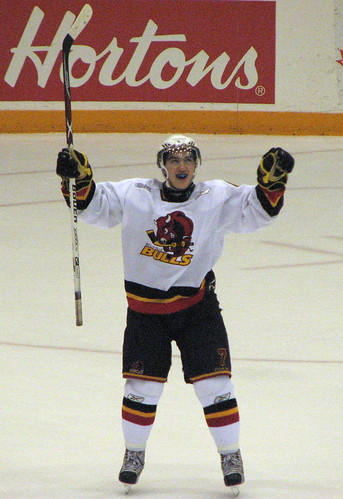 In many ways it’s not a record any hockey player wants to break. Being the all-time games played leader in the Ontario Hockey League just means that you got stuck in junior. You’re good enough to stick around, but not good enough to get out.
That’s that negative way of looking at it anyway. The truth is that it’s a testament to dedication, determination and, yes, skill that should be recognized.
So congratulations goes out to Belleville’s Cory Tanaka who played his 329th career game today, mostly with the Bulls (and he did it in style, helping Belleville defeat Brampton 3-2 to open up a six-point lead on the Battalion n the race for top spot in the East).
The junior hockey star that never makes the bigs has a special place in Canadian culture. People look at them with a mix of envy and pity. How hard it must be to realize that you were so close, never to have made the final step.
Yet, to be a major player on a junior team – and you don’t stick around for five years playing nearly every game unless you are a contributor – that’s something too. You become part of the fabric of a community in a way that few of us do and although you could eventually become like that character in Bruce Springsteen’s Glory Days, talking the ear off of someone you barely knew as a teenager while downing one too many beers, that doesn’t mean that it all didn’t matter.
Who knows what hockey is yet in Tanaka’s future (although Bulls fans hope it includes a second M-Cup run). It will probably involve the East Coast League, Europe or the CIS. But we do know what its history is. And it’s been pretty good. He’ll be an answer to a really tough trivia question. There are worse things to be.
Tuesday, February 17, 2009
Ottawa's stadium debate: Hunt takes it to a new low
"Given they're joined at the hip, the problem extends to the Civic Centre. The 67's are in serious jeopardy if the city makes the decision to build an outdoor stadium somewhere (other than Lansdowne Park)"
And with that flip and manipulative statement any sympathy this author had with the CFL bid in Ottawa went out the window. Jeff Hunt is going down the route that so many crass, mostly American, owners have done in the past. He wants his tax payer funded castle and if he doesn't get it he's going to take his toy and play with it somewhere else.
The 67's in jeopardy? Please. Where, exactly, is he going to move the team? Cornwall? North Bay? There is no place you could move Ottawa's junior hockey franchise that will provide Hunt with a better opportunity to be profitable. Ottawa, along with London and Kitchener, is the best market in the OHL. If Hunt actually moved the team from the capital he'd be, well, an idiot.
But, he knows damn well that playing the hockey card might just be enough to sway public opinion. Playing with the emotions of the diehard junior puckheads may be cynical and obscene, but it might just work.
Hunt built his reputation in Ottawa as the owner of the 67's. For him to even so much as suggested that there is a possibility that the team could move if he doesn't get his way with the CFL proposal is pretty damn low. I would have thought that he was better that that. Sadly, I guess I'm wrong.
Here's an idea. If Hunt wants to show that the CFL is a better bet than MLS in Ottawa then how about he do that? Demonstrate why Ottawa would benefit more from football than soccer and how the CFL bid is better for the people of the capital region.
Don't threaten to move their junior hockey team.
Subscribe to:
Posts (Atom)


 Posts
Posts


